How to Set Safe Action Limits for AI Agents in Finance
Written limits, human sign-offs and live monitoring keep finance agents in scope.
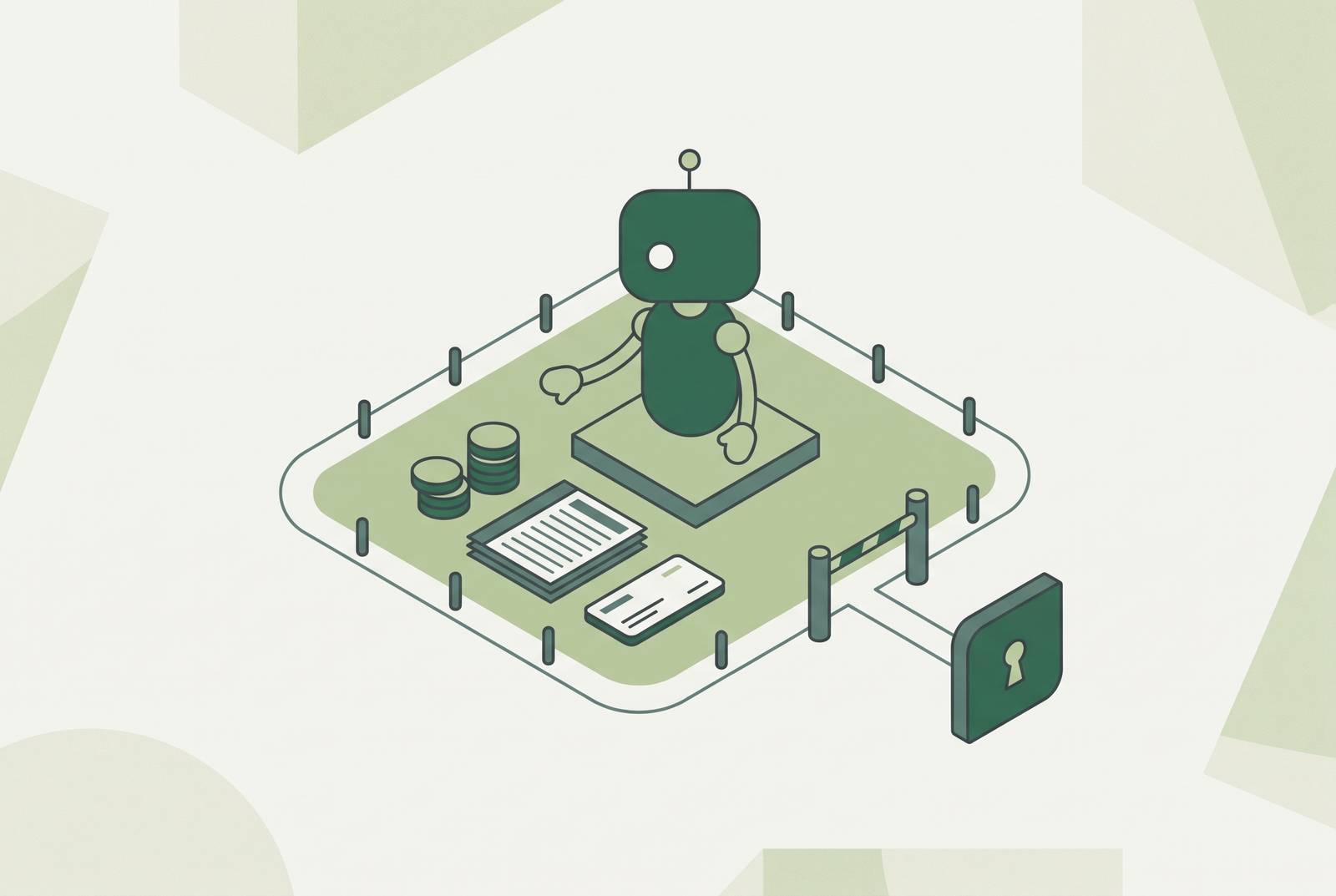
Before you let an AI agent handle finance work, agree in writing on exactly what it can and cannot do. Set clear limits on its authority. Decide which actions need a human sign-off. Keep read access separate from write access. Watch what the agent does while it runs.
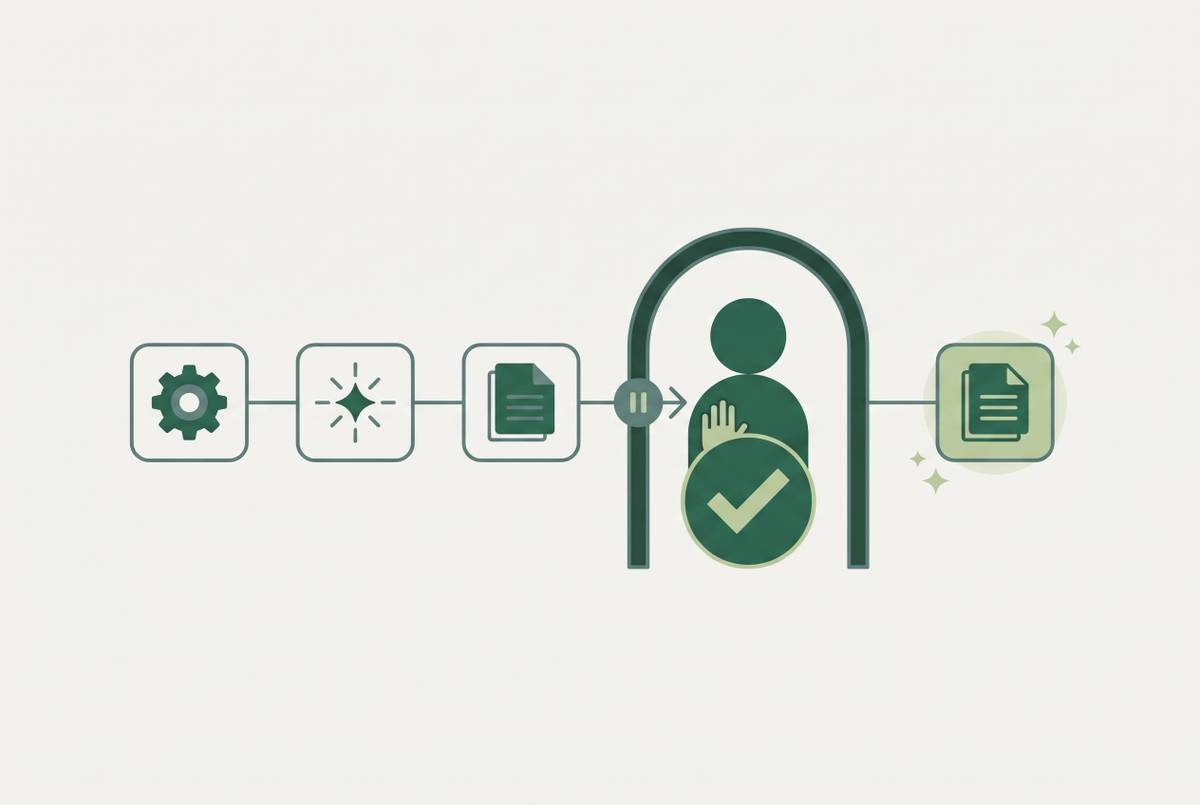
Start with a written scope for one workflow, one measurable outcome and one accountable finance manager, then turn it into a permission list that keeps read access separate from write access. Let the agent query records, format outputs and tidy data on its own. Initiating payments, posting entries, adjusting tax calculations and contacting outside parties each need a named human to approve every time, and each approval gate needs a time limit and an escalation path so silence never counts as consent. Add runtime monitoring that can pause execution, preserve state and hand the exception to a person when a policy limit is crossed, because a sequence of permitted steps can still breach the agreed scope.
Why AI agents in finance need stricter limits than ordinary software
An AI agent does not just answer questions. It makes plans, calls tools, runs steps in sequence, and changes records. A UCL research paper on agent-to-agent finance describes this as a shift from a tool that gives you information to one that acts for you in financial transactions. That shift breaks the basic assumption behind normal software controls. Normal software is assumed to behave in a predictable, pre-specified way. AI agents do not always behave that way.
Kaptein et al.'s paper Runtime Governance for AI Agents: Policies on Paths shows why that matters. Reading a database record can be harmless. Sending an external email can be permitted. But reading sensitive data and then emailing it outside the organisation is data theft. The danger is in the connection between steps, not in any single step. Checking each permission one at a time does not catch that risk. Writing instructions into a prompt does not enforce a hard limit either. Fixing this gap requires deliberate design.
What "sanctioned action boundaries" means in plain terms
Sanctioned action boundaries are the agreed terms on which an agent may act for your organisation. There are four layers.
The first is authority scope. This is a written statement of what task the agent may carry out, who is accountable for it, and which systems it may touch. The second is approval gates. These are specific actions the agent must pause on and wait for a human to approve before continuing. Being allowed into a workflow does not mean being allowed to finish every step in it.
The third is read versus write access. This means separate permission to look at a general ledger and separate permission to post an entry to it. The fourth is runtime monitoring. This means watching the whole sequence of actions as it unfolds, not just each action on its own. All four layers must work together. Strong approval gates without runtime monitoring still leave gaps between checkpoints.
A research paper on separating powers in AI systems warns against what it calls a "Logic Monopoly." That means one agent that plans the work, carries it out, and also decides whether its own conduct was acceptable. The paper says those three functions must be independent by design. Better instructions alone cannot create that independence. A limit is only real if the agent doing the work cannot also judge whether it stayed within that limit.
How do I set up approval gates and action boundaries before letting an AI agent run finance tasks autonomously?
Start with a written scope document. It should name one workflow, one measurable outcome, and one finance manager who is accountable for it. Turn that agreement into a permission list. The list should show which systems the agent may read and which it may change. Keep read and write separate. Also record who owns exceptions. When the agent hits a situation outside its authority, it should stop, preserve what it was doing, and hand the decision to the named person.
Let the size of the consequence set the amount of freedom. Querying records, formatting outputs, and tidying data can be given wider latitude. Initiating payments, posting entries, adjusting tax calculations, and contacting outside parties each need human verification every time they happen. A broad category approval is not enough. An instruction to "optimise cash flow," for example, could pull together invoice processing, supplier negotiation, and payment scheduling. The intended scope may have been much narrower. Each step might pass its own permission check while the whole chain goes beyond what was agreed.
The permission model must therefore constrain the whole chain. An independent check — one the agent doing the work cannot influence — must confirm the work stays inside the agreed scope. Scope defines what the agent may do. Approval gates define what it must pause before doing.
What a working approval gate looks like in routine finance workflows
An approval gate is a condition built into the workflow before it runs. When the agent reaches it, execution stops. A named person must decide whether to continue. Where you place gates should depend on how serious the consequence is. A gate before posting a journal entry protects a financial record. A gate before formatting a variance report adds work for reviewers without the same justification. Treating both alike leads to approval fatigue and approvals that go unread.
In a supplier payment reconciliation workflow, the agent may read the payment record and suggest a reconciliation under its existing authority. Posting that reconciliation still needs a separate gate, even if the suggestion looks routine. Santander AI Lab's ARIA system (a framework for governing AI agents in financial services) distinguishes between defining the approved operating range and stopping execution when that range is approached or crossed.
Every gate also needs a time limit and an escalation path for when the approver is unavailable. Silence must never become permission after a waiting period. In a workflow with more than one agent, gate assignment must cover the final outcome. Approving one agent's contribution does not authorise everything later agents might do with it.
Why monitoring must watch sequences of actions, not just individual steps
Standard access control asks whether the agent is allowed to send an email. Runtime monitoring — watching what the agent does while it runs — asks whether it may send this particular email given the data it has already read and the steps it has already taken. The history changes the answer. The same next step can be acceptable on one path and forbidden on another.
The runtime governance paper bases that judgment on the agent's identity, the steps taken so far, the proposed next action, and the state of the organisation. Prompt instructions lower the chance of a bad path, but they cannot strictly enforce a policy. Static access control ignores the path entirely. Neither is enough when the violation depends on a sequence, such as breaching an information barrier or sending data to an unauthorised outside party.
AI agents do not always follow the same path for the same task. So a fixed list of expected paths falls short too. The same task can produce different sequences on different runs. When agents write and run code, the possible behaviours can be very large. Runtime monitoring therefore needs controls that can pause or stop execution, preserve the current state, and hand the exception to a human when a policy limit is crossed. Audit logs record what happened. Runtime monitoring evaluates what is about to happen. They serve different purposes.
Why you need a clear record of every decision the agent makes
A useful decision record must let you rebuild a decision and the full context around it. It should show the data available at the time, the authority in force, the tools called, the policy checks run, and the outcomes. A timestamp and an agent name are not enough. ARIA calls for separate audit records for each layer of governance so that a human approval and a runtime containment event each produce distinct, independently reconstructable evidence.
The record must also show plans that were rejected, results that failed or were inconclusive, and corrections humans made later. Without those, the record shows only successful execution. It hides the decisions that shaped it. Human approvals are part of the same chain. The reasons a reviewer approved, overrode, or escalated should be recorded. The agent must not be able to alter the audit history that accountability depends on.
The European Commission's official AI Act page gives extended compliance dates of 2 December 2027 for high-risk uses listed in Annex III and 2 August 2028 for high-risk systems built into regulated products under Annex I. A finance workflow does not automatically fall into those categories. The runtime governance paper links high-risk obligations to logs that can be traced, the accuracy of inputs, the identity of the people involved, and which reference database was used. Clear decision records are therefore both a governance practice and an emerging legal expectation. Obligations also cover where and how the system runs.
How your choice of where to run the system affects how much control you keep
Where you deploy the system depends on data sovereignty (the rules about where data must be kept), record-keeping and residency requirements, and how quickly you need to go live. A private cloud network keeps traffic off the public internet while keeping the flexibility of cloud computing. Running on your own premises puts the platform in your own data centre. The choice can vary by workload. Less sensitive work can run in public cloud regions while the most sensitive work runs in a dedicated or on-premises environment.
Where the model sits does not by itself give you full control. The agent-to-agent finance paper identifies a hidden dependency. It arises when a locally hosted model still relies on a software-as-a-service control layer for policies, prompt templates, or usage data. Real control requires you to own the orchestration layer itself. That includes self-hosting, version pinning (fixing which version of a model runs so it cannot change without your knowledge), and full auditability. Open-weight models (AI models whose weights are publicly released) give you an artefact you can keep indefinitely. Closed APIs (models you access only through a provider's interface) can be deprecated or repriced outside your control. The practical test is whether you can revoke access, stop workloads, block data leaving, restore state, move artefacts, and keep running during a provider or network failure — without needing the provider's help.
Record-keeping rules need equally careful reading. SEC Rule 17a-4 and FINRA Rule 4511 require broker-dealer records to be kept in systems where tampering is evident and records can be audited. These are known as WORM or write-once-read-many systems. Neither rule names agent-generated records by name, so whether those records are covered depends on how the rules are interpreted. OCC guidance on third-party risk calls for documented checks proportionate to each relationship's assessed risk. With an architecture that is not tied to one model or one record-keeping system, you can keep your business rules, decision history, and permitted actions when you change providers.
Why overseeing several agents together is harder than overseeing each one alone
Approving each agent individually does not add up to approving what they do together. Santander AI Lab's paper calls this "constitutional non-compositionality." That means local controls on individual agents do not guarantee acceptable results at the group level. Its credit-decision example makes the risk concrete. Applicants with thin credit files could be excluded by a pattern that no single agent produced. Each part passes its own checks while the workflow as a whole discriminates. It then becomes unclear who is accountable.
ARIA proposes monitoring the population of agents together and comparing observed behaviour against expected behaviour. This catches patterns that individual monitoring misses. Its six capabilities span three areas: policy and population monitoring; bounded execution and containment; and policy adaptation while keeping humans able to understand and override decisions. Each area produces independently auditable evidence. Monitoring more agents one by one is not the same as evaluating what they do together.
The separation-of-power paper also describes cascading failures. These happen when an upstream error travels through a multi-step workflow. It also describes interaction patterns that can produce harmful outcomes without any agent being designed to cause them. Containment therefore needs to operate at the workflow level too. If human reviewers cannot understand and override decisions at the population level, escalation becomes ceremonial. These risks mean governance must be in place before individually checked agents are assembled into a workflow. Start with one bounded workflow.
How to start building safe action limits in your finance team today
Begin with a written agreement for one named workflow, one accountable owner, and one measurable outcome. Finance, operations, and technology leaders should agree the starting point, success measures, measurement period, and who owns exceptions before any consequential work runs. This agreement is a governance record. It should also weigh the cost of acting, the cost of delay, and the cost of a governance failure. That includes how long a problem might go undetected, how reversible it is, what the regulatory exposure is, and what remediation would cost. Weigh all of that against the expected efficiency gain.
Next, separate read access from write access and set the terms for approval before the agent may act. Letting the agent investigate and recommend first preserves useful analysis while limiting exposure during validation. Build the decision record before the first production run. It should capture inputs, tools called, parameters, outputs, reasoning traces, human approvals, corrections, and measured outcomes. Runtime path monitoring gives you the means to step in before a forbidden next step is taken.
Expand only after the bounded workflow delivers validated, traceable outcomes with working gates and monitoring. Its governance structure can then support additional workflows. Judge each new model or agent by workload quality, speed, risk, and total cost across both AI and human effort. Also judge it by what the provider claims it can do. Keep your business rules, approval thresholds, and the context you have built up under your own ownership, outside any provider you might later replace.
Sources
- Agent-to-Agent Finance: Blockchain Payments and Trust Infrastructure for Autonomous AI Agents
- Compliant with Local Controls, Collectively Discriminatory. A Governance Architecture for Multi-Agent AI in Regulated Finance
- Runtime Governance for AI Agents: Policies on Paths
- From Logic Monopoly to Social Contract: Separation of Power and the Institutional Foundations for Autonomous Agent Economies
- The Agentic Regulator: Risks for AI in Finance and a Proposed Agent-based Framework for Governance
- Governing at Machine Speed: An Adaptive Intelligence Architecture for Real-Time AI Policy Enforcement