Role-Based Approval Thresholds for AI Finance Decisions
Clear approval limits keep finance AI from acting beyond its authority.

AI tools in finance can now approve invoices, flag problems, and score risk on their own. Role-based approval thresholds are the rules that keep those tools inside limits someone actually chose. They spell out who can approve what, when a decision must go to a higher level, and how every action gets recorded.
Why AI in finance has moved faster than the rules around it
Finance AI used to mean forecasting. Now it takes action. Invoices get coded and routed without anyone touching them. Models raise exception flags instead of clerks. Risk scores attach to transactions before anyone reviews them. The tools moved fast. The rules meant to hold them did not.
On the security side, 82% of organizations found at least one AI tool running inside their systems that their own security team never knew existed. That is a governance blind spot with a dollar sign attached.
The growth curve makes the gap worse before it gets better. Gartner projects that 40% of enterprise software will carry task-specific AI tools by the end of 2026. That is up from under 5% in 2025. Every quarter that gap widens, more financial decisions get made by systems nobody formally approved to make them.
The real question is not whether AI belongs in the workflow. It clearly does. The narrower question is this: what can the AI recommend, what can it route on its own, and what must it never decide without a named person signing off first.
What approval thresholds actually cover in a finance workflow
Three verbs matter here because they carry different weight: recommend, route, decide. An AI that recommends a vendor payment needs a different level of human authority than one that routes the payment. Both need less authority than one that actually sends it. Lumping all three under one blanket "AI approval" policy is how you lose track of what you authorized.
A threshold is not just a dollar figure in a settings file. It sits at the intersection of several things: transaction value, policy risk, how sensitive the data is, whether the decision can be undone, and the confidence score the model gave its own output. A small reimbursement the model is highly confident about — and that can easily be reversed — sits nowhere near a large wire transfer the model is less sure about. That is true even if both clear the same dollar limit when that is the only variable in play.
Role-based access controls what each person or system can see and do. It must connect to your company's official approval rules through its identity management system. That is the software that tracks who is who and what they are allowed to do. It should not just sit as a setting someone configured once and forgot. The identity system answers "who is this." The approval rules answer "what is this person — or a tool acting on their behalf — allowed to approve." Those need to be the same answer, enforced the same way.
In practice, a threshold governs four things:
- What the AI can approve on its own (low-risk, low-value, easily reversed)
- What goes to a named person for manual review
- What escalates further, to a risk committee or an executive
- What gets assigned a specific owner when it falls outside every predefined category
Separating what the AI can read from what it can change
Reading a record and changing one are two different permissions. Treating them as the same thing is one of the most common mistakes in early AI finance rollouts. A tool that can pull invoice history to build a recommendation does not automatically need the ability to post that invoice to the accounting system. Those are separate decisions. Make them separately, before the workflow goes live.
For every role — whether it belongs to a person or an AI tool — you need to spell out four things in advance: what data it can read, what actions it can take without asking anyone, what actions need a human sign-off before they run, and what actions are off-limits no matter how confident the model is. Getting that last category wrong means the tool can take actions nobody authorized. That exposes your organization to losses and rule violations it never approved. A high confidence score is not a substitute for authority. A tool that is almost completely certain it should reverse a six-figure charge still should not have the power to do it alone.
Autonomy should scale with risk, in three rough tiers:
High-risk work touches confidential data, makes automated decisions on its own, or feeds directly into investment or compliance outcomes. This tier gets the tightest controls and mandatory human approval, full stop.
Moderate-risk work involves limited decision-making, usually for internal use only. It needs guardrails, but monitoring does not have to be constant.
Low-risk work is closer to a productivity boost than a decision. No sensitive data, no real decision-making. Standard security practices are enough here.
Decide the permission level for each role based on data sensitivity. Sort it into three buckets: permitted for general use, permitted only under human oversight, or not permitted at all for certain functions. Deciding that bucket after deployment is backwards.
The five principles that hold finance AI controls together
A finance AI governance model tends to rest on five principles. Each one addresses a different way things can go wrong.
Human oversight puts a real person in the loop for high-risk or high-value transactions. That person is not just a checkpoint who clicks approve. They are the accountable owner of what happens next.
Explainability requires plain-language reasoning behind every recommendation or automated action. If an invoice gets coded a certain way or flagged for review, the system needs to say why — not just hand over a number. That reasoning is what makes the decision defensible later, in front of an auditor who only cares whether the logic holds up.
Auditability means time-stamped logs of every AI recommendation, every human approval, and every system action taken. Build this into the workflow from day one. If you bolt it on later, the trail simply will not exist when someone needs it.
Security covers strong encryption, data privacy, role-based access control, and agreements with AI software providers that they will not keep or use your financial data. Finance data leaking into a vendor's training system is not a hypothetical risk worth shrugging off.
Continuous monitoring covers the ongoing work. Check whether the model's outputs are drifting over time. Catch unusual patterns. Run accuracy checks. Keep a running list of risk reduction steps that actually get carried out rather than filed away.
Tipalti's framing lists seven main AI risks in finance: errors and false outputs from the model, model drift that nobody notices, breaking regulations, lack of explainability, over-reliance on automation, security exposure from vendors, and leaks of sensitive financial data. Every one of those maps to at least one of the five principles above. The framework exists because those seven risks are real and recurring, not theoretical.
Take invoice coding as a direct example. A well-built approval AI should match the coding against historical records. It should apply the actual approval policy on the books. It should flag anything that breaks a pattern for human review. And it should catch problems before they clear. That chain has to stay visible at every step. Hiding it behind a single confidence score defeats the entire purpose of explainability.
Governance should not slow your finance team down. It should sit inside the financial system by design, not get layered on top after the fact like a compliance sticker.
Building escalation paths that connect threshold crossings to named decision owners
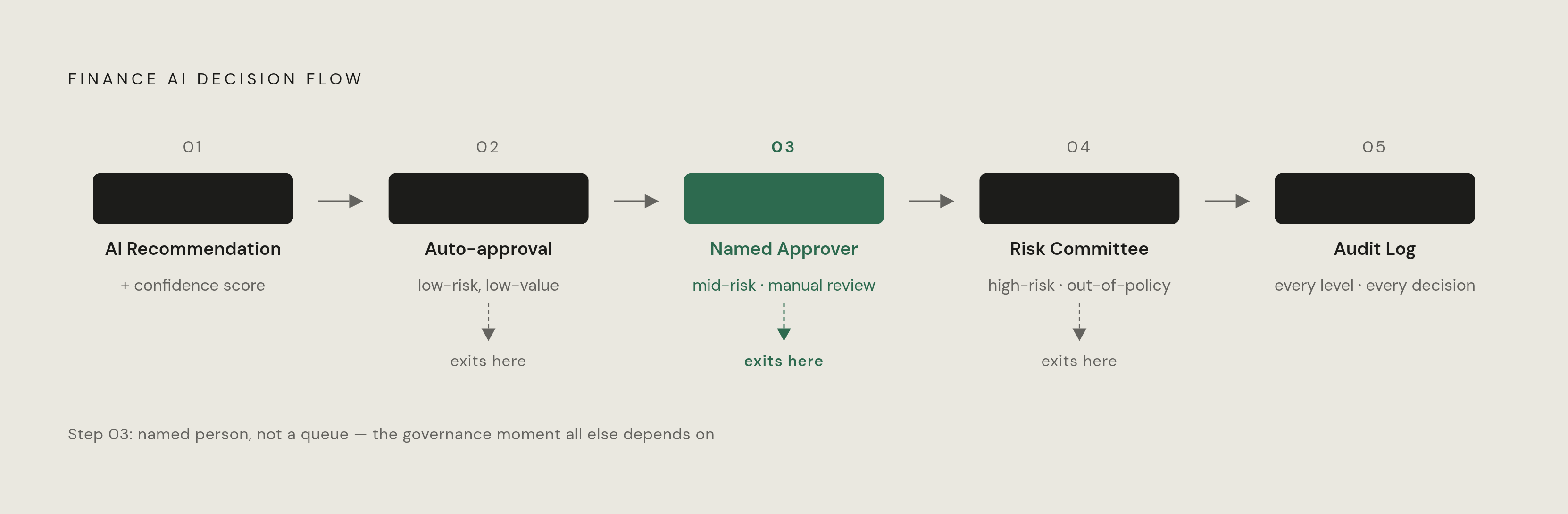
Escalation only works if you build it as a structure, not a hope. A workable version runs five checkpoints in sequence. First, the AI produces its recommendation along with a confidence score. Second, automatic approval kicks in, but only for items that are low-risk and low-value. Third, anything in the middle-risk band goes to a named person for manual review — not a general queue. Fourth, high-risk or out-of-policy cases escalate to a risk committee. Fifth, every decision at every level gets logged in a form that is ready for audit the moment someone asks for it.
Every recommendation needs supporting evidence attached: the data the AI drew from, the logic it applied, and the confidence level it assigned to its own output. Without that, the audit trail only records that something happened — not why.
Escalation paths should not be added after the workflow is already running. They belong in the design from day one. Enforce them automatically through policy rules built into the system. Do not rely on someone remembering to check. A rule that only fires when a human remembers to look for it is not a rule — it is a suggestion.
A clear responsibility chart for AI-assisted finance decisions needs to name who is responsible for six things: approval, validation, ongoing monitoring, incident response, suspension, and retirement of the workflow itself. Skipping the "retirement" column is common and it is a mistake. Every AI workflow eventually needs to be shut down or replaced. That decision needs an owner just as much as the approval decision does.
The regulatory and financial cost of skipped escalation and missing records
Regulators in financial services do not treat a missing log as a technical oversight. They treat it as a record-keeping violation, full stop. Every automated decision has to be logged promptly. "The system did not capture that" is not an answer regulators accept.
Audit-trail practice, drawing on SEC record-keeping rules, the EU AI Act's Article 12, and FINRA's requirements, converges on the same basic principle. Every automated decision must be captured in enough detail to reconstruct what happened. That includes the model's inputs, outputs, and confidence levels, as well as any human override and the reason for it. Missing any one of those fields leaves a hole in the trail. Holes get found eventually.
The EU AI Act's Article 99 sets penalty exposure for high-risk system obligations at up to €15 million or 3% of global annual revenue. The steeper tier — €35 million or 7% — applies only to prohibited AI practices under Article 5, a different and narrower category. Confusing the two tiers when you assess compliance risk leads a finance department to underestimate its exposure. Even the lower tier is not a number any finance department wants to test.
On top of the regulatory ceiling, financial institutions deploying AI without proper audit infrastructure have faced governance-failure fines reaching well into seven figures across 2024 and 2025. That is the cost of not being able to show anyone what happened — not the cost of the AI mistake itself.
Matching the level of human oversight to the risk level of the decision
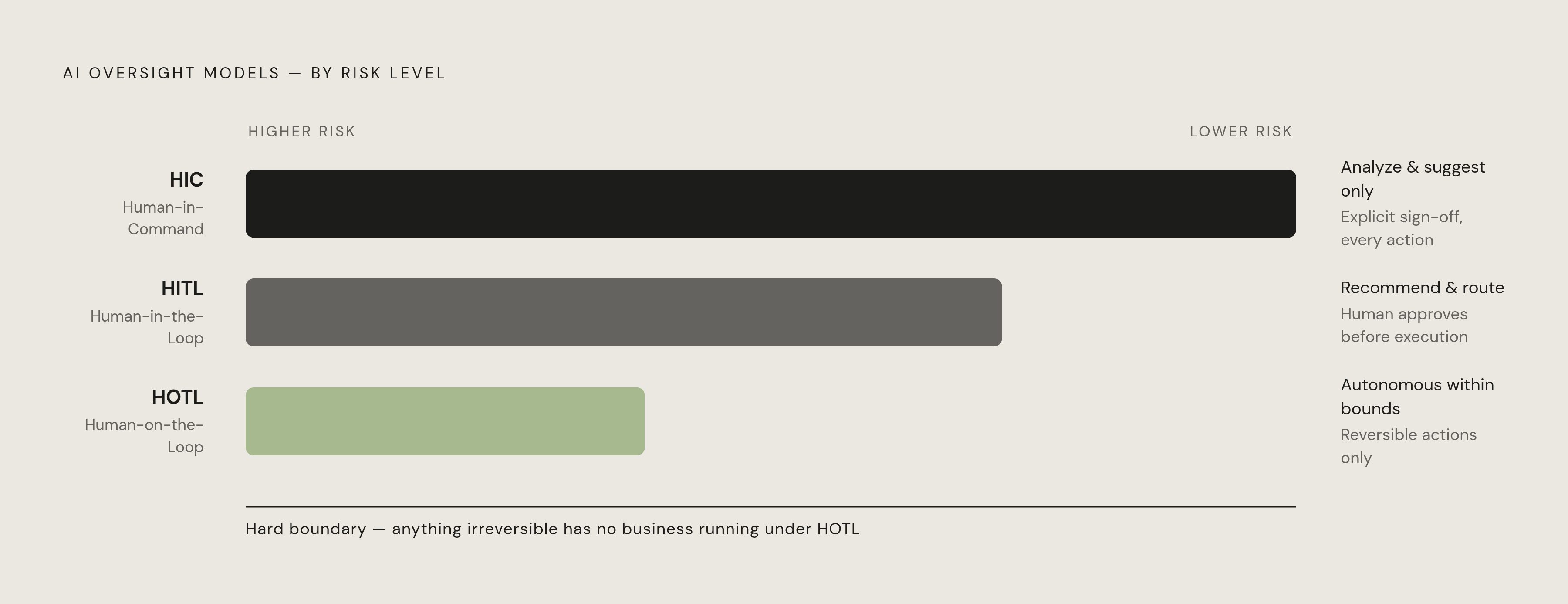
Three oversight models cover most of the ground here. Picking the wrong one for the risk level is where many governance programs quietly fail.
Human-in-Command (HIC) keeps a person holding final authority at every step. The AI can analyze and suggest, but it cannot act without explicit sign-off each time. This model belongs with the highest-risk, hardest-to-reverse decisions — the ones where getting it wrong is not something a rollback fixes.
Human-in-the-Loop (HITL) lets the AI recommend and route on its own, but a human must review and approve before anything runs. This is the standard fit for high-value or compliance-affecting finance work. It is the middle ground where speed matters but so does a second set of eyes.
Human-on-the-Loop (HOTL) flips the default. The AI acts on its own inside limits set in advance. A human monitors and can step in if something looks off. This only belongs with reversible, low-stakes actions that have already been validated thoroughly. Anything irreversible has no business running under HOTL.
Finance sits in a category of its own for a reason. Errors here do not stay contained. They hit individual wealth. They can ripple into market stability. They open the door to fraud in ways that other business functions simply do not. That is why finance needs governance and risk controls that are tighter than most other departments would ever need.
The oversight model is not a matter of preference or team culture. It follows from risk classification. That classification should score every AI use case across five dimensions: regulatory exposure, data sensitivity, how reversible the decision is, whether human oversight is available in real time, and how large the potential business impact runs. Get the classification right, and the oversight model follows directly.
Setting up the agent registry, approval rules, and stop controls before going live
Security, compliance, and auditability now sit at the top of the list for organizations moving AI tools into production. A KPMG survey found 75% of large-enterprise leaders naming those three as the most critical requirements for deploying AI tools. Managing the complexity of multiple AI tools working together has become the main bottleneck as pilots try to move into live systems.
That is part of why a senior executive role overseeing AI has sharpened its focus toward governing automated AI tools. In practice that means four things: keeping an up-to-date registry of every AI tool in use, setting the policies that define who approves within what limits, chairing an Agentic AI Committee that signs off on new tool deployments before they go live, and owning incident response when a tool causes real harm.
AI tool security architecture needs three layers working together. Identity management for AI tools ensures each tool only ever holds time-limited, minimal credentials — never a standing key to everything. Running any tool-generated code inside an isolated container means a bad output cannot reach outside its own box. And human sign-off checkpoints require explicit approval any time an action crosses a preset financial, operational, or data-modification limit.
Live review before execution matters most where the action cannot be undone. That includes financial payments, data deletion, and anything permanent. Those need a central gateway sitting between the tool and the systems it touches. The gateway enforces policy and keeps a continuous audit record running in the background. If you skip that gateway, the tool's reach quietly outpaces anyone's ability to watch it.
How the deployment environment affects data ownership and enforceable limits
By August 2026, the standard setup for regulated industries runs inside a Virtual Private Cloud — a private, walled-off section of a major cloud platform. Organizations that need the tightest possible control run everything on their own servers instead. Most regulated enterprises land on the private cloud option after weighing both. It gives strong data separation without the budget or operational overhead of running your own AI hardware.
That choice of environment is not just an infrastructure detail. It decides whether threshold rules and audit logs stay fully under your organization's control, or whether a vendor has some level of access to them. It decides whether you can show a regulator that your data stayed in the right place. And it shapes what the tools can even be permitted to do. A threshold rule enforced inside an environment you do not fully control is a threshold rule you cannot fully guarantee.
The deployment environment is one of the load-bearing walls of the governance conversation. Get it wrong, and even a well-designed approval structure rests on a foundation nobody can fully verify.
Sources
- AI Governance Strategies for Finance Leaders Modernizing Reporting and Approval Workflows
- AI Governance for Institutional Readiness in Finance
- Why FINRA’s 2026 report puts AI governance under scrutiny
- lawrence-emenike.medium.com
- AI Risk Management in Finance: 2026 Governance Guide
- AI Finance Decisioning: Governance & Decision Rights | BP3
- Finance AI Policy and Guidance Template | MAIN
- blog.pebblous.ai