How to Stop Automated Finance Pipelines Skipping Approval Gates
Build approvals into agent permissions, not just the pipeline.
When a finance system skips its approval step, money moves. Credit gets issued. A fraud alert gets closed without the required sign-off. That is not a quality problem — it is a control failure with a paper trail.
That difference matters. A bypass in a system that only makes recommendations means someone got bad advice. A bypass in a system that actually executes means an unauthorized change is already in the books. It is already affecting a customer or a ledger.
Regulatory pressure makes this urgent. The EU AI Act — the European Union's law covering artificial intelligence — names credit scoring, fraud detection, and automated financial decision-making as high-risk activities. Institutions running these systems must show they can explain decisions, keep humans in the loop, and prove it to an auditor. The deadline for standalone systems in this category was pushed back to December 2027. But the requirement to build oversight in from the start — not assemble paperwork after an examiner asks — is already clear.
The real exposure lives in coordination gaps between systems. Research by Redwood Software found that although most financial institutions run a central automation platform, only 18.6% have visibility across all their systems at once. That means most institutions have automation running everywhere but no single view of what any of it is doing. An unauthorized path does not need a hacker or a rogue employee to open up. It opens wherever one system's idea of "approved" ends and another system's execution logic begins.
How patchwork automation creates the conditions for a bypass
Nobody designed this problem on purpose. Most finance automation stacks grew in layers over years. Scheduling and workload tools came first. Then robotic process automation — software that mimics repetitive human tasks. Then connection middleware. Then AI agents layered on top. Each layer was built by a different team solving a different problem. No single system was ever asked to see the full chain from start to finish.
Redwood's research puts a number on the result. 65.1% of financial institutions say their older automation tools limit their ability to modernize. Siloed — meaning disconnected and isolated — environments are holding back AI readiness. Every layer made sense to the team that added it. The incoherent whole is what is left when nobody owned the joins between those decisions.
The practical result: an approval gate set up on one layer has no power over a different layer unless someone deliberately wired the two together. A gate on the payment instruction workflow says nothing about a ledger adjustment triggered by a separate reconciliation agent, unless an engineer explicitly connected them. When one AI agent passes a task to another, what the receiving agent is allowed to do depends entirely on how that handoff was built. An agent that receives an instruction from an upstream agent can easily treat that instruction as enough permission — even when the actual approval never happened.
That is why calling this an edge case undersells it. The gap opens in the space between systems that were never designed to check each other's work. It opens every time a new agent is added to a stack that was never mapped end to end.
Build approval gates into what agents are allowed to do, not just onto the pipeline
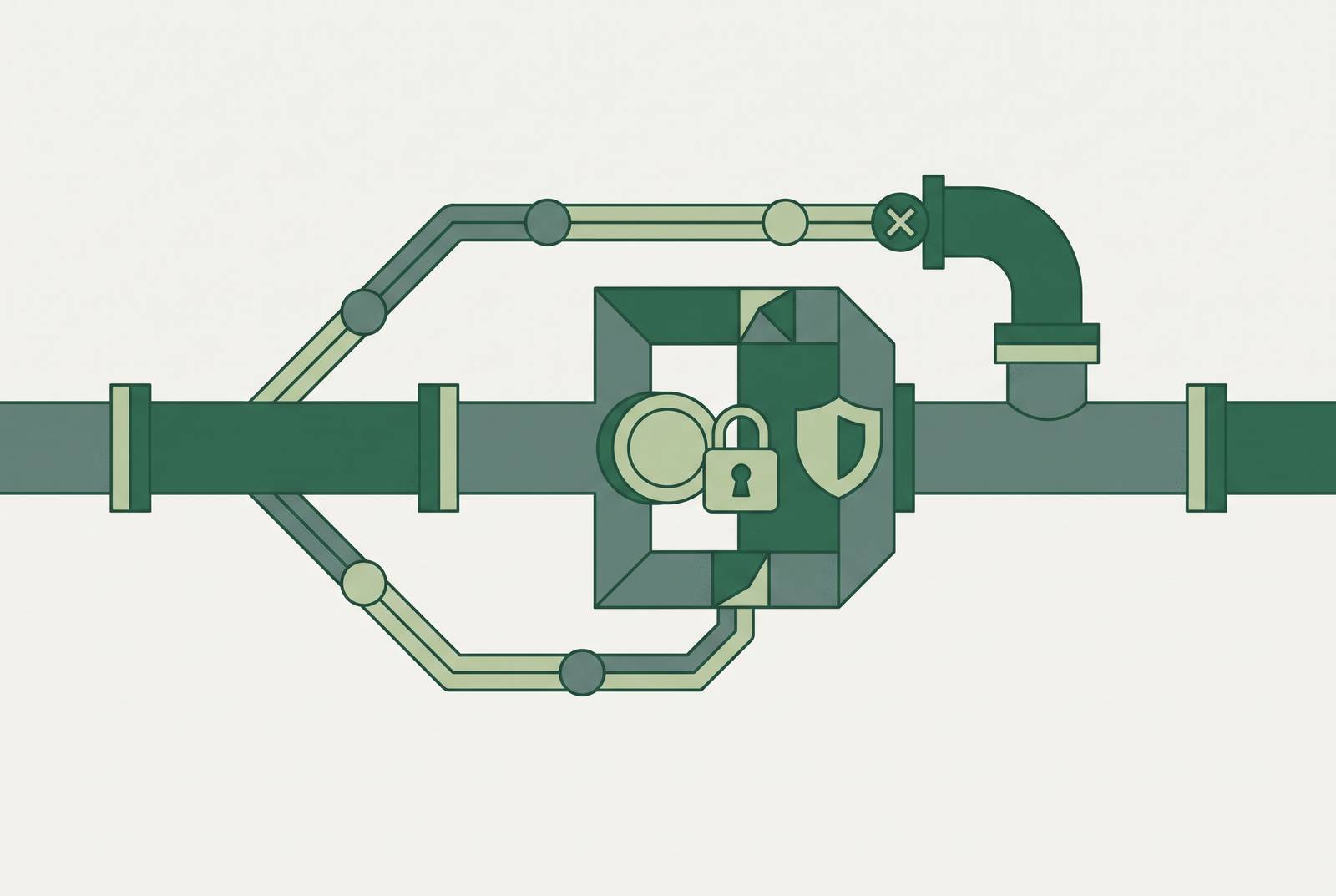
A gate bolted onto a pipeline works like a speed bump. Execution slows down, passes through a check, and keeps going. A gate built into the permission model works like a lock. Execution cannot complete the action at all without a key that does not exist until someone issues it. That difference is not just about words.
Building gates into the permission model starts with separating the right to read from the right to write. This separation happens at the identity and permission layer, not inside the workflow. An agent that can pull up a payment record for review should not automatically be able to change that record — even if both actions happen inside the same process run. Permission to look and permission to change must be two separate grants, checked separately, every time.
Approval thresholds need to be set up the same way — as conditions the system enforces, not checkpoints a human happens to notice. A tiered structure makes this concrete. One documented model works like this: spend below a defined level needs a department head's sign-off; a higher band needs VP-level approval plus a written business case; the band above that needs the CFO to review with a stage-gated funding plan; anything above the top threshold needs an executive committee approval with board notification. Each tier is a hard condition. The agent cannot move past its tier without the specific permission for that tier, because the permission simply does not exist until it is granted.
Just-in-time access enforces this at the moment of action. Permission is issued for one specific action in one specific context. It expires the moment that action finishes. An agent cannot stretch a single approval to cover a second action it was never granted. Enterprise AI governance practice already treats this as its own governed stage of the AI lifecycle, separate from anything happening inside the model itself. Approval gates and access controls sit at the deployment layer as infrastructure the deployment cannot skip.
Keep the thinking step and the doing step separate
AI agents reason in probabilities. That is the nature of the tool, not a flaw to engineer away. The governance answer is not to make the model more certain. It is to wrap that probabilistic reasoning in a control layer that is deterministic — meaning it follows fixed rules — and fully auditable. An agent's conclusion about what should happen next is not the same thing as permission to make it happen. The system must enforce that gap by design rather than trust the agent to respect it.
In practice, the recommendation gets produced and logged first, on its own, before any request for write permission goes out. Execution is a second, separate transaction. It needs its own authorization rather than inheriting the momentum of the reasoning step that came before it. A dual-system architecture is one way institutions implement this split. A fast reasoning pipeline feeds a slower decision layer where every input, weight, and threshold gets logged, timestamped, and recorded. The reasoning result has no path to execution until it clears that layer.
BNP Paribas Asset Management describes building "white box" systems rather than "black box" ones, where every investment decision has to trace back to specific data inputs and specific economic reasoning. That traceability is the condition that makes the decision valid in the first place.
This split also changes what a human reviewer can actually do. A reviewer looking at the agent's reasoning before execution can judge whether the logic supports the action being proposed. A reviewer who only sees a completed transaction can confirm that something happened, and nothing more, because the reasoning that led there is already gone.
What records and decision trails must actually capture
A log that only records what the model output is not enough to govern anything. Useful audit evidence must capture every tool call the agent made. It must capture every data source it referenced. It must capture the exact permission state at the moment of each call. It must capture every downstream change that resulted. You must be able to reconstruct afterward whether the permission model held or whether it was bypassed.
That standard looks specific in practice. Service accounts — the system identities agents use to act — need clear, singular ownership. The scope of what each account can do must stay limited to what the task actually requires. Read and write permissions need to show up as separate entries in the log. Every action an agent takes needs an identity attached to it that traces back to one specific authorization grant.
Logs and decision records are not the same thing, even though they get lumped together. A compliance log answers "what happened." A decision record — connecting the evidence, the human reasoning, the approval, the resulting action, and the measured outcome, including outcomes that failed or came back inconclusive — answers a harder question: was the permission that got granted actually sound? That second record preserves the institutional reasoning behind a decision, so a reviewer can assess the logic, not just confirm the transaction cleared.
Exceptions and overrides need the same treatment. When a human reviewer overrides an agent's recommendation or grants an exception outside the normal tier, that judgment must be logged with its reasoning attached. It must not be silently overwritten by whatever happens next. That override becomes part of the record and shapes how the system should handle similar situations going forward.
None of this works as a static archive. Governance frameworks require continuous monitoring across performance, drift, and compliance signals as a baseline requirement. A complete but static log does not satisfy that. The monitoring layer must catch, in real time, when the permission model is being stretched past what it was designed to allow.
Monitoring and the ability to pause or revoke access are what keep gates working in practice
A gate built correctly into the permission model can still fail at runtime if nothing is watching for the conditions that make the original permission invalid. Data changes. Thresholds get exceeded mid-process. An agent's actions drift from the scope it was approved for. A chain of actions ends up going further than the initial authorization ever covered. These are not hypothetical failure modes. They are ordinary ways a permission that was valid when granted stops being valid an hour later.
Governing the model itself is not enough on its own. Agentic AI — AI that takes actions in the world rather than just producing text — needs an explicit definition of which tools it can call. It needs clear scope boundaries. It needs a list of which actions require approval. And it needs a full record of every tool call the agent makes, not just the outputs the model produces. The bypass risk sits in the tool calls themselves — in what the agent actually goes and does — regardless of whatever the model said its intention was.
Auto-revoking permissions reinforce the same principle. A permission granted for one action expires the moment that action finishes. An agent cannot quietly bank authorization across a session and spend it somewhere else. Configurable approval gates paired with agent inventory, telemetry — meaning usage data collected in real time — and monitoring let teams set risk limits and name exception owners. Routine work runs inside its current permissions without a human needing to sign off on every single instance. Enterprise governance frameworks already specify that deployment workflows must include approval gates and access controls as a governed stage. Monitoring must cover performance, drift, and compliance signals. It must trigger a defined response rather than just flag an anomaly and move on. Monitoring is the mechanism that keeps the gate valid while conditions underneath it keep changing.
Decide where to set thresholds by weighing what a mistake actually costs
The real question for a governance team is where to set the threshold — for which class of action, and with what window for reversing course if the action turns out wrong. Those settings must come from comparing three scenarios. First: acting and getting it wrong, such as an irreversible ledger change from an automation error. Second: delaying, meaning missed service-level agreements, liquidity strain, or customers walking away. Third: failing to govern, which under the EU AI Act can mean a regulatory penalty of up to seven percent of global revenue.
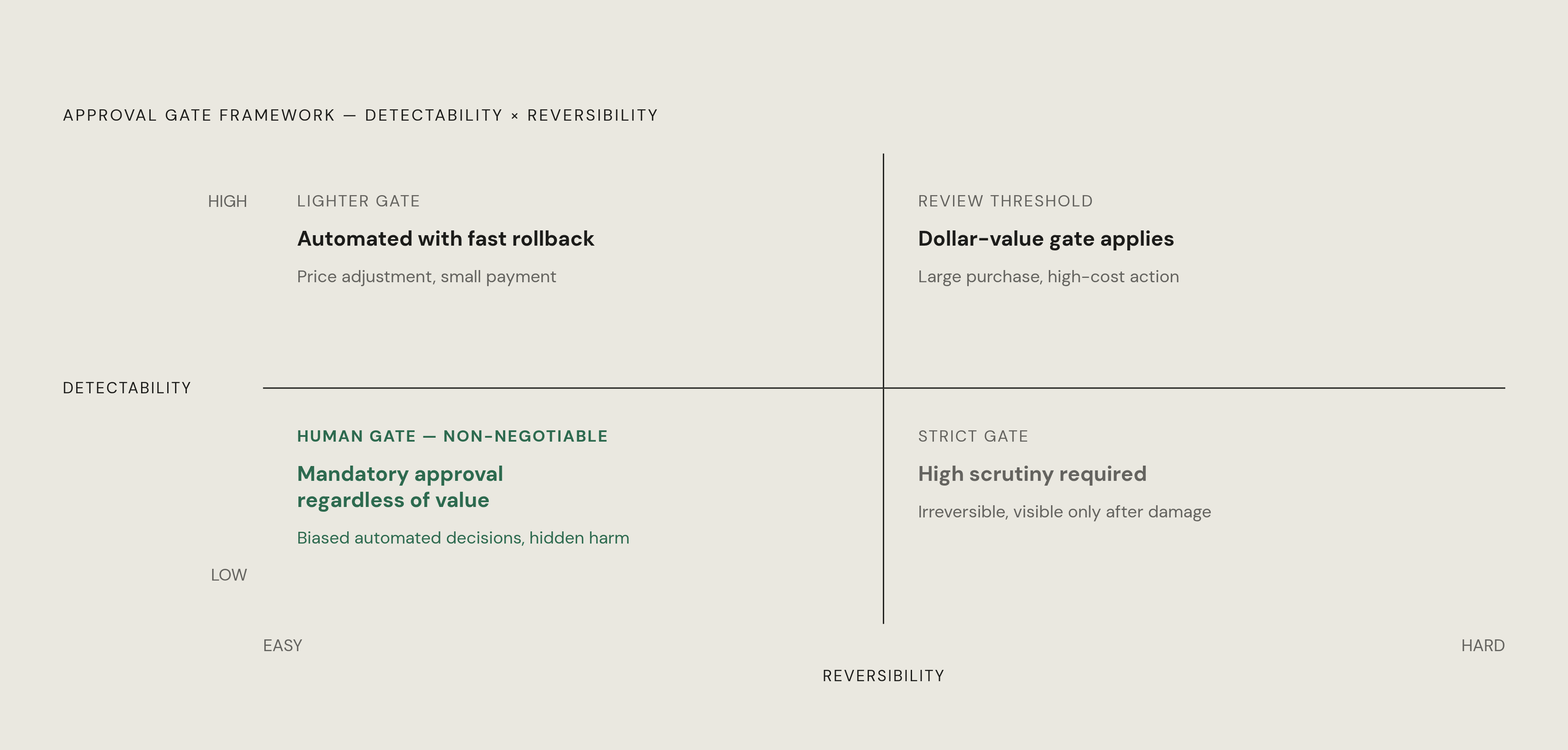
Two variables decide where the gate should actually sit. How easily can a bad action be detected? How easily can it be reversed? A high-value action that is simple to undo can carry a lighter gate, backed by fast rollback. The cost of a mistake stays low even if one slips through. A moderate-value action that cannot be reversed needs a heavier gate regardless of the dollar figure attached to it, because there is no fixing it once it is done.
Bias built into an automated decision is hard to detect right away. It is expensive to reverse once it is written into a record. It is worse still once it has cleared an audit review that never caught it. That combination — low detectability paired with high reversal cost — justifies a mandatory human gate even on a transaction whose dollar value looks modest on its own.
Before locking in a gate configuration, stress-test the business case behind it. Add a real buffer to whatever a vendor estimated the cost would be. Cut the projected benefit down by a meaningful margin. Stretch out the assumed time to value. If the automation still clears the hurdle after all three adjustments, the gate configuration built on top of it is standing on solid ground rather than an optimistic vendor slide.
Most teams are still far from this standard — and that gap is documented
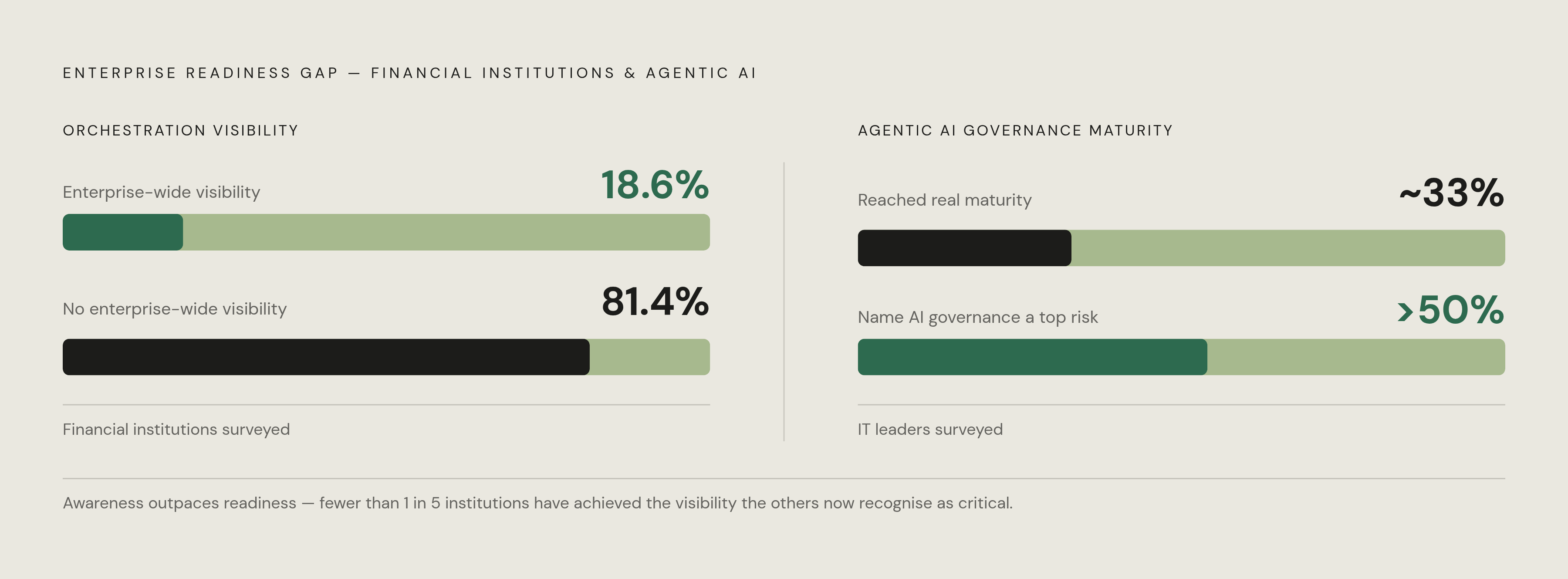
Most institutions are nowhere near the standard this post lays out, and that gap is documented rather than assumed. More than half of IT leaders now name AI governance as a top enterprise risk priority. Yet only around a third of organizations have reached real maturity in governing agentic AI. Everything described above is a target institutions are building toward — a baseline most of them have not yet met.
That gap has less to do with technology than with sequencing. Agents got deployed at a pace governance frameworks could not match. Institutions that wait for a complete framework before starting the governance work will pay for that delay later. An incident will force the remediation to happen under pressure instead of on a schedule anyone chose.
Stage-gate governance — the kind that uses documented milestones rather than an annual budget cycle — forces accountability. It lets a failing initiative be caught faster than waiting for year-end review. The same discipline applies directly to gate configuration. Start with one named workflow. Assign one accountable owner. Define one measurable outcome. Agree on the baseline before anything goes live. Then expand the scope only as the results actually earn it.
The safest entry point starts with read access and investigation only. Let agents surface evidence and recommendations while a human still holds every write permission. That sequencing is what makes the eventual execution step trustworthy once it arrives. By the time an agent gets a write permission, the permission model around it has already been tested on everything except the one action that actually changes a record.
Sources
- AI Governance Solutions for Regulated Industries: Top 10 Tools for 2026
- AI in Financial Services | Unified Governance for Banking Automation
- AI in Finance 2026: The CFO Guide to Automation, Compliance & AP Efficiency - SoftCo
- The ultimate guide to AI agents in finance: How FP&A teams are using agentic AI in 2026 | Aleph