How to Add Human Approval to Agentic Workflows
Tier-based approval gates route high-risk agentic actions to humans while letting safe work run.
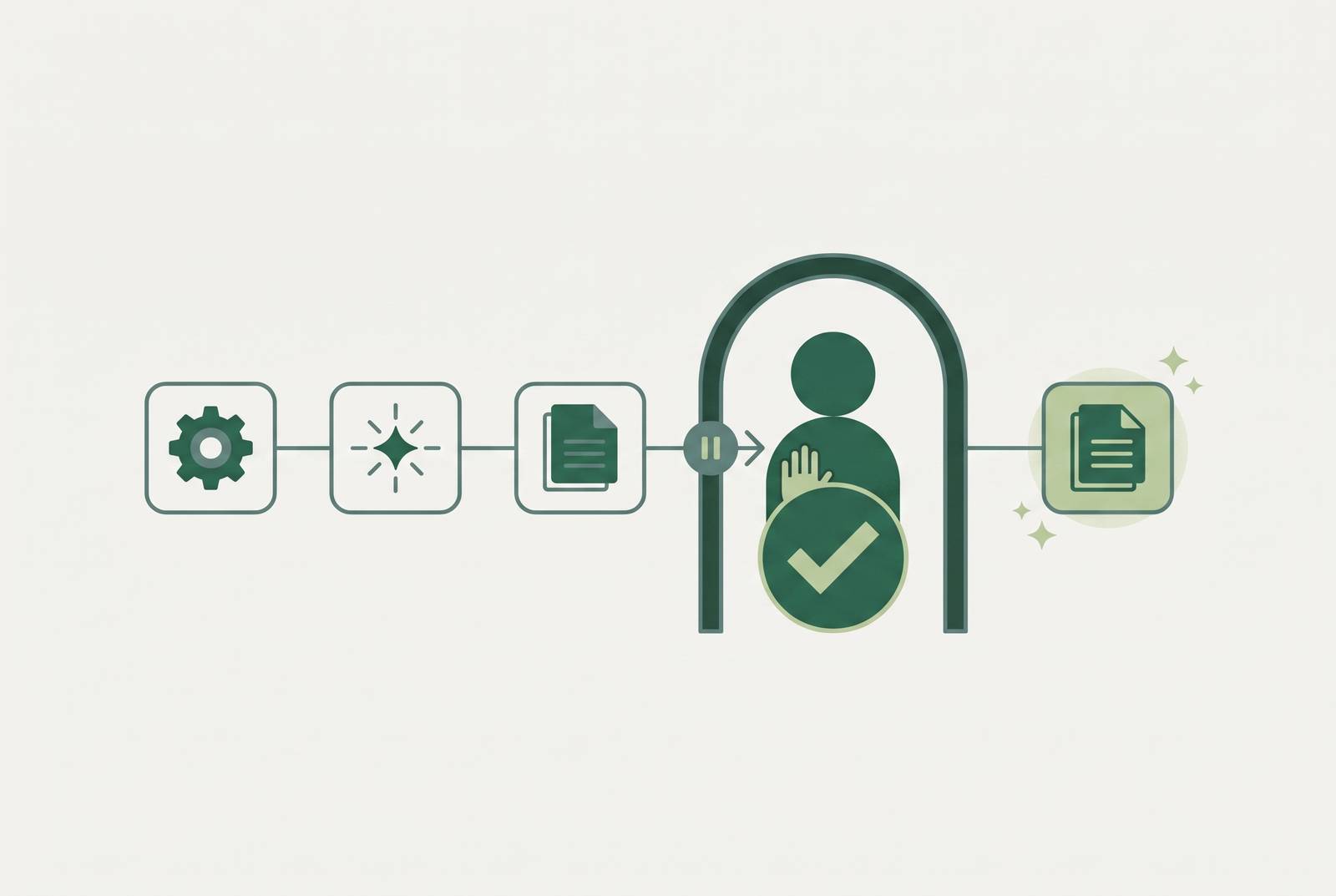
For enterprise agentic workflow automation, the practical model is to let low-risk work run, batch reversible changes, require individual approval for high-consequence actions, and leave irreversible judgment with a human owner.
Why agentic workflows create a new category of approval problem
An agent pursues a goal across systems. A bad chatbot answer wastes a minute. An agent with a payments tool, a mailbox, and a production database can move money, email customers, and delete records before anyone reads a log. With that reach, one unchecked decision can cascade through finance, access, and customer records.
That reach grows with the decisions the agent controls. Output decisions set what the agent generates, task decisions set which tools it calls, and process decisions lead to new tasks and tools. Each level widens the consequences of an error. Even the basic execution loop has several points where mistakes can compound as the agent plans, calls a tool, observes the result, updates its state, and decides whether to continue.
Governance is therefore a production requirement. EU AI Act high-risk obligations include risk management, data governance, logging, transparency, and human oversight, with obligations phasing in through December 2027 and August 2028 for agents taking autonomous actions in regulated domains. Those requirements reinforce a basic design tension. Agents are useful because they can act, but acting creates risk that a review after the fact cannot always contain.
What human-in-the-loop actually means inside an agentic execution path
Human-in-the-loop means the agent pauses inside its execution path until a person approves, edits, or rejects a proposed action. The pause is the defining feature here. Human-on-the-loop means the agent keeps running while a person watches and can intervene. Human-in-command means people set policies, budgets, and limits in advance. Human-out-of-the-loop means people review results later through sampling or audits.
These models serve different kinds of work. In-the-loop oversight is a good fit for high-impact actions, but it slows the work and can tire people out. On-the-loop oversight works well for large amounts of work that can be reversed, though people can miss alerts. In-command oversight governs fleets of agents, but gaps in policy may surface late. Out-of-the-loop review is a good fit for low-risk, sandboxed tasks because by the time people review the work, any damage has already been done.
OWASP LLM06:2025 identifies excessive functionality, excessive permissions, and excessive autonomy as root causes of Excessive Agency. Approval addresses only excessive autonomy. A rule that says humans must approve risky actions is therefore not enough on its own. The execution path must make sure that rule is followed, and the agent must have only the tools and permissions it needs for its task.
Why approving every action defeats its own purpose
A prompt before every action can slow the work without giving people much control. Anthropic’s research found that users approve the vast majority of Claude Code permission prompts and describes the resulting loss of attention as approval fatigue. People stop reading what they see all day. When routine field checks and payment changes look alike in a queue, the interface makes it harder to distinguish clerical work from a consequential decision.
The review cost can also erase the saving. An agent that does a junior analyst’s work but needs a senior reviewer to approve each step may cost more in total. That design consumes the attention needed for the decisions where a person could actually prevent harm.
Gate on consequence. Read-only and easily reversible work need different treatment from actions that move money, change permissions, touch regulated data, or cross a trust boundary. Anthropic’s auto-mode approach uses a model to screen actions and flag the risky ones, which is a reasonable trade for a sandboxed coding assistant but gives too little control over refunds or access roles. A queue of decisions that are ready for review works better, with approval tiers setting which ones go to a person.
A four-tier approval model matched to action consequence
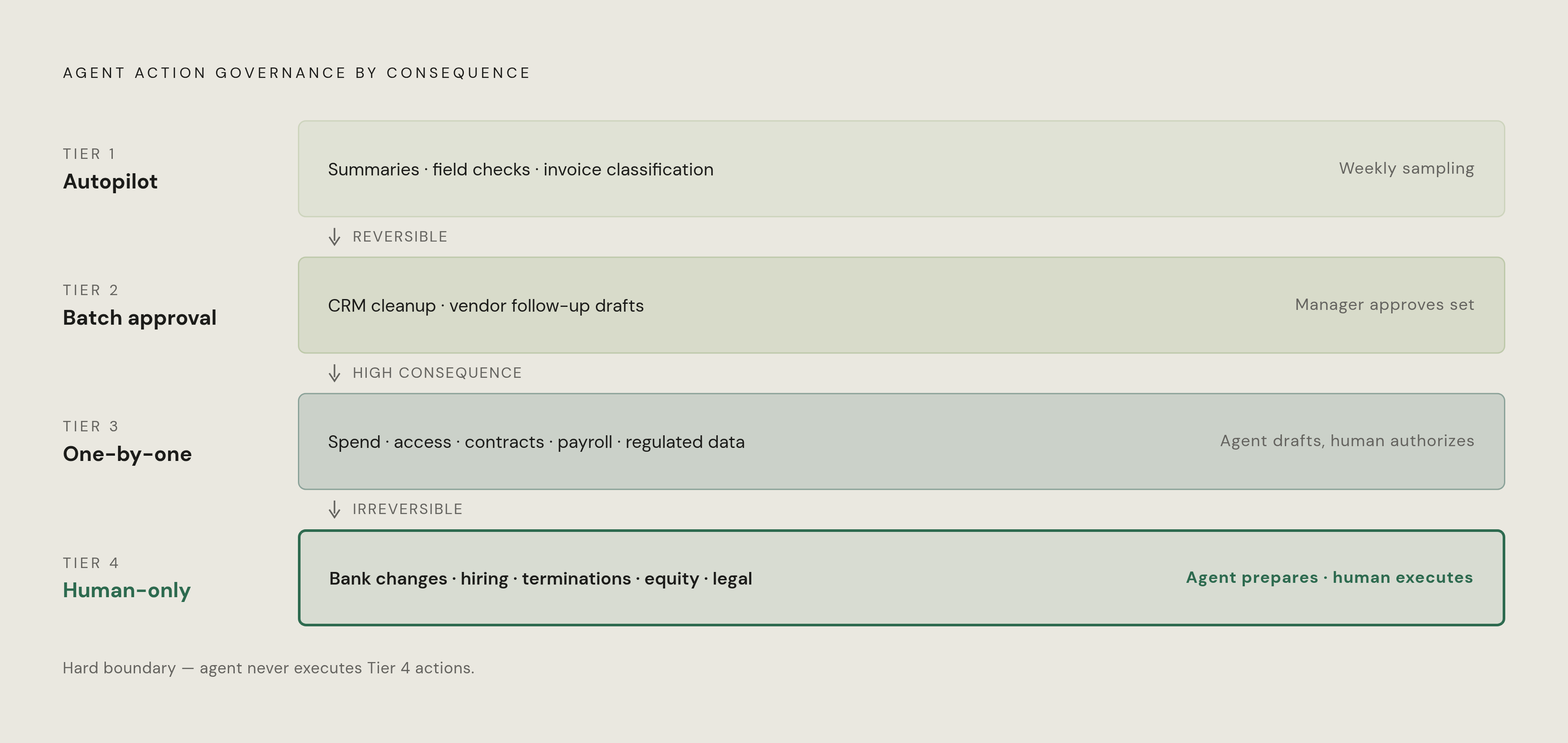
Tier 1 is autopilot, with no approval required. It covers read-only work such as internal summaries, field checks, spend analysis, invoice classification, and duplicate detection. Weekly output sampling and correction-rate measurement provide oversight without interrupting each task. For a new deployment, read-only is the safe starting point.
Tier 2 is batch approval for reversible actions. Examples include low-stakes follow-ups, CRM cleanup, internal task creation, vendor follow-up drafts, and renewal reminder packets. A manager approves, edits, or rejects the set in minutes. Grouping this work preserves review without making every small action a separate interruption.
Tier 3 requires one-by-one approval for high-consequence actions involving spend, access, contracts, customer commitments, production changes, pricing, payroll, regulated data, or public communication. In finance, examples include invoices above contract, duplicate payment reversals, software license cancellations, and vendor contract changes. The agent gathers evidence, checks it against policy, drafts the change, and suggests what to do. The action that changes the business waits for a person.
Tier 4 is human-only work involving irreversible judgment. Bank account changes, payroll adjustments, hiring decisions, terminations, legal promises, equity grants, and sensitive employee decisions belong here. The agent can prepare the packet but should not execute. This differs from Tier 3, where approval allows the agent to carry out the proposed action.
These boundaries must exist before execution begins. The agent should not decide its own tier at runtime, and complex work does not automatically deserve more approval than a simple but consequential change. Destroying or exfiltrating data, degrading security, crossing trust boundaries, and bypassing review belong in Tier 3 or Tier 4. Unneeded capabilities should be removed before checkpoints are added, with reading and changing treated as separate permissions.
What the approving person actually needs to see
A reviewer needs more than a yes-or-no question. The approval surface should show the proposed action, its reason, the source evidence, the dollar exposure, and the expected outcome. It should also identify who is affected, which systems are touched, and what the drafted work looks like. Without that context, approval is a guess.
An invoice above contract makes the requirement concrete. The reviewer needs the proposed payment action, the invoice and contract evidence behind it, the amount exposed, and the expected result of approving it. A duplicate payment reversal needs the evidence supporting the duplicate finding. The person should be able to approve, reject, or ask for more information before deciding.
Trace2Flow, Wu et al.’s 2026 study with 20 participants, found that checking evidence from different sources against each other helped people spot errors in agent executions. The study also found that editable, graph-based views of completed executions improved understanding and validation over prompt-only conditions.
The decision should leave a useful record. Approvals, rejections, and their reasons should feed into future agent behavior so the organization can identify where the agent’s judgment diverges from its own. Rejections are especially useful evidence of that gap. A log that records only accepted proposals loses part of the learning.
How to implement durable approval checkpoints technically
A checkpoint that works reliably must pause execution, keep the state, and get the decision to the right person. All three parts are necessary for production use. A pause without durable state can lose the workflow when the system restarts, while durable state without a review interface that people can use leaves the work waiting with no clear way to move it forward.
LangGraph shows how this works through interrupt(), which pauses the graph just before the agent acts on a recommendation in the real world. A checkpointer stores the state while execution waits for an external decision. PostgreSQL, or Redis with persistence configured, can preserve that state across process restarts, crashes, and deployments. This allows a workflow to resume after an approval delay lasting hours or days.
OpenAI Agents SDK supports a similar flow in which a tool call pauses for approval or rejection and later resumes from the same state. The underlying principle is explicit execution control. State transitions represented in the workflow are easier to evaluate and debug than an implied sequence left inside a prompt. Typed tool definitions also let teams classify actions by tier at design time.
The reviewer interface is a separate deliverable. LangGraph’s interrupt mechanism does not by itself provide the place where a reviewer sees the proposal, submits a decision, and returns it to the agent. Teams should plan that interface with the checkpoint. OpenTelemetry-compatible spans then make the agent loop visible in compatible monitoring tools so teams can audit whether checkpoints are firing and being resolved.
What to measure to know whether the approval design is working
Approval rate alone says little about control. Teams should track how often people reject actions in each tier, why they reject them, and what happens after approval. If reviewers approve almost everything, the work in that tier may be a good fit for autopilot, or reviewers may have too little information to judge it. A high rejection rate can instead expose proposals outside the agent’s mandate, requiring a narrower scope.
Agent reliability determines what reaches the reviewer. Useful measures include task success rate, tool-call correctness, hallucination rate on intermediate steps, plan adherence, and unrecoverable-error rate. Poor tool-call correctness fills the queue with proposals that should not be there. Unrecoverable errors after approval also call for scrutiny of whether reviewers could see the downstream consequences.
Business value needs a baseline agreed before launch. Teams should name the measures, owner, and measurement period, then count implementation, AI, human review, correction, and monitoring costs together. Time saved and cash saved are different measures, while counts of users and agents show how widely the system is used but say little about its value. Estimates should remain separate from confirmed results. The CIVIC-AI augmentation framework, Wu et al.’s 2026 work, includes durable net value, meaningful human control, and accountability and recovery among its conditions, making outcomes and control part of the same evaluation.
Applying risk-tiered approval to cross-system financial workflows
An agent can find a cost gap between procurement and accounts payable, then propose a payment reversal, contract change, or supplier cancellation. Those are separate events with different consequences. The read-only finding can run on autopilot while the corrective action waits for individual approval or a human owner.
A connected view can also change the decision itself. Procurement may see a supplier savings opportunity while support and engineering see a remediation cost. Neither view is enough on its own. An agent connecting HR, finance, sales, support, and procurement can bring those facts together, but permission to discover them should not imply permission to act on them.
In practice, spend analysis, invoice classification, duplicate payment detection, unused software seat identification, and contract expiry flagging can run continuously as read-only work. Payment reversals, license cancellations, vendor renewal negotiations, and accounts receivable follow-up with payment terms require one-by-one approval. Bank account changes, payroll adjustments, new vendor onboarding with payment authority, and legal commitments remain human-only. The deployment sequence is find first, propose second, and change only after approval.
The approval log then becomes business evidence. Every approval, rejection, and reason should be traceable to an individual, a timestamp, and the evidence presented, giving the CFO and board a record of authorization before execution. Accountability also requires the organization to explain AI-influenced transactions and reverse those approved in error.
Revenue protection follows the same steps, from a read-only flag for renewal risk to a follow-up draft approved in a batch, a pricing concession approved on its own, and a contract restructure owned by a human. The framework also works outside finance, for work in operations and work with customers.