How to Evaluate Enterprise AI Agent Platforms on Governance
Governance controls, not model choice, decide if agents can safely run workflows.

When you choose an enterprise AI agent platform, look at governance first and model flexibility second. The questions that matter most are simple. Can the platform separate who can access a system from who can act on it? Does it check rules before an action runs? Does it keep a clear record of every decision? Can people step in and stop it? Model choice still matters. But those controls decide whether agents can safely move from answering questions to running real business workflows.
Why model flexibility no longer sets platforms apart
The leading platforms can already swap between AI models. That is now a basic expectation, not a differentiator. Meanwhile, the work agents do has changed sharply. Assistants answer questions. Agents carry out multi-step tasks. They change records, trigger payments, and send external communications. When software can update a business system or file a regulatory communication, the first question is not which AI model it uses. It is what the agent is allowed to do.
Gartner predicts that more than 40% of agentic AI projects will be cancelled by the end of 2027. The reasons cited are rising costs, unclear business value, and weak risk controls. Gartner does not cite model quality as a cause. Even a capable model cannot set spending limits on its own. It cannot decide where an approval boundary lies. It cannot keep records for a compliance review. AI agents need governance built into the platform to scale safely. Yet most evaluations underweight that dimension.
Why old-style controls break down when agents work continuously
Traditional controls assume a person logs in, does something, and logs off. Agents that run around the clock do not fit that pattern. An agent given broad read access in January may still have it months later. By then, its original purpose or the sensitivity of the data may have changed. Agents also work at machine speed. A misconfigured or compromised agent can touch millions of records before a daily audit catches it.
Having technical access to a system is not the same as having the right to act on it. Without controls embedded in the platform, an agent cannot tell the difference between data it was meant to use and data it can merely reach. It may query the wrong datasets, pass errors to the next step, or use out-of-date information without noticing. Multi-agent workflows — where one agent hands work to another — make those boundaries harder to see. A compliance reporting agent might pick up sensitive personal data from another agent's output. That can happen even though each agent individually stayed within its own permissions. Static, session-level rules cannot govern an entire workflow. Each action needs a policy check before it runs.
The four governance tests every platform evaluation must pass first
Agent identity and authority is the first test. Every agent needs its own identity, its own credentials, clear permissions, and a written record of its lifecycle. It should have authority of its own rather than borrowing a developer's or end user's authority. A central agent registry — a single list that records what each agent owns and can access — should log ownership and access. Each type of agent should have a separate account. There should be a clear retirement process. The right to read a record is not the right to change it. An agent allowed to read a claims file must receive a separate permission to update it.
Runtime enforcement is the second test. Fast-moving agents cannot be governed by looking back at what they did after the fact. Policy checks must intercept actions before they run. Each check should assess the impact, whether the action can be undone, the amount of money involved, the category of action, and the relevant rule. The instructions an agent receives are not an enforcement layer. A denied or expired request must fail completely, with no alternative path triggered. This is where an evaluation distinguishes a platform that documents rules from one that actually applies them.
Decision evidence is the third test. A log records that something happened. A structured decision record explains why it happened. That difference matters when something goes wrong. The record must preserve the context the agent used. It must also capture the version of the rule that applied, who or what authorized the action, and the outcome — including failures and inconclusive results. Corrections, exceptions, and human overrides belong in that same record so the evidence stays in one place.
Intervention is the fourth test. The platform must have a way to stop an agent mid-task, cancel its credentials, and undo actions where that is possible. How far a mistake can spread — sometimes called blast radius — should be known before an action is authorized. The system should also make clear how long you have to detect and stop each type of action. The EU AI Act's Articles 14 and 26 set out the human oversight and intervention that high-risk deployments must have. An evaluation therefore needs to establish both who can intervene and whether the system gives that person enough time to act.
Why separating access from authority is harder than vendors suggest
Having credentials — login details — to reach a financial system does not mean an agent can approve an invoice payment. In procurement, agents can add up many small transactions. Each one may fall below an approval threshold. Together they can add up to a large total. Credential-level access control does not catch that. Action-level policy enforcement must separate the right to use a system from the right to spend money. It must also make clear what each approval threshold covers.
When one agent passes work to a second agent, permission can appear to travel down the chain. That can happen even though nobody explicitly granted it. The boundary must survive that handoff. That requires a clear allow-or-deny list for every tool and action. It also requires a review and registration step for every high-impact tool before it goes into production, and tracking of the full chain of handoffs. Lifecycle controls must close the other end. When an agent is decommissioned, permissions must be cancelled and the registry updated — the same way employee offboarding removes access.
How a clear decision record becomes more than a compliance requirement
What went wrong, and why? A useful decision record answers both questions. It connects the evidence and assumptions behind a recommendation to its authorization, action, and outcome. That makes it possible to compare what was expected with what actually happened. Failures deserve the same detail as successes. You need records of failed and inconclusive outcomes to detect drift and find root causes.
Human corrections add value only when their reasoning stays attached to the original decision. An exception explained elsewhere may satisfy a local review. But it leaves the next agent unable to learn from it. The EU AI Act reinforces traceability through record-keeping requirements. The NIST AI Risk Management Framework — a widely used US standard for managing AI risk — calls for records that support oversight and investigation. Connected decision histories do more than meet those obligations. They let agents check whether conditions have changed before drawing on past lessons, so the organization's knowledge builds over time.
How human oversight should be matched to the risk of each action, not applied uniformly
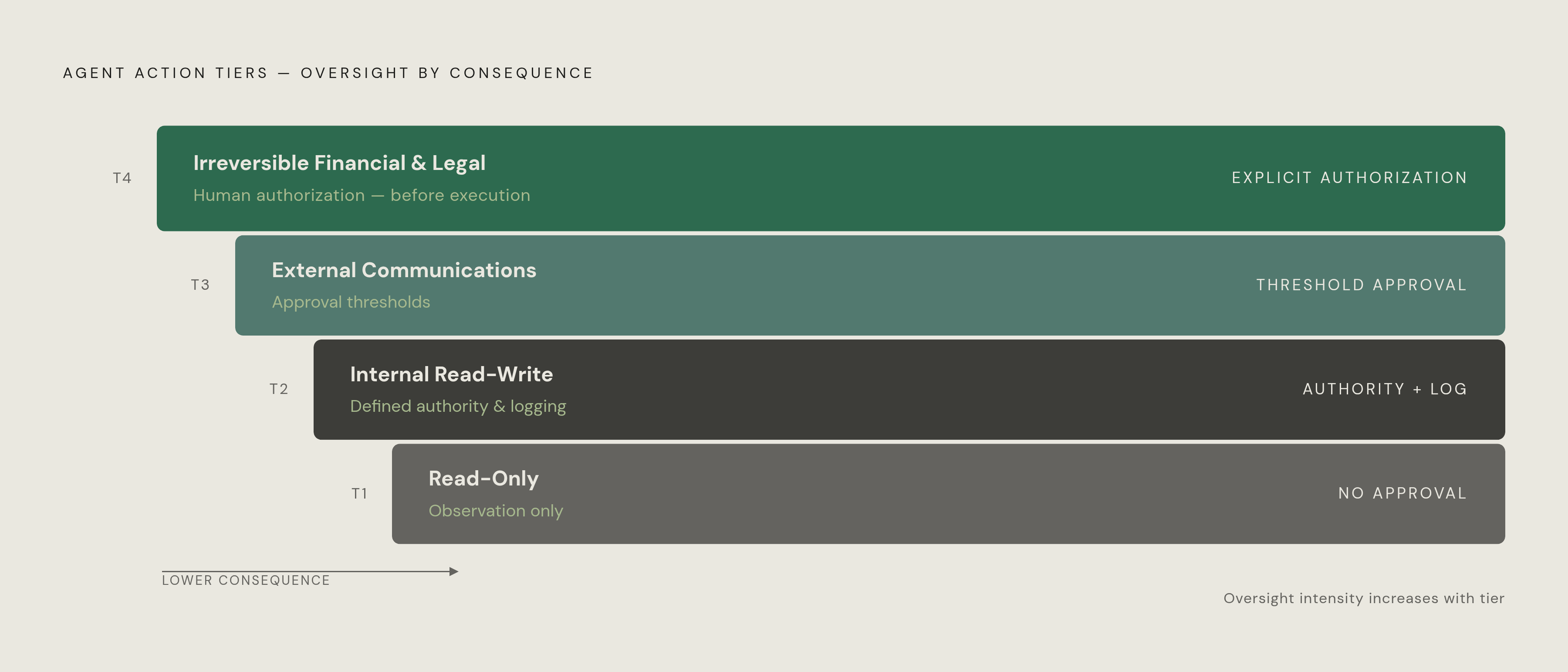
Clearer evidence makes selective human review more credible. Reviewers can see both the recommendation and the basis for it. If every routine action waits for a person, agents lose much of their value without a matching reduction in risk. Oversight should follow the consequence and reversibility of the action instead. A high-value but fully reversible action needs different treatment from a lower-value action that cannot be undone.
Tier 1 read-only actions need observation but not approval. Tier 2 internal read-write actions — where the agent can change records inside the organization — need defined authority and logging. Tier 3 external communications need approval thresholds. Tier 4 irreversible financial or legal actions need explicit human authorization before they run. These gates must be built into the platform rather than left to the agent's own judgment about when to ask for permission.
Business owners must set approval thresholds, risk limits, and budget constraints. They must also name who is responsible for exceptions. Each review point needs a named reviewer, the underlying evidence, and clear authority to approve, reject, or stop the action. Start with read access and investigation. Let agents show their value through analysis and recommendations. Write authority — the ability to change records — can then expand as quality is demonstrated, rather than being granted broadly and tightened after an incident.
What governance-first evaluation looks like for insurance workflows
Insurance exposes governance boundaries that a generic demonstration can hide. Producer licensing (the process of registering and renewing agents who sell insurance), claims processing, and policy administration all combine regulated data, licensing obligations, records spread across systems, and financial decisions that cannot easily be reversed. The requirements become visible under pressure. An agent tracking producer licenses may monitor status across every state, send compliant activity-based communications, and route renewals. But coverage explanations, recommendations, or comparisons that make up licensed advice must come from a licensed professional. That boundary must be enforced through the platform's architecture. It cannot be left to the agent's judgment.
To enforce it, the system also needs to link a producer's application, licensing progress, and support history when those records sit in separate systems. Claims processing has the same problem. Context is spread across documents, coverage data, and case routing. Data access alone is not enough. A layer that tracks data origin, classification, and freshness must be in place. The approval architecture must distinguish actions the agent can handle alone from those that need human review. It must also name an exception owner when thresholds are exceeded.
Guidewire's Qusar release, announced August 3, 2026, introduced an Agentic Framework providing secure, real-time access to policy, claims, and billing data inside Guidewire Cloud Platform. For organizations evaluating agents around those records, the governance question is whether that access is scoped at the action level or only at the credential level. Duck Creek's insurance-native Agentic AI Platform, launched April 28, 2026, is designed to deploy, orchestrate, and govern agents across the insurance lifecycle. For that platform, the evaluation needs to look at the chain of handoffs across policy, claims, and billing.
Model portability needs an equally concrete test. A platform that can work with different AI models and different core business systems should let you keep your context, business rules, and decision history when models or agents are swapped. Comparing replacement models then means assessing workload quality, speed, risk, and total AI plus human cost. It is not just about treating model choice as an isolated feature. Insurance makes these dependencies obvious, but the same test applies wherever agents act on connected business records.
How to tell whether a governance architecture is actually working once agents are live
A governance architecture you cannot measure against a baseline is compliance theater — the appearance of control without the substance. Before deployment, agree on your existing error rate, processing time, and exception volume. Without that, apparent gains cannot be separated from seasonal variation or other process changes. The number of agents running proves very little by itself. The useful measure is fully loaded cost per successful outcome. That means combining implementation cost spread over time, ongoing AI cost, human intervention cost, and the cost of failed attempts, then dividing by successful outcomes.
That accounting needs separate views of performance. Business outcomes cover revenue, cost, and error rate against the baseline. Operational outcomes cover processing time, throughput, and manual effort. Risk and governance outcomes track compliance incidents, audit results, and cases where model behavior drifts from what was expected. Adoption outcomes track how deeply agents are built into workflows and how much confidence employees have in them. Time saved must also remain separate from cash savings. Fewer hours do not automatically reduce costs if freed capacity is not redeployed.
Plausible failure modes need assessments of likelihood, cost, how easy they are to detect, and whether they can be undone. Compare those assessments against observed outcomes after launch. Drift detection, keeping decision records, and weekly checks against known-good examples provide an ongoing check that agents remain within their authorized scope. Decision records make that comparison possible in practice. The organizations that scale governed AI successfully will be those that agree on the baseline, define what success looks like, and measure business outcomes.