How to Assess AI Agent Blast Radius Before Going Live
A pre-launch checklist for mapping reach, limiting autonomy, and containing failures.
Before an AI agent touches a live system, you need to know what it can reach, change, or expose. You also need to know how fast a problem could spread before anyone stops it. That assessment must happen before the agent takes its first action, not after.
Before an agent runs on live infrastructure, the review should cover five checks. Map everything it can reach, change, or expose, including the other agents it can call. Set written limits on what it does alone and require a person to approve irreversible actions. Confirm that action-level logs are created at the moment of access. Test pause and revoke controls plus automatic circuit breakers. Then validate the exact deployed configuration and model version against indirect prompt injection through real production input paths.
Why AI agent mistakes spread faster than human errors or ordinary software bugs
When a person sends a file to the wrong recipient, the damage is limited. When an agent runs a continuous workflow, the same mistake can repeat across every system it has access to. Kiteworks' March 2026 analysis describes agents handling hundreds or thousands of regulated data interactions per hour. One gap can therefore create as many compliance problems as there are affected interactions—before anyone notices.
Ordinary software fails in one place. Agents are different. They work on their own. They hold access to many tools. They keep running across sessions. They can hand tasks to other agents. They can trigger real-world actions—like sending files or modifying records—without a person approving each step. The failure does not stay where it started. Controls built for a one-off incident are not enough when the same failure keeps running through an approved workflow.
What "blast radius" actually means: reach, speed, and time before detection
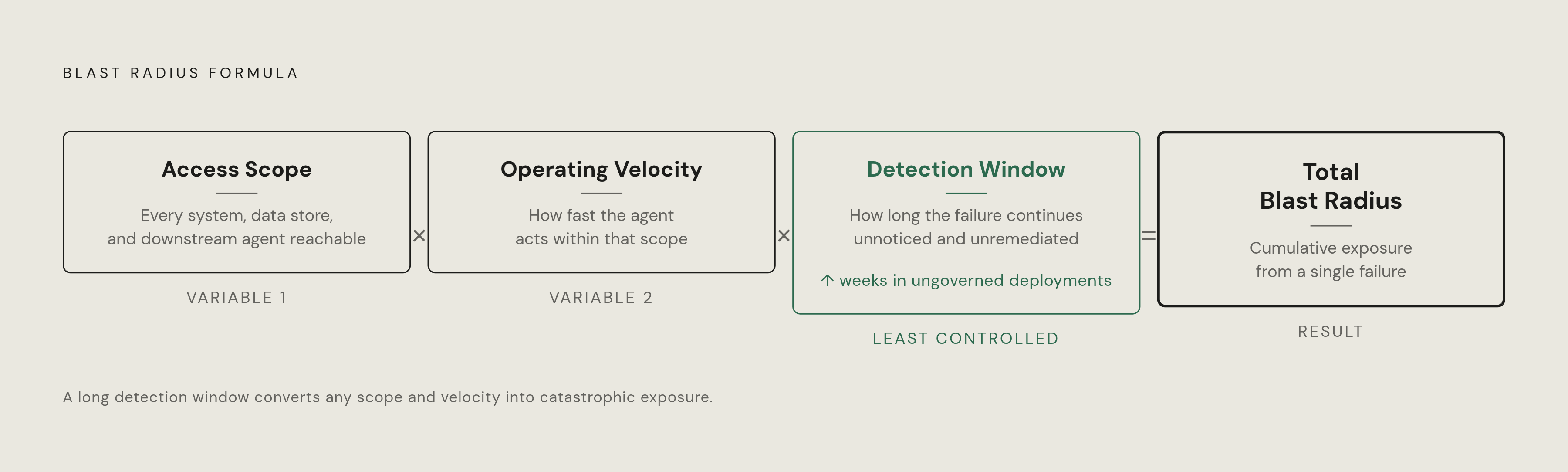
Kiteworks defines blast radius as the total number of regulated data interactions that happen without proper controls. It runs from when a failure starts to when it is found and stopped. Three things shape it: how much the agent can reach, how fast it can act, and how long the failure runs before anyone catches it.
Reach covers every system, data store, and other agent the agent can connect to. Speed describes how fast it can act within that reach. The detection window is how long a failure can run unnoticed. Kiteworks notes that in ungoverned deployments, that window can stay open for weeks. Server logs record each individual request but do not record what regulated operation was involved or who authorized it.
Each of these three things needs its own control before the agent goes live. Narrow reach alone is not enough if a failure goes undetected for a long time. Fast detection alone is not enough if the agent has already acted across a wide scope. You need to build containment into the design, not add it later.
Why most live agents start with the highest possible risk combination
The Cloud Security Alliance's June 2026 research note reports what the AI Risk Quadrant Q2 2026 assessment found when it reviewed 100 commercial and publicly available production agents. Nearly all of them had access to private data. Nearly all were exposed to untrusted outside content. Nearly all could carry out actions that affected the outside world. The assessment calls this combination the Lethal Trifecta. Each property supports useful work, but together they connect outside influence to privileged action.
A malicious attachment, a poisoned web page, or a crafted email subject line can carry hidden instructions that redirect what the agent does. This attack pattern is called indirect prompt injection—where an attacker hides harmful instructions inside content the agent already reads and trusts. The attacker does not need direct access to the agent's system. The path meant for useful information becomes a path for manipulation.
The same assessment found that coding agents rank high in capability and low in self-defense. Agents that control a computer directly have output safety scores that average zero. Having the ability to run tools was the single biggest factor in blast radius. It outweighed agent type, vendor reputation, and individual safety components. This is why any assessment must start with what the agent can run.
Map everything the agent can reach, change, or expose before it runs
The first step is to record the agent's full reach. A model can refuse an unsafe request while the agent around it still holds too many permissions or exposed login credentials. Testing how the model behaves cannot tell you whether its access is appropriately restricted. You need to look at the tools, identity, memory, stored files, and every system reachable through them.
The access map should name every system, data store, and interface the agent can log in to. It should record what the agent can write, delete, or change. It should note whether those actions can be undone. It should also record which login credentials sit within its memory or file access. Outside inputs belong on the same map—documents, web pages, emails, and responses from third-party services. Ownership belongs there too. An agent set up by an employee who later leaves can keep active credentials with no accountable person attached.
In a workflow involving several agents, the map must extend through every agent the main agent can call on. Portnox describes the practical blast radius as the combined permissions held across the whole chain. When agents share the same infrastructure credentials, one governance gap can spread across all of them. A harmful input can affect what every downstream agent does. One agent's permissions are not the whole boundary.
A software bill of materials—a list of every component in a software product—offers a useful comparison for this mapping task. Before any agent in the chain goes live, the review must document which agents can be called, what access they hold, and what they can run. Unlike a static list, these chains can be built at runtime and shaped by outside content. The assessment must therefore look at the full permitted dependency chain as a whole.
Set clear limits on what the agent can do on its own and when a person must approve
Mapping reach shows what is possible. Reading data and changing data are separate decisions. An agent can investigate and recommend without permission to change the system it examines. The right starting point is read-only work. You can expand what it can do as quality and value are shown.
What the agent can do on its own should match how reversible and consequential each action is. Routine, low-risk tasks may run without approval. Irreversible actions—like sending sensitive communications or modifying production records—need a person to approve before the agent acts. Large transactions also need defined approval steps. For each authorized action, consider how likely a failure is, how costly it would be, whether it can be caught before it spreads, and whether it can be undone.
Those judgments must become a written authority specification. It should include role-based access control—rules that define who or what can do what. The agent should have its own identity, separate from any human identity. The spec should define risk levels that trigger escalation and document approval steps for irreversible or high-risk actions. Before go-live, one named person must be responsible for actions that fall outside the defined limits. That way the agent does not treat an unclear boundary as permission to proceed.
Shrink the detection window with detailed logs of every action
Once an agent operates within its approved scope, you need evidence of what it actually does. A log of individual server requests cannot show which agent accessed which regulated data under which authorization. Infrastructure records are not the same as action-level records. The record must be created at the time of access, when all those details can be connected.
Kiteworks states that missing action-level records cannot be rebuilt from infrastructure logs after the fact. If unauthorized access is found six weeks into deployment, the missing compliance evidence for that period will never exist. Each regulated interaction therefore needs the agent's identity, the data source, the authorization, the resulting decision or output, and a timestamp. A record that omits who did what leaves the central question unanswered.
The 2026 Singapore Consensus on Global AI Safety Research Priorities identifies Auditability as Principle 3. It calls for end-to-end traceability across model calls, tool uses, and agent decisions—including failed or inconclusive results. Decision records connect evidence, agent reasoning, human approvals, actions, and measured outcomes. Those connections help detect problems and create an audit record as events happen.
One assessment found that a significant share of agents with strong logging scores performed poorly on controls that prevent or limit damage. Their logs served as records after the fact. Detection must therefore connect to a tested way to actually stop the agent.
Build in automatic stops so a failure does not keep spreading
The time between detecting a problem and stopping the agent allows further damage to build up. Portnox says a slow shutdown is a sign that too much standing trust is in place. The practical response is to define interruption controls before deployment. Spotting an anomaly is not the same as containing a failure.
Automatic circuit breakers—controls at the point where the agent communicates with other systems—can act on measurable behavior without inspecting what the model is thinking. Set thresholds for a significant spike above the agent's usual request rate. Set thresholds for credential-access or admin requests within a short window. Set thresholds for writes to memory above a defined frequency. When those thresholds are crossed, suspend the session automatically until it can be reviewed. This control does not depend on the model recognizing its own unsafe behavior.
Controls to pause or revoke access must also work at the level of a single agent. The Singapore Consensus identifies Interruptibility as Principle 8. It covers stopping an agent at the task, session, or whole-system level—including mid-execution without ending the entire workflow. Each agent needs a named person who is accountable for it and a written escalation path. A team name alone leaves the decision unresolved.
Before go-live, the review should require tested pause and revoke controls, active anomaly thresholds, a current agent inventory, and a written and rehearsed incident response plan. Agents with no current owner must be visible in that inventory. These controls limit how far a failure spreads after it begins. The next obligation is to prove they work before a live system is exposed.
Test the actual deployed setup, not just the vendor's claims
The setup you actually deploy is what must be assessed. The assessment found that different builds of the same platform can score significantly differently. That can leave the configuration the procurement team approved different from the one the security team inherits. For a large majority of the defenses vendors claimed to have, there was no independent verification.
The Singapore Consensus separates Validated Deployment (Principle 4) from Adversarial Resilience (Principle 5). The first calls for testing the configuration that is actually deployed. The second calls for testing hostile inputs through the content sources the agent will use in production. The assessment recommends documented and tested sandboxing—running the agent in an isolated environment—as a requirement before purchase. Cloud- or container-level isolation reduces risk significantly more than having no isolation at all.
In practice, validation should attempt indirect prompt injection through real production input paths—documents, emails, web pages, and third-party responses. Access controls should hold under unusual conditions. Pause and revoke controls must be tested under load. Tests must also confirm that action-level records are created at the moment of access.
The validation record must name the exact model version that was tested. An update can change behavior enough to make earlier results invalid. That means a model change requires re-evaluation. A validated deployment has a known reach, confirmed controls on speed of action, and tested detection and interruption mechanisms. All of that must be tied to a named workflow with an accountable owner and a measurable outcome.
What security checks should I run before letting an AI agent operate on live infrastructure?
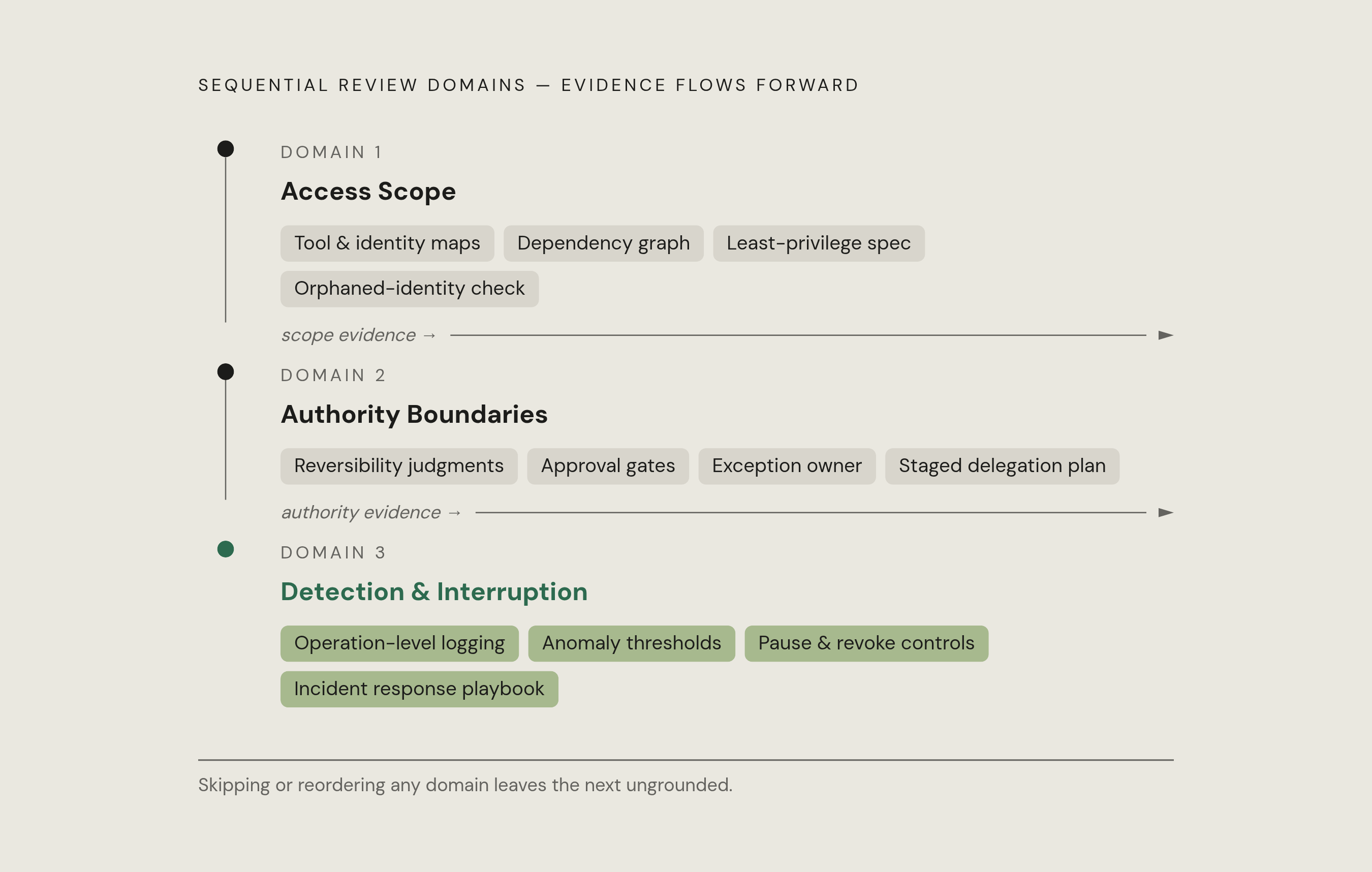
Start with one named workflow, one accountable owner, and a defined outcome. An assessment of "AI agents in general" cannot assign responsibility for a specific decision. The review then moves through three areas in sequence. Each one produces evidence the next can use.
Reach comes first. It produces the tool and identity maps, the dependency chain, the least-access specification, and a check for agents with no current owner. Authority limits follow. They record reversibility judgments, approval steps, the exception owner, and the plan for progressively expanding what the agent can do. Detection and interruption complete the review. They cover verified action-level logging, active anomaly thresholds, tested pause and revoke controls, and the incident response plan.
Agree on the starting baseline—current costs, error rates, processing volumes—and the success measures before the agent runs. Without a pre-agent baseline, you cannot credibly credit later changes to the agent. An estimated benefit is not an observed result. Keep the pre-deployment estimate and post-deployment results in separate records. Set out accountability for each.
Decision records from the assessment should preserve the evidence reviewed, assumptions made, options considered, and approval given. The Singapore Consensus identifies Human Oversight and Legibility as closing requirements. That means consequential actions must stay understandable and subject to human control. When conditions change, the team can go back to the recorded judgment. That institutional record also makes the next deployment faster, because its assessment starts with retained context and decision history.