Audit Trail Gaps from Third-Party AI APIs: What You Need to Know
Vendor AI hides the middle of your audit trail, and regulators still hold you accountable.
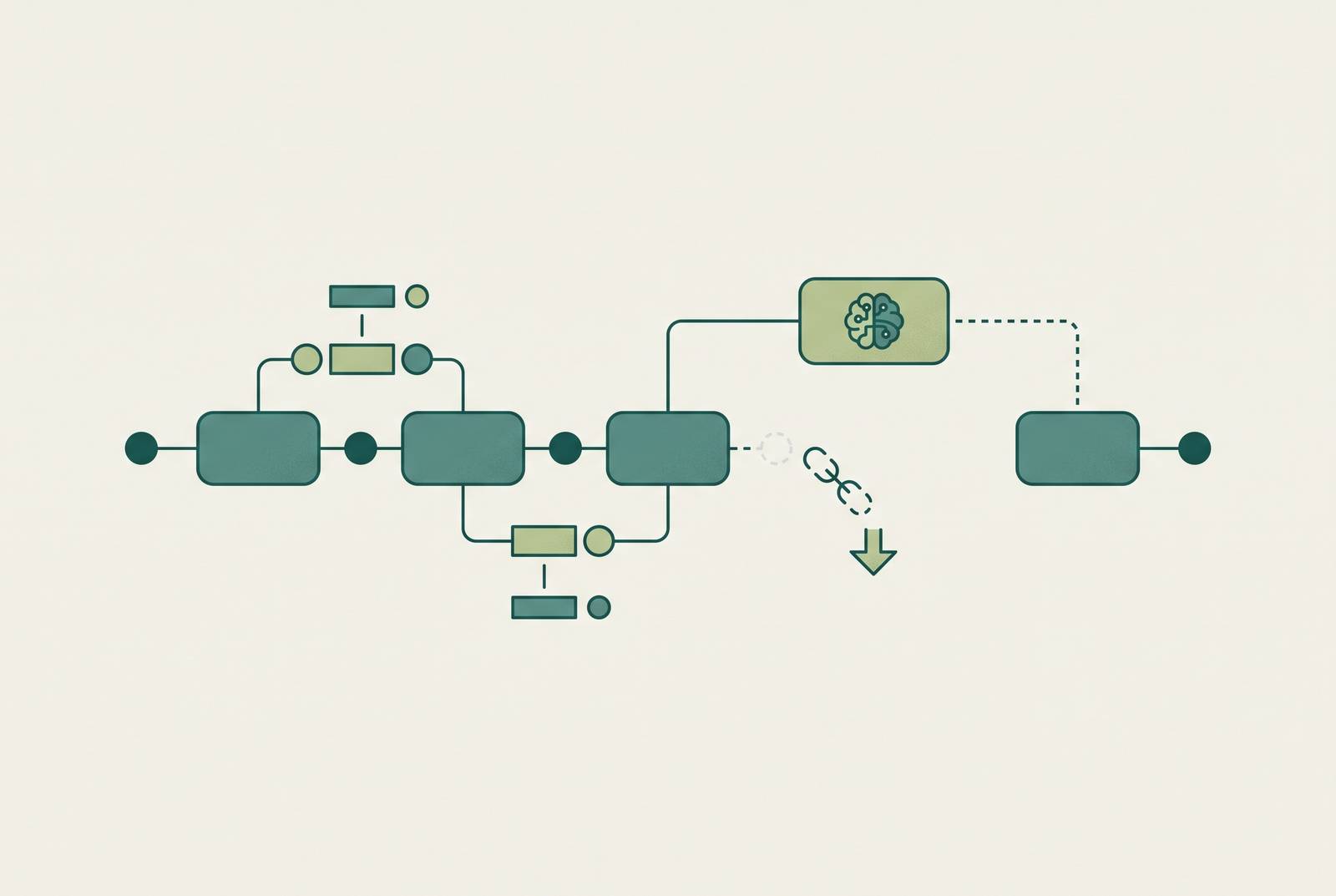
When your organization uses a third-party AI service, your audit trail breaks. The audit trail is the record of who did what and when. It breaks the moment work crosses into the vendor's system. More internal logging alone will not fix this. You need governance built into the whole process. That means capturing identity, evidence, approvals, and outcomes on both sides of that boundary.
Why the record breaks at the vendor's boundary
When you send a request to an AI service, your systems log that you sent it. They also log that you got a response back. But a lot happens between those two events. The vendor's system may reason over your data, call other tools, and take actions. Your own logging cannot capture that middle part. You have no technical or legal access to it.
This is different from a standard software integration. An AI agent's path can change as it runs. The model reasons step by step, calls tools, and takes multi-step actions. The final answer is just the endpoint of that process. If those steps touch regulated data, you need evidence of what happened. Buying the service does not transfer your obligation to account for how it was used.
What happens inside the vendor's system that you cannot see
Standard server logs record that a call was made and a response came back. They do not capture which records the model retrieved. They do not show which rules it evaluated. They do not record what intermediate outputs it produced or what settings it used when calling other tools. A decision record — a record linking what the model reasoned from, to what it retrieved, decided, and authorized — is missing.
This gets harder when one AI component hands work off to another. An orchestrating agent may pass a task to a sub-agent. That sub-agent might call a payment system and write to a database. Meanwhile, your systems see only the outer request. Each layer adds activity you cannot see. A successful response can still leave you unable to explain the chain that produced it.
The boundary can also shift without any change on your side. A vendor's support platform may route tickets through an AI model you did not know about. A subprocessor — a company the vendor itself uses — may add an AI tool that is outside your inventory. Model updates create another gap. If a vendor quietly upgrades a model and that upgrade is not tied to a change record in your systems, you can no longer link historical decisions to the exact model version that produced them.
Why regulators hold you accountable for what you cannot see
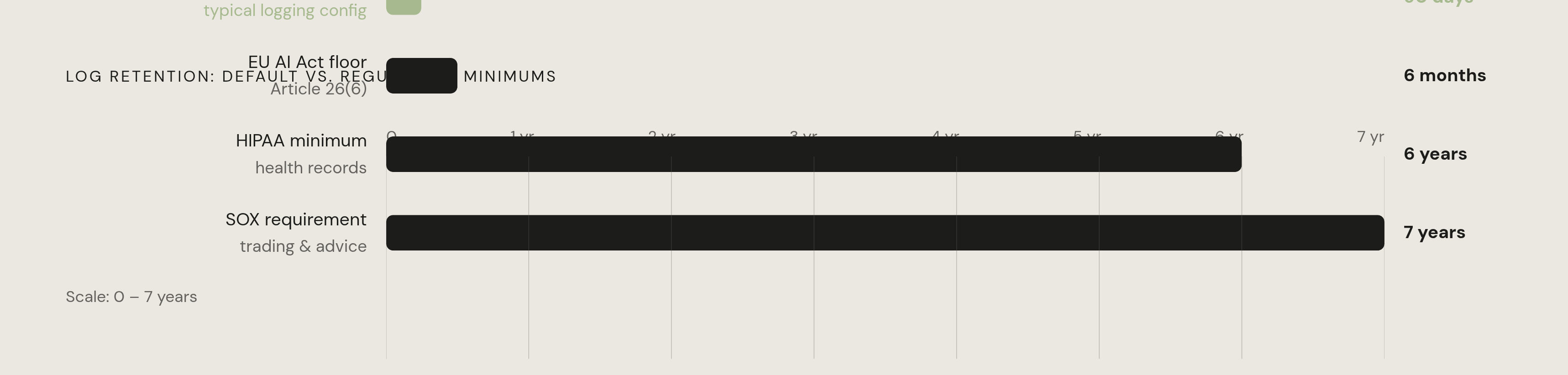
Your organization still carries regulatory duties even when the work runs in the model provider's infrastructure. The EU AI Act (the European Union's law on artificial intelligence), Article 26(6), requires organizations using high-risk AI systems to keep automatically generated logs under their own control for at least six months. That phrase "under their control" matters. A vendor contract does not replace your own compliance duties.
Attribution makes this mismatch clearest. HIPAA's unique user identification rule (the US health data privacy law), GDPR's accountability principle (the EU data protection law), and SOX's audit trail requirements (the US financial reporting law) all call for a record that links access to a specific person. A service account — a technical login credential used by software rather than a human — points to a system, not a person. When no log connects that credential to the person who directed the workflow, you cannot explain who started the access.
There are also retention requirements — rules about how long records must be kept. Financial services audit trails for trading and advice can be subject to requirements of up to seven years. Healthcare audit records are subject to six-year requirements under HIPAA. Standard operational defaults can fall far short of those periods. COSO (the Committee of Sponsoring Organizations of the Treadway Commission, a body that sets internal control standards) published "Achieving Effective Internal Control Over Generative AI" in February 2026. It calls for prompts, inputs, outputs, model and configuration versions, and evidence of human review. The record must show that the control worked. A final answer alone cannot show what the AI acted on or whether anyone reviewed it.
Seven specific failures that show up in real audits
The first failure is service account attribution. An API key — a credential that software uses to call a service — records which service accessed regulated data. It does not record the human who started the workflow. This breaks the individual attribution required under HIPAA, GDPR, and SOX.
The second is confidence scores replacing reasoning. A bare score does not identify the rule or evidence behind an output. It cannot, on its own, satisfy a regulatory requirement to explain a decision.
The third is a silent model upgrade. Without a change record in your systems, a historical decision cannot be tied to the model version that produced it. That leaves a gap in the version evidence the COSO guidance calls for. It also undermines your ability to reproduce results.
The fourth is logs split across systems. Reasoning, tool calls, actions, and human review may all be recorded somewhere. But the records may be too scattered to piece together during an examination.
The fifth is the absence of tamper evidence. Records stored in a database that can be edited, without cryptographic integrity proof (a mathematical seal that shows whether a record has been changed), can be challenged as unreliable during an examination.
The sixth is a retention mismatch. A 90-day default for operational storage keeps records for far less time than the six-month EU AI Act floor, six-year HIPAA requirements, and seven-year SOX requirements where those apply. By the time records are requested, they may already be gone.
The seventh is a missing exception trail. Recording that a case was escalated but leaving out its resolution and the human reasoning behind it leaves the human review evidence incomplete. That gap appears exactly where an examiner needs to understand why the normal path changed.
What a governance setup that spans both sides of the boundary actually requires
To close these gaps, you need instrumentation — the ability to record and measure activity — built into the execution path itself. Developer records for debugging and compliance records for regulators have different uses. Each needs its own storage and retention policies. A decision record must preserve the trigger, user identity, inputs, available reasoning, outputs, and downstream actions. It must also include human review and tamper-evident integrity proof.
The record must also capture every tool and outside service called. That includes exact settings and responses, the context supplied to the model, and the specific records returned by external databases or other tools. Recording only the final answer discards its evidentiary foundation. Identity must travel the same path. The authenticated human user needs to stay linked through the application, service credential, and vendor interaction. That way the record can answer who directed access and which account carried it out.
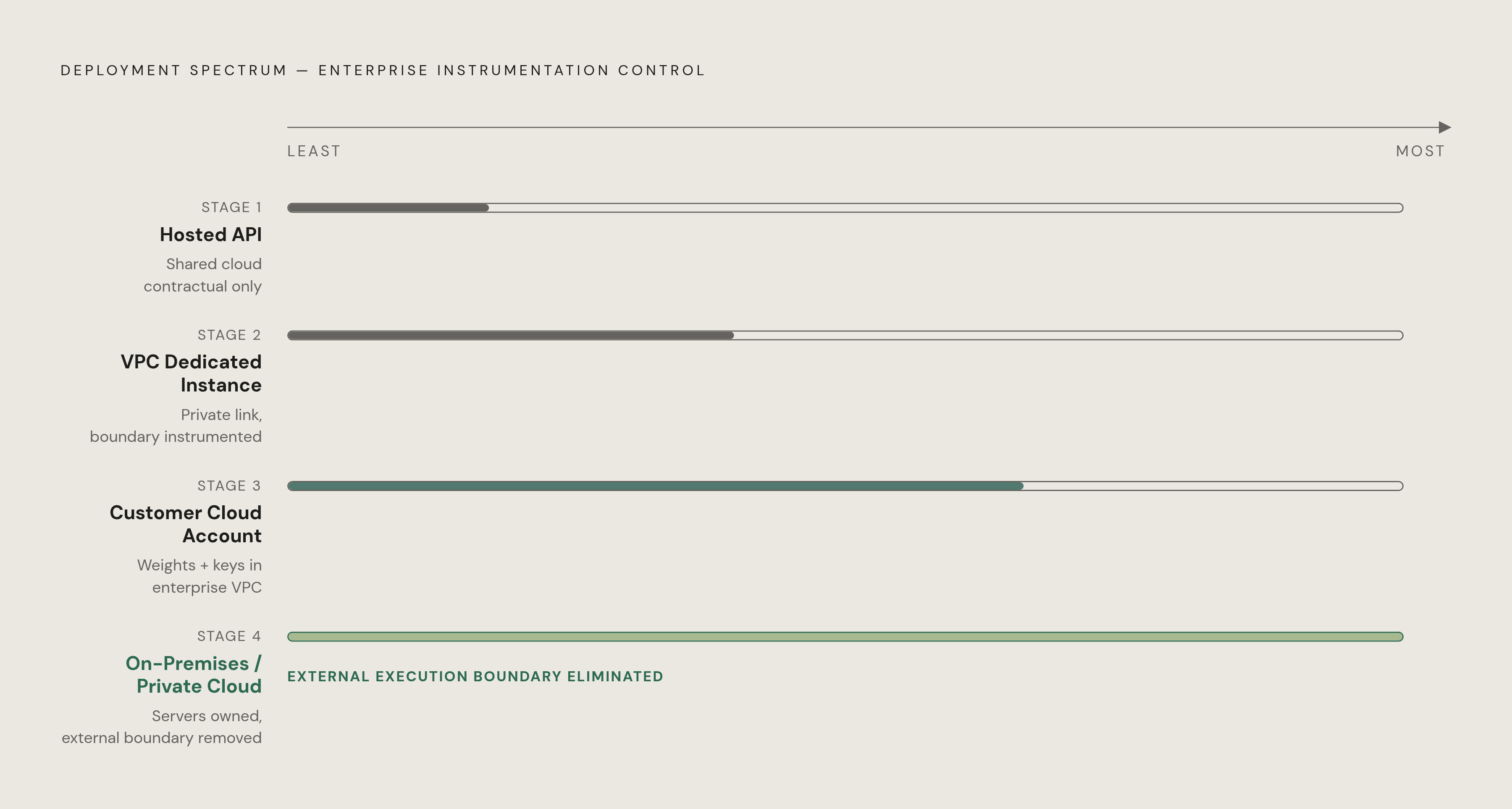
Your deployment choices determine how much of that path you can record. A hosted API under standard business terms sends prompts through shared cloud infrastructure. That leaves you most dependent on contractual protections. A VPC-isolated dedicated instance through a private link (a setup where the vendor runs a dedicated server for you, connected through a private network) reduces exposure and improves what you can record at the boundary. With a customer-controlled cloud account, the model and encryption keys sit inside your own cloud environment. Logging can then happen at the infrastructure level. With on-premises or private-cloud deployment, the work runs on servers you own and connects to your own identity system. That gives you the most control over recording and removes that external execution boundary.
Control over infrastructure still needs structured human oversight. Approval checkpoints, monitoring while work runs, and batch review should reflect the risk, sensitivity, and reversibility of each action. The record needs to show what a qualified reviewer saw, what they decided, and when. It should include any override. Otherwise, a claimed approval step may be no more auditable than the model behind it.
Why systems that are not tied to a single vendor reduce boundary risk when vendors change
Switching vendors can break continuity even when the new model performs well. Model upgrades and changes to API contracts — the technical agreements that govern how you call a service — can break that continuity further. This is especially true when your business context, rules, and decision history are stored inside the vendor's system. You must assess whether you can still reconstruct historical decisions after the switch. That means doing so without rebuilding evidence from disconnected vendor records.
A connected map of company records and decision history that your company owns and controls — separate from any particular model — avoids this problem. Business rules, human judgments, approvals, and measured outcomes stay in your own storage. Another model can then use your company's knowledge while you keep ownership of your history. As one option for this approach, Nodes builds decision records connecting evidence, reasoning, approvals, actions, and measured outcomes within the deployer's own infrastructure and ownership. It runs in the customer's own cloud, on its own servers, or in Nodes Cloud. The customer keeps its data and what it learns even when changing AI models. Its retained record addresses fragmentation across vendor boundaries. Visibility into external execution still depends on what the workflow can capture.
Governance controls that must accompany the technical setup
Technical records need people authorized to act on them. Without named accountability, documented approval steps, and enforceable pause controls, instrumentation can describe activity that no one owns. Even with a governance board, each workflow needs an owner who is accountable for it. The organization needs clear responsibility for agent behavior, security review, and exceptions. That includes naming who can stop work when it leaves approved bounds.
Approval should come before execution. Autonomy should expand only as quality and reliability are demonstrated. Read access and investigation should come before permission to change records, with those permissions kept separate. Repeated work must stay within the approvals and policies currently in force. Exception owners need to be named in advance. Platforms should be assessed for the ability to pause or revoke access for one individual agent without stopping the entire deployment. Monitoring reveals a problem. A working stop control can interrupt it.
That authority must extend to agents introduced by vendors and subprocessors. An inventory that lists only agents built inside the enterprise leaves out AI activity already running in the corporate data pipeline. Vendor contracts must clearly require logs for those agents. The parties need a Data Processing Agreement (a formal contract governing how personal data is handled) when a vendor processes personal data in the workflow. The agreement should state which party retains which logs, in what format, for how long, and who produces them when a regulator asks.
Before deployment, the parties also need to agree on a baseline — how to measure success, who will measure it, and over what time period. These give the outcome record a defined starting point. An audit trail can then tell the difference between an authorized change and a demonstrated improvement. Without that agreement, even a well-recorded workflow may show what changed without showing whether the change achieved the intended result.
Where to start when your existing audit trail is already incomplete
Start with the workflow that carries the greatest risk. Third-party AI workflows that touch health data (PHI — protected health information), personal financial data, or employment decisions should come first. Attribution requirements apply to those uses. Begin with one named workflow and its accountable owner. Agree the measurement baseline, then instrument that workflow end to end before expanding the program.
For each AI-influenced decision, the minimum record should include a timestamp and decision ID. It should also include the human user's identity, the AI system and model version, and attributed inputs. Add the specific policy invoked, plain-language reasoning or the closest available proxy, and the output. Then include the downstream action, human review status, and tamper-evident integrity proof. These fields form a reconstruction path. They link the person and evidence at the start to the action and review at the end.
Fixing gaps depends on the kind of gap you find. Service account attribution can often be fixed at the integration layer while keeping the AI platform. Retention gaps call for changes to the storage policy and may need a separate compliance store. Tamper evidence requires cryptographic signing at the moment of writing. Missing reasoning inside a vendor boundary may require a different deployment level or platform. Local logging cannot reveal an inaccessible execution path.
Agent governance requires lasting discipline as infrastructure, alongside reliability and security. Its record must remain usable when a regulator, a court, or a failed outcome demands an explanation. That requirement belongs in the design of the workflow.