When Should AI Escalate to a Human? A Plain Guide
Confidence scores mislead, so risk tiers should decide when humans step in.
When an AI system is not sure enough about an answer, it should pass the decision to a person. The hard part is knowing when "not sure enough" actually kicks in. The confidence score the AI reports is not as reliable as it looks.
A confidence score is not the same as a safety check
Most vendor guides say the same thing: pick a number. Whenever the AI's confidence score drops below it, send the decision to a human. That sounds rigorous. But the confidence score a generative AI (a large language model, the kind that writes text) gives you is its own self-assessment. It is not a measured probability. It is the model saying "I think I'm right," not an independent test proving it. Treating self-assessment as measured fact is a mistake built into most live systems AI Agent Index 2025.
The gap is not trivial. Digital Applied's analysis found that a claimed 90% confidence score often matches something closer to 75% real-world accuracy AI Agent Index 2025. A threshold set at 90% feels conservative, but it isn't AI Agent Index 2025.
None of this means confidence scores are useless. It means they are one input. Everything else in this post is about what needs to sit around that input before you trust it with a decision that matters.
Errors multiply when several AI steps run in sequence
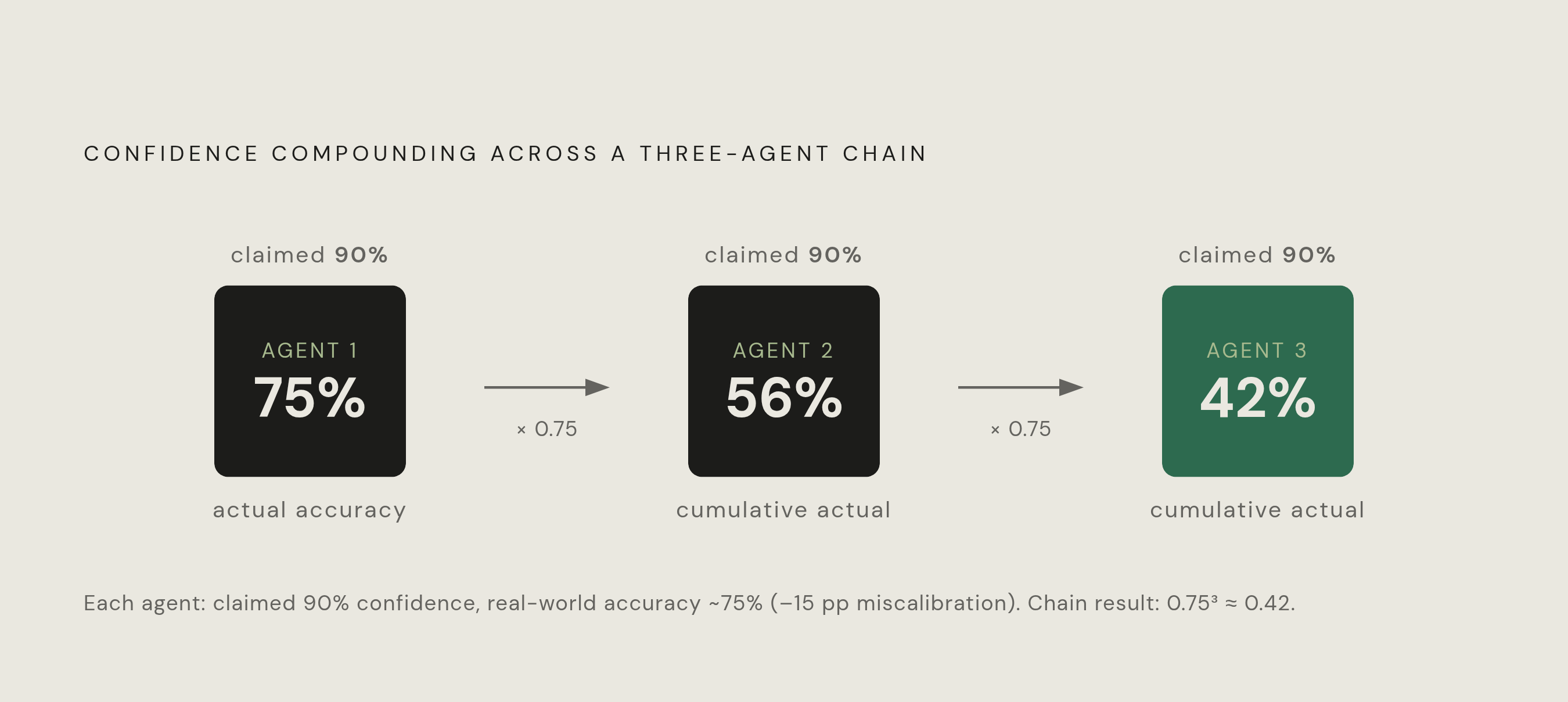
Most production AI does not run as a single model making a single call. It runs as a chain. One AI hands its output to a second. That second one hands its output to a third, and so on. Each step carries the error of the step before it. That adds up fast.
Say each AI in a three-step chain is off by roughly 15 percentage points. Each one still reports a claimed 90% confidence. The real chance that all three steps land correctly is far lower than 90% AI Agent Index 2025 The Neural Base. It drops to roughly 42%, according to Digital Applied's calibration analysis AI Agent Index 2025 The Neural Base. Multiplying optimistic numbers together makes confidence collapse in a way that looking at any one step's score would never show AI Agent Index 2025 The Neural Base.
That gap between what the numbers imply and what actually survives a three-step chain is a large, compounding error AI Agent Index 2025 The Neural Base. It is not a rounding error worth a footnote. It is the numerical case for building human-review checkpoints in the first place. Teams that grew from a pilot with one model to a pipeline with several rarely rebuilt their oversight to match. That is the gap this post is really about.
Sort actions by how bad and how permanent the mistake would be, before you set any threshold
Confidence alone answers the wrong question. The question that actually matters is: what does it cost, and how hard is it to undo, if the AI gets this wrong?
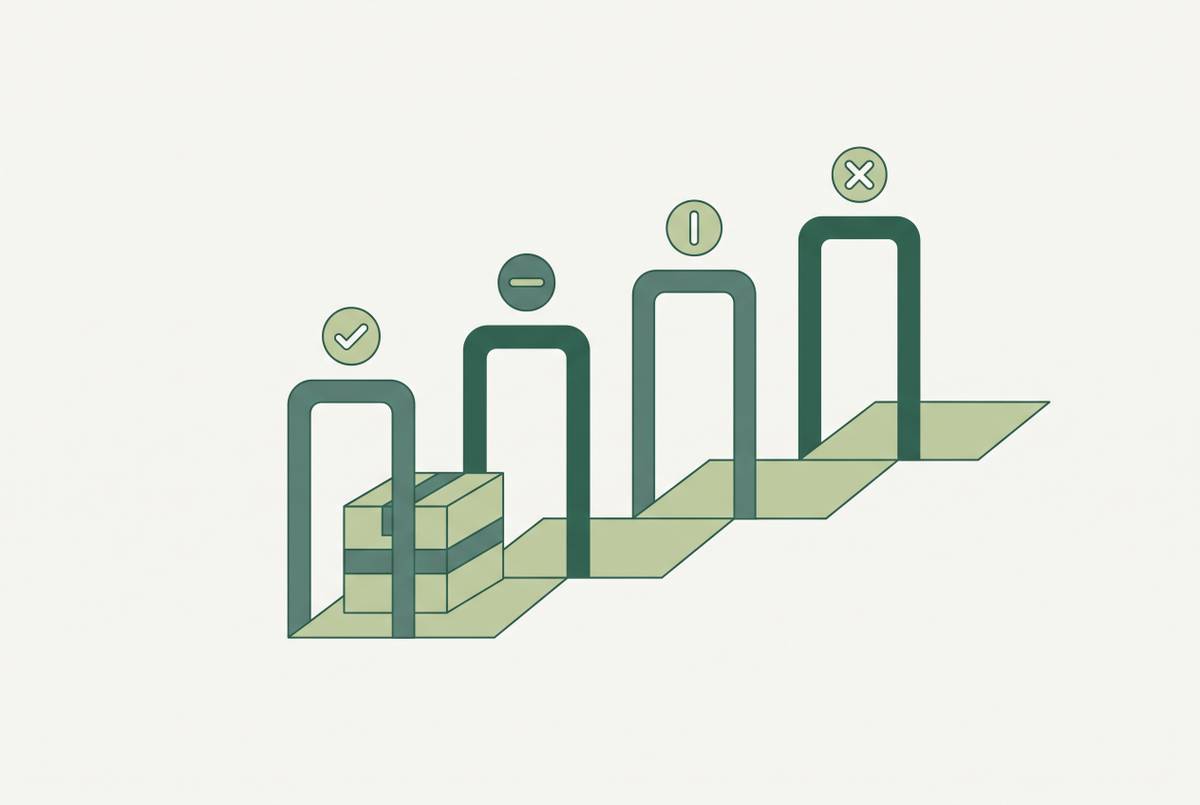
Digital Applied's June 2026 framework sorts every AI action into one of four tiers. Each tier is based on how reversible the action is and how much damage a mistake could do. Read-only actions sit at the bottom. Nothing changes, so you need minimal oversight. One step up are reversible actions — changes you can undo — where occasional human spot-checks are enough. Above that sit actions that cross into another system or organization. Those need tighter review. At the top sit high-risk or permanent actions: pushing code to production, moving money, deleting data, changing permissions, or sending a message on the organization's behalf. Those require a person to approve, no matter what confidence score the AI reports.
That last point deserves to be stated plainly. High confidence does not give an AI the right to take a permanent action without supervision. The tier determines the oversight required. The score does not override the tier, ever.
A calibration detail matters here. Mature financial-services deployments can run human-review rates as low as 2 to 5%. New deployments should start higher, around 10 to 15%. Only tune that number down after a period of real human feedback The Neural Base. Keeping "which tier is this action?" separate from "what did the model claim?" is the first design decision any escalation system has to make. It has to happen before anyone discusses specific numbers.
Add human behavior signals and real consequences to the confidence reading
Confidence alone, even sorted by consequence tier, still misses signals that live outside the AI's own output. Dr. Dave Heath's analysis names three inputs that belong in any escalation rule. The first is the AI's calibrated confidence score. The second is behavioral signals from the human team: how long they take to respond, how often they edit or override the AI, and patterns of hesitation. The third is the actual business cost of a wrong call in that specific workflow.
In practice, that means a graduated band rather than a single cutoff line. Auto-approve above a calibrated 95% confidence The Neural Base. Route the middle band to human review within a set time window. Escalate or block with an appeals option below the floor. Those thresholds should be backed by actual operations data, not accuracy claims from a vendor's marketing sheet The Neural Base.
There are really two separate tests to run. First: can the AI actually find a correct answer here (the grounding check)? Second: should it answer at all, given what is at stake? Running them as one test produces both false confidence and unnecessary escalations. A clarifying-question step between the two checks recovers answers that a single blunt cutoff would have sent to a human for no good reason.
Other triggers deserve attention even when the confidence score looks fine. Watch for signs of customer frustration. Apply policy rules that say certain topics always go to a person. And if a customer simply asks to speak with a human, let them. There is also a quieter risk: systems that look more reliable on the surface make their human reviewers less alert over time. Tracking behavioral signals catches that growing complacency before it causes harm.
Make the handoff useful for the person receiving it
An escalation firing correctly is only half the job. Teams most often skip checking whether the person on the receiving end has enough context to do anything useful with it.
A reviewer needs the original input that triggered the workflow. They need the AI's recommendation and the evidence behind it. They need the specific reason for escalation — whether that is a confidence band, a policy rule, a value threshold, or some other exception. And they need real choices: approve, edit, reject, or reroute. Each option should be clearly visible, not hidden behind a single vague button labeled "approve."
Approval design carries its own quiet risks. An approval must be tied to the exact action it was granted for. It must be protected against reuse, so an approval for one dollar amount or one recipient cannot be applied to a different one. Waiting in real time for a person to click something collides badly with real infrastructure: gateway timeouts, expired session tokens, state that goes stale while someone is in a meeting. A design that records the approval and resumes the workflow when the person responds — without losing state or corrupting data — is the pattern that actually survives production traffic.
Escalation is a designed property of the system, built in from the start for when the AI fails. The checkpoint has to be able to pause, wait, and resume without corrupting anything in between. Context matters as much as mechanics. A reviewer who sees a flagged transaction next to prior decisions, application history, and support context can make a real judgment call. A reviewer who sees a bare data field just rubber-stamps whatever is in front of them.
Name who owns the exception, who can audit it, and who is accountable if the override goes wrong
A workflow can be fast, well-built, and still fail completely if nobody can say afterward who approved what. Exception ownership has to be a named requirement in the design. You cannot assume it gets sorted out later.
There is one question every deployment needs answered before it goes live: if a person overrides the AI's recommendation and that override causes a problem, who owns the outcome? Not "the team." Not "the system." A specific person, or a defined role, with the authority and the accountability attached to it.
Every escalated decision needs an audit record. That record should carry the original input, the AI's recommendation, the specific reason for escalation, the human action taken, and — when the reviewer overrode the recommendation — the reasoning behind that call. Decision records that link evidence, recommendations, human reasoning, approvals, actions, and measured outcomes (including failed or inconclusive ones) build the institutional memory that makes overrides teachable rather than invisible.
Identity tracking is where most organizations quietly fail. When an AI system accesses regulated data under a shared account, there is no record of which individual actually directed that access. HIPAA's unique user identification rule, GDPR's accountability principle, and SOX's audit trail requirements all demand individual attribution. Shared-account logging simply cannot provide that.
The cost of getting this wrong is not theoretical. FINRA fined UBS Financial Services $1.1 million over automated trade confirmations that produced systematically incorrect regulatory disclosures. The violation was not that the AI performed badly in some abstract sense. The violation was the gap between what the system claimed to do and what its own logs could actually prove happened. That is the exact failure mode this section is warning against. Regulatory rules require keeping at least 366 days of operational logs and 7 years of audit records for systems covered by SOX, 6 years for HIPAA, and at least 6 months for high-risk AI systems under EU AI Act Article 12, which was originally scheduled to take full effect for high-risk systems on August 2, 2026, but was extended by the AI Omnibus (in force July 27, 2026) to December 2, 2027 for Annex III high-risk systems.
Build real pause and stop controls, not just a checkbox
There is a wide gap between organizations deploying AI agents and organizations actually governing them. A survey of 750 senior technology leaders across the UK and USA, conducted in April 2026, found that only 19.7% of organizations say all their agents are fully secured and governed before going live Gravitee State of AI Agent Security. That leaves the large majority pushing agents into production faster than the controls around them can keep up.
Pause and stop controls sound basic. Yet a 2025 AI Agent Index study found four agents out of thirty — Alibaba MobileAgent, HubSpot Breeze, IBM watsonx, and n8n — lack documented stop options despite running on their own. Twenty of the thirty had documented mechanisms. That is the majority, but it still means a meaningful share of live agents have no clean way to be halted mid-task.
Enterprise platforms often make this worse with a coarseness problem. Many only let you stop every agent at once or pull an entire deployment. There is no fine-grained way to revoke a single task's access. Better practice gives each agent the minimum permissions it needs, scoped narrowly to the task at hand. Those permissions should be removed automatically the moment the task finishes. Access decisions should be made at the moment of action, not fixed once at setup.
Regulation is catching up to this gap. The Senate's AI AGENT Act of 2026 defines agents as needing to operate in a transparent, documented, scope-limited, and revocable way. It would require large platforms to support revocation when consent is withdrawn or an agent is linked to repeated harmful activity. Without real revocation infrastructure behind it, a pause button is theater. Read access and write permission need to stay separate too. Recurring jobs should run under the permissions and policies that exist right now, not whatever was set up when the workflow was first built.
The oversight structure that makes escalation paths last
Deployment is outrunning oversight across the industry. That is not a small failure rate for something enterprises are betting real budget on.
A durable escalation path needs a governance body behind it. The structure that holds up in practice is cross-functional. Product, legal, security, risk, and data operations sit together with actual power to block deployments — not an advisory role that gets overruled whenever a launch date is tight. Below that group, accountability splits by function. Data governance committees own policy on what the AI is allowed to use and what error rates are acceptable. AI and engineering teams own how the agent behaves, what rules it follows, and how it is tested. Security and compliance teams handle audit review and incident investigation. Domain teams own data quality and the definitions specific to their area.
Boards themselves are lagging. McKinsey found only about 39% of Fortune 100 boards have explicit AI oversight mechanisms in place — whether that is a dedicated committee, a director with AI expertise, or a governance sub-board. That leaves the majority of the largest companies in the country without a formal structure watching this at the top.
Standards are starting to fill in around this, even if boards have not caught up yet. Forrester published its AEGIS framework for AI enterprise guardrails in 2025. NIST launched its AI Agent Standards Initiative in February 2026. ISO/IEC 42005:2025 covers AI system impact assessments, and ISO/IEC 42006:2025 covers the bodies that audit and certify AI management systems. Taken together, these mark a shift from informal best-practice guidance toward controls that are actually repeatable and auditable. An escalation system needs that kind of foundation to hold up under scrutiny. Enterprises are deploying AI agents faster than they are building oversight structures: 51% of enterprises have AI agents in production, yet 40% of those projects are projected to be canceled by 2027, citing rising costs, unclear value, and weak risk controls, per a research brief.
The cost of not being able to prove your oversight works, and how tracking real outcomes closes the gap
Not being able to prove your oversight works is not just a compliance headache. It is a business problem with a price tag. Grant Thornton's 2026 AI Impact Survey, covering 950 C-suite and senior business leaders, found 78% lack strong confidence they could pass an independent AI governance audit within 90 days. And 46% point to governance or compliance barriers as a leading cause of AI underperformance or outright failure.
Most organizations are not reckless about this, to their credit. Only 5% allow agents to execute high-stakes decisions with no human review at all, and 60% cap agents at moderate-risk tasks. The checkpoints mostly exist. For most organizations, though, those checkpoints exist without the underlying structure that would let anyone defend them under audit.
Closing that gap pays off in a way that is hard to argue with. Organizations with fully integrated AI are nearly four times more likely to report revenue growth than those still stuck in pilot mode — 58% versus 15% — according to Grant Thornton's 2026 findings. That gap tracks closely with governance maturity, not just technical capability.
Overrides that go unrecorded and unanalyzed just recreate the same error problem the escalation system was built to catch. Human review of high-stakes decisions, low-confidence predictions, and a sample of auto-approved cases pulled to check for drift all need to feed back into recalibration. Without that, the loop never closes. Keep estimates separate from observed results. Keep time saved separate from cash actually saved. And remember that escalation rate by itself measures adoption, not value.
The organizations that can show how their AI reaches a decision, who is accountable for the outcome, and what happens the moment something goes wrong are the ones positioned to scale with confidence. Escalation design, seen this way, is core infrastructure the system depends on — beyond any compliance checklist. It is the infrastructure that makes the gap between piloting and scaling actually measurable, and actually closeable.
Sources
- 2026 AI Impact Survey Report | Grant Thornton
- Designing AI escalation thresholds on confidence, not hope
- State of AI Agent Security Report 2026 | Gravitee
- The 2025 AI Agent Index: Documenting Technical and Safety Features of Deployed Agentic AI Systems
- AI Confidence Thresholds: When to Escalate to a Human
- Lesson 4.5 — Confidence Thresholds & Escalation Logic | AI Training | raia
- The Confidence Dichotomy: Analyzing and Mitigating Miscalibration in Tool-Use Agents
- Defining Escalation Criteria That Actually Work in Human-AI Teams - TianPan.co