How to Find a Process Problem, Fix It With AI and Measure the Result
AI can fix the cross-team process problems that cost companies money silently.
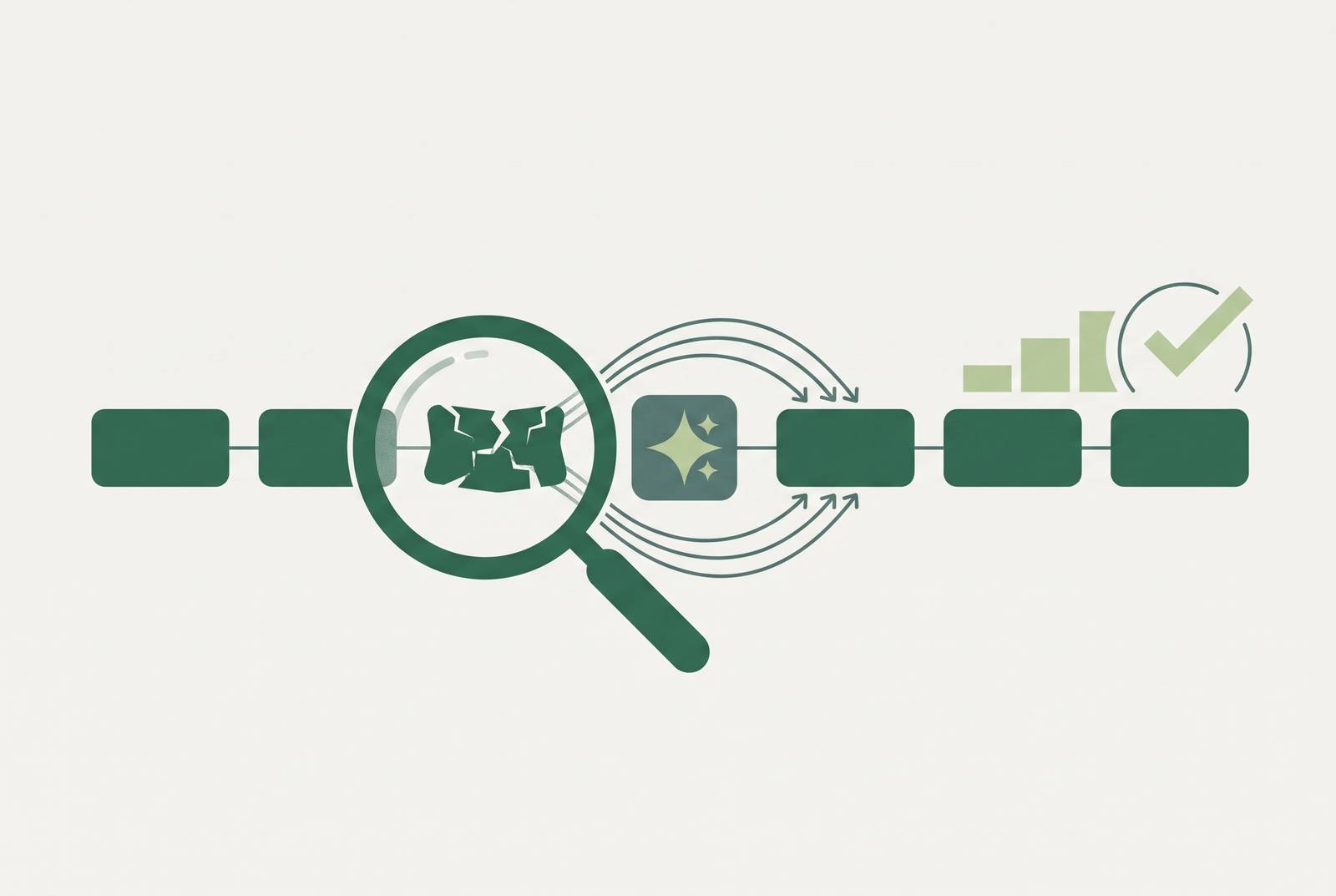
Agentic workflow automation for enterprise pays back when it connects three jobs, which are finding a costly process failure, fixing its cause, and proving the financial result. The best fit depends on the workflow, existing systems, and governance requirements. This article explains how to make that choice and turn an AI deployment into savings a finance leader can defend.
Why process problems stay hidden until they cost real money
Purchasing sees a cheaper supplier, while support and engineering see the cleanup cost of switching. Each team has part of the answer. Neither sees whether the lower price outweighs the extra work, so a local saving can hide a wider loss.
Renewal risk follows the same pattern. Sales sees a contract date, while support sees that usage is falling and the same complaint keeps coming back. The warning becomes visible only when those signals are combined in the same view. Yet teams report upward through their own systems, so identifying the problem requires a view across them.
Manual work makes these gaps more expensive. Paper approvals, repeated data entry, and siloed spreadsheets demand administrative effort because no system connects them. Unauthorized AI usage leaves a similar blind spot when its costs are outside official budgets. These failures stay hidden because the view is incomplete.
How to find a process problem worth fixing
A useful diagnostic starts with evidence of how work happens, rather than interviews or guesses about how it should happen. Process mining reconstructs actual flows from event logs in live business systems. It exposes delays, duplicate steps, and cost leaks that self-reporting misses. The audit then moves through four phases, namely process mapping, measurement and data analysis, root cause analysis, and roadmap development. Each phase supplies evidence for the next.
Process mapping establishes the route work takes, including the points where it crosses between teams and systems. Look for recurring stalls, different outcomes from the same task, and workflows that break when one person is unavailable. Value analysis helps tell which steps serve the customer and which only add costs inside the business.
Measurement then adds the time and cost of the work to the map. Separate processing time, waiting time, and total cycle time, because waiting usually contains the largest cost. A task can require little hands-on work yet spend a long time stalled between approvals. Extend the analysis beyond the workflow where needed to include labor utilization, equipment performance, supplier quality, and financial data.
Root cause analysis asks why the delay or inconsistency keeps recurring. The 5 Whys or fishbone diagrams can trace a symptom back to its structural cause. A slow invoice approval may look like a people problem until time analysis reveals duplicate data entry that sends the invoice back to the start. Faster approval would miss the cause entirely.
Roadmap development turns that finding into a clear plan for a fix. The plan must name the specific step, the cost it creates, its owner, and the measure that will show improvement. Without those details, the proposed fix is still an idea to be tested. With them, the team has enough evidence to judge whether AI is the right fix.
What makes a process problem a good candidate for an AI fix
AI is a strong candidate when the cost comes from repetitive execution, disconnected data, or inconsistent inputs and routing. It is a weaker answer when the work depends on genuine judgment or a relationship. That is the selection test, before any tool comparison. Doing a task often makes it more likely that a fix will pay off because the same improvement helps each time the task repeats.
Invoicing, accounts payable, data entry, HR onboarding, IT support tickets, procurement, contract review, and compliance reporting all contain this kind of work. But a workflow’s name does not justify automating everything inside it. Some tasks need preparation followed by a human decision. In those cases, AI can prepare the brief while a person approves the next step.
Gaps between systems are another good fit because AI can keep track of the context across records that people would otherwise look at one by one. Where inconsistent outcomes stem from inconsistent inputs or routing, automation can make those steps consistent. It cannot make a faulty rule correct. If the diagnosis is wrong, automating the process embeds that error into every transaction.
Complexity alone is therefore not a reason to reject AI. Assess whether that complexity comes from real judgment requirements or from stitching together data that should already be connected. Those are different problems with different answers. A confirmed data gap supports an automation case, while a judgment requirement points toward human approval.
The fix: how AI actually addresses each category of process waste
AI tackles process waste in three ways, through repetitive execution, cross-system leakage detection, and governance of AI spend itself. These solve different problems and require different evidence of success. A faster back-office task does not prove that procurement leakage has fallen. Likewise, finding an overpayment does not establish that the agent used to find it is economical to run.
Back-office execution is the most direct starting point. Finance, HR, payroll, data entry, and compliance account for a large share of operating costs at most mid-size organizations. UiPath, Automation Anywhere, and Microsoft Power Automate address high-volume processes in environments with substantial legacy systems. The choice depends on the existing system landscape and governance requirements.
Salesforce reported $100 million in annualized support savings and reduced support headcount after using AI to resolve tickets that previously required human agents. The result had initially been described as a substantial year-over-year reduction in support costs. For a separate deployment, however, the useful comparison is cost per AI-handled and human-handled resolution within comparable intent categories.
Invoices above contract, duplicate payments, maverick buying, and renewals above market can sit across purchasing and finance records. Coupa and SAP Ariba benchmark and describe spending patterns across large transaction volumes. Coupa is the stronger fit for broad, ERP-agnostic spend management, while Ariba is stronger for SAP-centric enterprises because of native S/4HANA integration and supplier-network reach. Gartner named both Leaders in its 2026 Source-to-Pay Magic Quadrant.
Coupa and Celonis announced an integration on May 13, 2026 that adds process intelligence inside the Coupa platform. Its stated aims include automating procurement workflows, eliminating maverick buying, accelerating touchless invoicing, and optimizing working capital. Broader business leakage still requires broader evidence. An AI system that connects records from finance, sales, support, and operations can reveal a renewal warning that a contract record or a pattern of complaints would miss on its own.
AI spend itself needs its own controls. Agentic workflows can trigger many LLM calls per user task, so their costs do not scale like traditional software costs. TrueFoundry describes a scenario in its 2026 guide in which three teams connect one agent to a frontier model through separate API keys. There is no token usage tagging, per-team budget, or model routing policy. By the second month, the CFO is asking why the bill grew by an order of magnitude.
AI FinOps applies cost governance to inference API spend, fine-tuning compute, vector storage, observability, and human-in-the-loop review. A standard line on a cloud invoice does not show all those costs. Quarterly audits of API keys, third-party integrations, and developer tools can also surface unauthorized usage outside official budgets. Across all three categories, teams need to agree on the problem and how to measure success before work on the deployment begins.
How to measure whether the fix actually worked
Every AI initiative should begin with a one-page value thesis naming the financial outcome it targets. That outcome may be cost reduction, revenue protection, or risk mitigation. Be specific before spending starts. A vague promise to improve efficiency leaves too much room to redefine success after the deployment.
Agree in writing on the goal, the fee, the savings calculation, the measurement owner, and the time period. For cost reduction, the calculation is (Baseline Costs − Current Costs) / Baseline Costs, expressed as a percentage. The starting number must be agreed before the result is known. The CFO should be able to reproduce the calculation from company records and reach the number promised at the start.
Costs must include more than the software bill. Count AI tool spend, human review time, correction cycles, and monitoring overhead. A reduction in one team’s workload is not a net saving if equivalent expense appears elsewhere. Keep cash savings that have been confirmed separate from time saved and the value expected in the future. Each can be useful, but they are not interchangeable.
A past result provides a concrete example. Sample data from a large insurance carrier showed large net savings in hiring in a past quarter, which the customer’s CFO confirmed using the customer’s own definition of savings. Time to hire fell by more than two-thirds. The evidence is limited to past sample data.
The decision also needs more than a before-and-after comparison. Compare acting now, waiting, gathering more evidence, and changing nothing, because each option has a cost. That prevents the analysis from treating delay as free. It also makes room for further diagnosis when the evidence does not yet support implementation.
Logins, agent counts, activations, and adoption rates show that a tool is running. They do not establish that it pays back. Tasks processed, time saved, and tickets deflected must connect to outcomes such as cash saved, revenue protected, or lower cost per unit. Once those outcomes are confirmed, the evidence becomes input for the next diagnostic.
Treating find, fix, and measure as one connected sequence, not three separate projects
The three stages depend on one another for their value. Diagnosis supplies the cause a fix must address, while measurement tests how well the fix addressed it. Separating them breaks that chain of evidence. A diagnostic can become an unused report, and a deployment can leave finance unable to justify funding the next one.
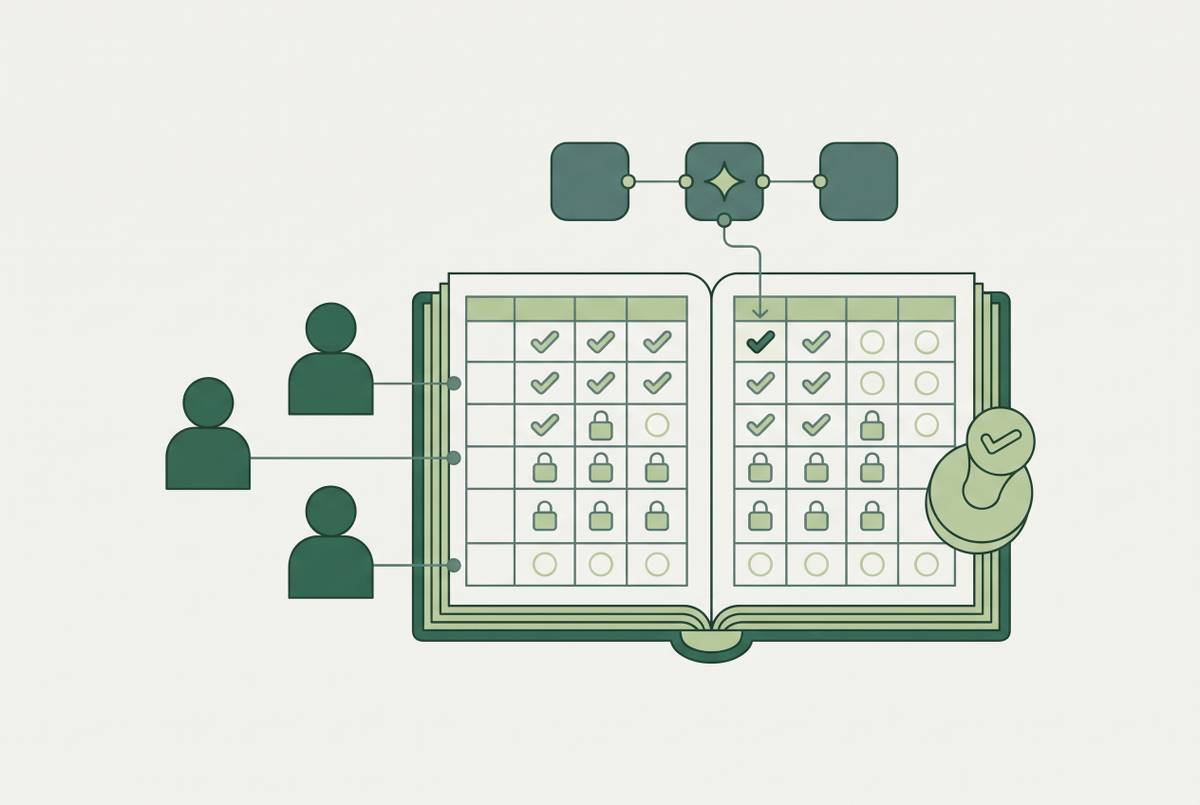
A system needs to look across connected data before changing anything so that the diagnostic leaves the process being studied as it is. Read permission and change permission should be kept separate. Every change needs a person’s approval so the fix can be traced and its measurement kept clean.
That control needs a record of the evidence, reasoning, approval, action, and result, including failed attempts. The record preserves what the organization learned about which signals predicted the problem, which fix worked, and what exceptions looked like. Failure belongs in that history too. Leaving it out would discard evidence the next decision needs.
The goal is a repeatable capability. With a baseline already set and a measurement method already agreed, the next opportunity can be assessed faster and more precisely. That is where recoverable savings begin to compound. The enterprise gains not just a repaired workflow, but a disciplined way to find and prove the next repair.