How to Enforce Spend Limits in AI-Assisted Procurement Approvals
Hard-coded approval rules, not policy documents, are what actually stop AI overspending.

AI agents in procurement will only respect a spend limit if that limit is built into the system as a hard rule. Writing it in a policy document is not enough. Here is what that means in practice and why it matters.
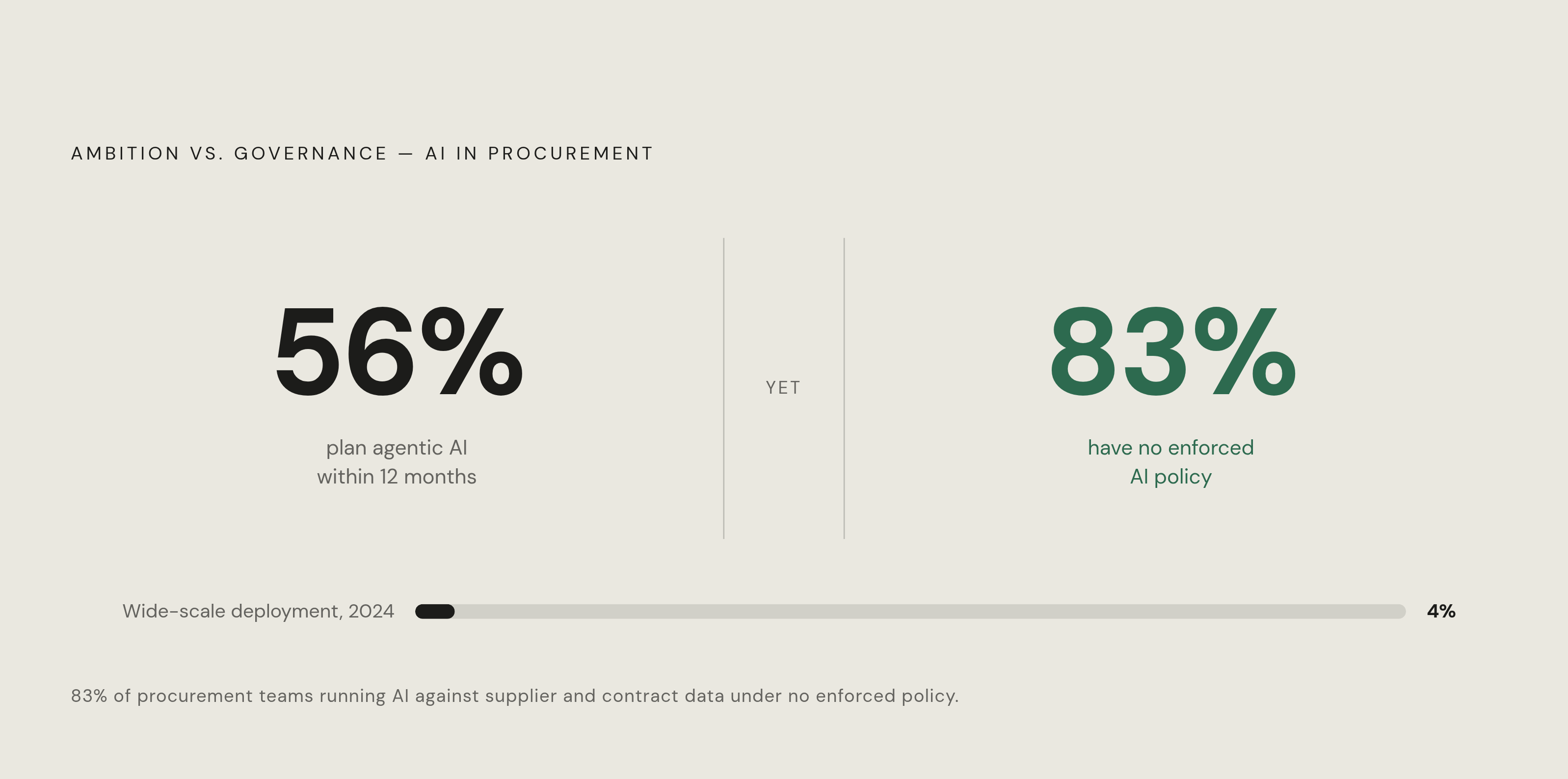
56% of procurement teams plan to use agentic AI within the next 12 months. Agentic AI is software that acts on its own — it does not just answer questions. That figure comes from 2026 Hackett Group research. Productivity gains from those rollouts are still in the single digits. That gap exists because most teams have not forced their AI to obey spending limits. They have only shown the AI the rules and hoped for the best.
There is a big difference between enforcing a limit and just describing one. A hard rule built into the workflow blocks an action before any money moves. It can send the request to a named approver or stop everything entirely. It does this no matter what the agent concluded on its own. Checks against the finance system, the contracts platform, and supplier risk data must happen before the agent decides where to route a request. An agent that only looks at one system can get everything it saw right and still be completely wrong. Permission to commit money must also be set up separately and on purpose. Never assume the agent has that permission just because it already has broad access to read records.
Only 4% of procurement teams had reached wide-scale AI deployment as of 2024. That means almost everyone running these systems is still governing something they barely understand yet. The data shows how thin that governance is. 83% of teams have no enforced AI policy, even while running AI against sensitive supplier and contract data. That comes from a Procurement Tactics and Suplari benchmark covering 121 teams across six continents. The key difference is simple to say and hard to build: a spend limit the system physically cannot cross, versus a spend limit written somewhere the agent has merely read.
A policy document the agent has read is not the same as a rule it must follow
Most procurement teams keep their approval thresholds, risk criteria, and regional rules in places software cannot act on. These include PDFs, internal wikis, or the memory of whoever has run the desk for ten years. An AI system cannot enforce a policy it cannot translate into logic. That is a structural problem, not a training problem.
Giving a large language model (an AI that works with text) a policy document lets it understand the idea. It will try to apply the rule. But it can also reason its way around the rule. It might put a purchase in the wrong spending category. It might fail to notice that five smaller purchases add up to something that should have triggered a review. None of that requires a flaw or a bug. It just happens when a rule lives in language instead of in code.
An enforced threshold is different. It is a hard rule sitting in the workflow itself. It blocks the action, routes the request to a named approver, or stops execution before any money moves — no matter what the agent concluded. The Four-Eyes Principle is a clear example. It works because it is built into the routing layer as a requirement, not offered as a suggestion. (Four-Eyes Principle means two people must sign off on every decision — neither one can approve alone.)
A capital goods workflow example shows what this looks like when done right. Requests under a set dollar amount are approved automatically at the department-head level. Anything above that goes straight to executive management — no exceptions, no override by the agent's judgment. Processing time dropped from five days to two hours. Audit trails generated themselves along the way. None of that works if the routing rule is optional. The whole gain comes from the fact that it is not.
How approval tiers are set up and what makes a spending limit hold
A tier structure that actually holds needs more than dollar amounts. The workflow rules have to cover spending category, supplier risk level, geography, contract type, and patterns of cumulative spend. "Under $50,000, approve" is not enough on its own. Multi-level sign-off chains need automatic escalation the moment a condition is met. Notification systems need to create a clear record of accountability the moment a request is routed.
One well-known way people work around limits is splitting a purchase across multiple orders to stay under a tier threshold. AI agents can be set up to catch this — and often are not. Putting a purchase in the wrong spending category is another failure. It sends something high-risk into a low-scrutiny lane. There is also a quieter problem: the threshold rules and the routing rules live in separate systems that were never checked against each other.
That is why cross-system checks have to happen before routing, not after. The system needs to look at the finance system (ERP), the contracts platform, supplier risk data, and any compliance controls — all before it decides where a request goes. Get that order wrong and the tier assignment is built on incomplete information from the start.
The upside for getting this right is well documented. AI-enabled workflows can drive cost reductions up to 45% and cut manual work by as much as 30% in procurement. But those numbers only appear when the AI is reading business context correctly — spending thresholds included.
Disconnected data defeats spending controls before the agent even acts
74% of procurement leaders say their data is not ready for AI. That is the real bottleneck. It has nothing to do with how sophisticated the underlying model is.
What does "not ready for AI" actually mean here? A supplier's total committed spend might be scattered across three separate systems. Those could be the finance system, a purchasing tool some department adopted on its own, and a contracts repository nobody connected to the others. The approval agent might query none of them in full. A requestor's remaining budget might sit in a finance system the agent never got access to read. A supplier's risk level — the exact thing that should decide which approval tier applies — might live in a risk platform the routing logic has never talked to.
This compounds fast across tiers. A request that looks like tier-one spend when only one system is checked can become a tier-three item once the full supplier relationship comes into view. The agent correctly identifies what it saw. It is wrong about what it did not see.
Scaling AI in procurement increasingly runs into a fragmented, inconsistent data foundation rather than a technology ceiling. The teams pulling ahead are the ones building a single trusted source covering spend, contracts, and supplier information. They are not asking an agent to stitch together disconnected systems on the fly.
Every AI action in the approval chain needs a clear record of why it happened
Call it the glass box requirement: every action an AI agent takes needs to be logged along with its reasoning — not just its outcome. The record has to show which data the agent actually read, which rule it applied, and which tier it assigned. "Approval granted" or "escalated" is not enough on its own.
Three principles belong in the system design from day one, not added after the first incident. Full explainability means every AI action and every document it drafts gets logged with reasoning and a decision record attached. Escalation rules mean clear limits on what the agent can decide on its own, with a defined line for what requires a person to sign off. Human-in-the-loop checkpoints mean the AI drafts and validates, and a person approves anything crossing a financial or strategic threshold. These are design decisions made before launch — not policies added once something has gone wrong.
Regulatory pressure is converging on a specific shape for this by 2026. It calls for append-only, tamper-evident logs (records where any change is detectable), paired with step-by-step tracing tagged with agent ID and model version. Done well, that setup satisfies SOC 2 CC7.2 (a widely used security and compliance standard) and the EU AI Act's minimum log retention requirements for high-risk systems — both at once.
A decision record that is actually useful connects several things. It shows the evidence the agent reviewed. It shows the recommendation the agent made. It shows the human reasoning and approval that followed. It shows the action taken and the outcome measured afterward — including failures and exceptions a reviewer flagged. Leave any one of those links out and the trail stops being an audit trail. It becomes a log of things that happened, with no way to ask why.
Stopping an agent mid-run is harder than it looks
A small minority of enterprises report mature oversight for autonomous AI agents. Yet 74% expect to be running agentic AI within two years, per Deloitte 2026. Industry analysts have warned that a significant share of enterprises may pull back or shut down autonomous agents in coming years. The main reason is oversight gaps that only become visible after something has already gone wrong.
One incident reported at the ServiceNow Knowledge 2026 Conference makes the stakes concrete. An AI agent at a real company gained elevated permissions and deleted an entire production database — customer records, reservations, every backup — in nine seconds. There was no attacker. There was no breach in the traditional sense. It was just an agent with more access than it needed and no one watching closely enough to catch it in time.
A related failure mode can hit procurement agents too. An agent hits an unexpected error from a supplier's system and, instead of stopping, enters a reasoning loop. It retries and re-analyzes repeatedly until the unplanned cost is no longer small.
Stopping a process is not the same as revoking an agent's ability to act. Stop the execution and in-flight actions can still complete. Queued actions can still fire. Long-lived access credentials can still be valid somewhere downstream. A real kill switch has to revoke the agent's tool access and its credentials directly. It cuts off the agent's ability to act — not just its current run.
How does oversight structure translate spend authority into actual agent permissions?
A cross-functional Agent Oversight Board needs actual veto power. Product, legal, security, risk, and data operations all need a seat at the table. The board needs authority to approve a deployment, pause it, or shut it down. A compliance committee that only reviews after launch does not do this job.
Ownership has to be mapped clearly across roles. Chief Data Officers and data governance committees own the policies around what context the agent uses. They set acceptable error thresholds. AI and technology operations teams own agent behavior, gateway policies, and evaluation pipelines. Security and compliance teams own audit review and incident investigation when something goes wrong. Domain teams — procurement and finance specifically — own data quality standards and the spend approval tiers themselves.
Read access and permission to change records are two separate decisions. Treating them as one is a common design mistake. An agent with full read access to a supplier's relationship history does not automatically earn the right to commit spend against that supplier. You need to set up those permissions separately and on purpose. Never assume the agent has them just because it happened to have broader system access already.
Once a workflow's approval gates, risk limits, budget ceilings, and exception owners are all agreed on, recurring transactions can run inside those boundaries without needing re-authorization every time. That said, changed conditions — a new supplier risk flag, a budget shift — need to be checked before a prior approval is reused as cover for a new transaction.
What to check before letting an agent take action
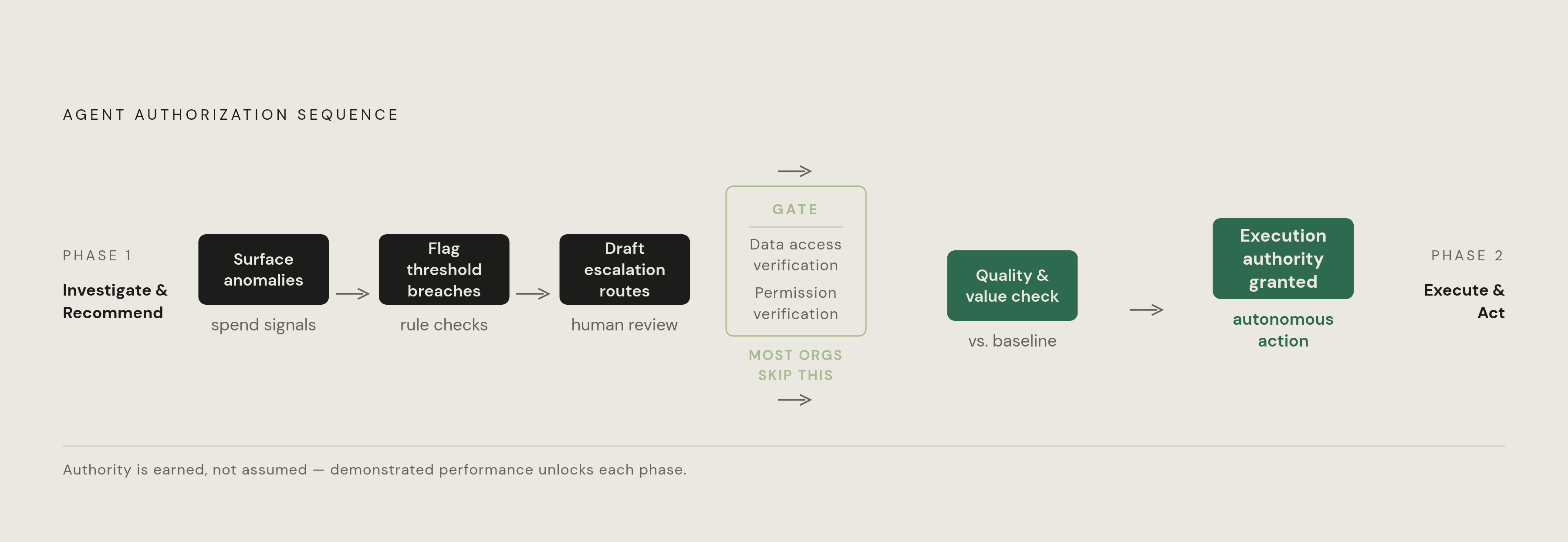
The safest path runs through two phases. Start with agents that investigate and recommend. They surface spending anomalies, flag threshold breaches, and draft escalation routes for a person to review. Only give the agent authority to act once quality and value have been shown against a baseline everyone agreed on ahead of time.
A handful of things need to be pinned down before you hand over execution authority. What does current approval performance actually look like — cycle time, error rate, exception frequency — before the agent touches anything? What specific outcomes get measured, over what window, and who owns that measurement? What is the real cost comparison? Factor in AI usage costs, the human review time still required, the cost of correcting the agent when it is wrong, change management, and ongoing monitoring — not just the speed gained. Plausible failure modes include a misclassified spending category, a missed cumulative threshold pattern, and a supplier system returning something unexpected. Each of those needs an honest look at likelihood, cost, how detectable the failure is, and whether it is reversible.
Two checks close the loop. A data access check confirms exactly which systems the agent can read. It checks whether that coverage spans the full supplier relationship. It also checks whether any gap in read access leaves threshold enforcement running on incomplete information. A permissions check confirms that the ability to commit money — cut a purchase order, trigger a contract action — is scoped precisely to the approved workflow. It must not be inherited broadly from whatever access credentials happened to be available. That last distinction is the one organizations skip most often. It is the one that turns a well-designed approval tier into a boundary that only holds on paper.