What SOX Section 404 Requires for AI Approval Gates
Auditors will test your AI controls like any other, so build them to hold.
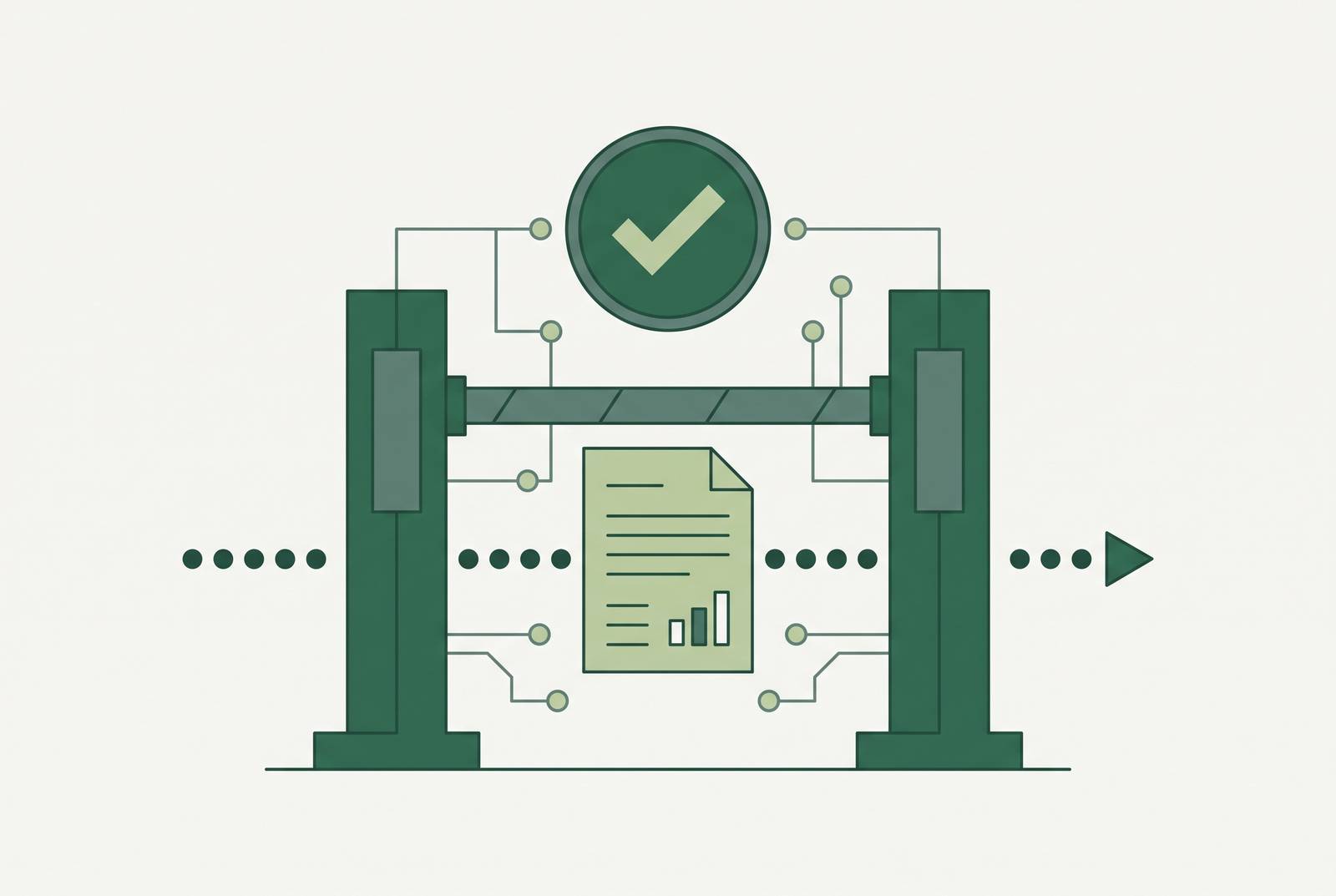
If your company uses AI to help prepare financial reports, the same rules that govern human controls apply — no exceptions. This post explains exactly what a human approval step must include to pass an audit when AI is involved.
How SOX Section 404 applies to AI in financial reporting
Section 404(a) of the Sarbanes-Oxley Act requires management to review and report on financial reporting controls every year. Section 404(b) requires an outside auditor to independently verify that review. That auditor process is governed by PCAOB AS 2201 for larger public companies. Neither section mentions AI. Neither carves AI out.
The frameworks companies use to meet that standard predate AI. The 2013 COSO Internal Control Framework and SEC Release 33-8810 are still the main references. The SEC's Financial Reporting Manual was updated June 29, 2026, but the changes were only administrative. It added no new guidance on AI in financial reporting. No regulator has issued AI-specific guidance to fill that gap.
Auditors are tightening their approach anyway. The PCAOB's QC 1000 quality control standard is a new rule. It requires audit firms to manage technology risk at the firm level. It takes effect December 15, 2026. The first full audit cycles under it land in calendar year 2027. That means auditors going into 2027 engagements must look more closely at AI-assisted controls than they did before.
The law has not changed. What has changed is where companies can fail. There are new categories of risk, new evidence requirements, and new testing rules. A traditional SOX program was never built to handle them. KPMG's December 2025 ICFR Handbook says good financial reporting controls are the tool you need to manage the risks that complex systems, AI, and automation bring. The legal bar has not moved. The ground beneath it has.
AI is already running in your financial reporting — often without a deliberate decision to let it
Most companies find, mid-assessment, that AI is already running inside their accounting software, automation platforms, and analytics tools. Nobody formally approved those tools as financial controls. That discovery — not the technology itself — is usually the first real problem. AI already runs material steps in the financial close. That includes reconciliation, journal entry review, and writing variance explanations. A sweep of your environment typically turns up four types of exposure: AI built into accounting systems, standalone analytics platforms, automation tools with machine-learning parts, and generative AI used to draft documents.
The sharpest risk is structural. AI models built for reconciliation often act as both preparer and checker at the same time. The model processes a transaction, classifies it, and clears it on its own if it falls below a set threshold. A person reviewing a flagged exception is not doing the same job as a person reviewing every transaction the exception was pulled from. When the model auto-clears everything below the threshold, no person ever sees those cleared transactions. That is the default design of most AI-assisted reconciliation tools on the market. The classic control requirement is that one person prepares and another approves. When AI auto-clears, there is no human on one side of the transaction.
A data problem feeds that risk and rarely gets called a compliance issue. Sales, accounting, and banking systems mean AI controls often act on inputs that were never fully checked before the model touched them. Bad input is not just a quality problem here. A control must prove that its input data was complete and accurate before the AI acted on it. Unreliable inputs break the control itself, not just the output it produces.
Vendor updates add more exposure. Software vendors push model updates on their own schedule. A change that arrives one day can break a control that was working the day before — without anyone noticing. Checking controls only at one point in time is how most legacy SOX programs still work. That approach leaves blind spots that can last weeks or months. By 2026, regulators and auditors no longer accept point-in-time control checks. They want ongoing proof that financial data is accurate across every system and process.
Labeling each AI tool correctly is the most important decision in the whole program
The single most important decision in an AI-assisted SOX program is how you label each tool. That label sets the testing scope, the testing frequency, and the documentation burden under COSO (the internal control framework most companies use). Get the label wrong and every downstream decision inherits that error.
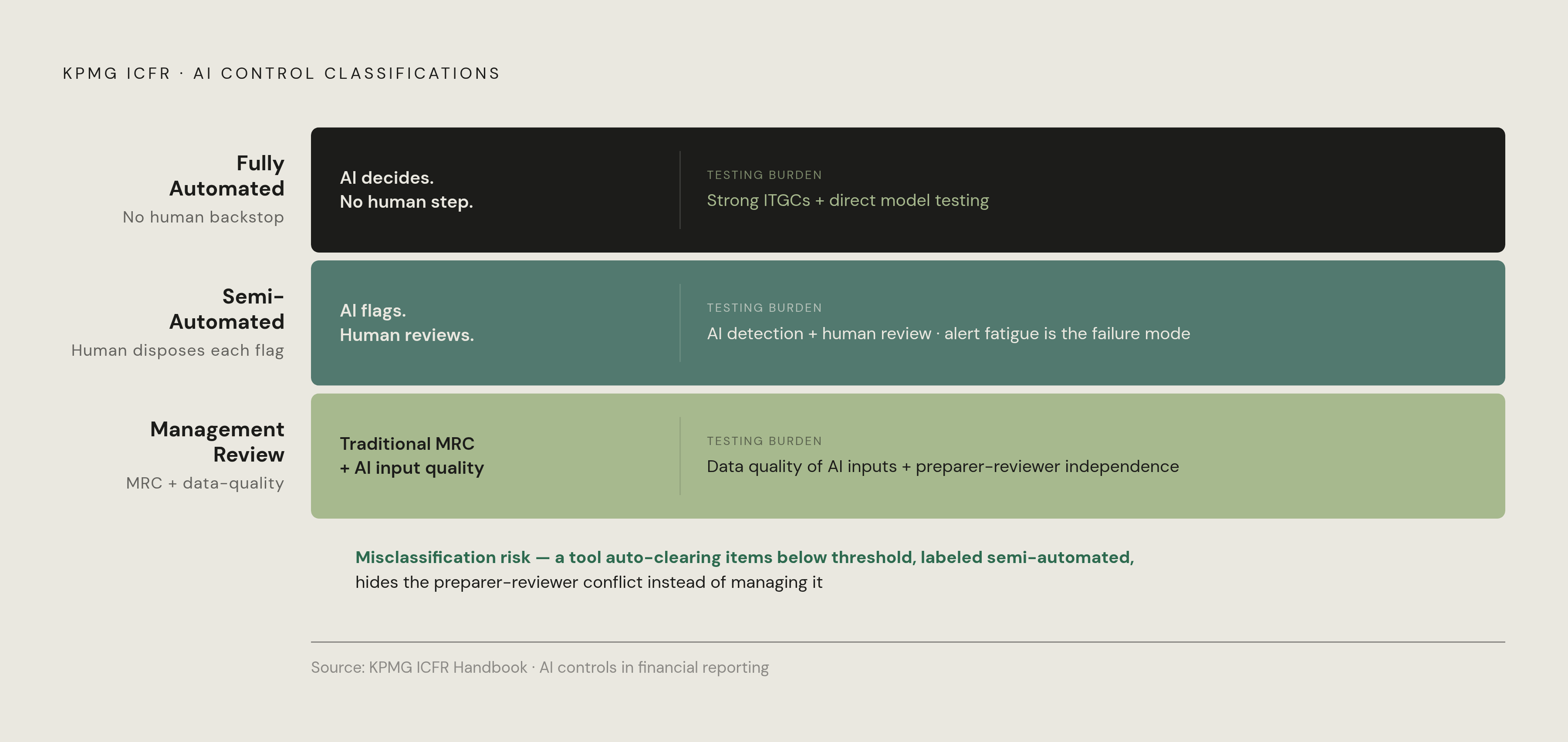
KPMG's ICFR Handbook sets out three categories. You need to map each one against every AI tool that touches financial reporting.
A fully automated control is one where the AI makes the control decision with no human in the loop. This carries the highest testing burden. The IT systems supporting it must be strong. The model itself must be tested directly. There is no human backstop if it fails.
A semi-automated control is one where the AI flags exceptions and a human decides what to do with each one. Both layers need separate testing: the AI's detection logic and the human's review behavior. The underappreciated risk here is fatigue. A reviewer who sees hundreds of flagged items a day starts approving them without really looking. An auditor testing this control will look for evidence that the reviewer genuinely engaged with each flag. A pattern of instant, uniform approvals suggests nobody actually looked.
The third category is a management review control. It works like a traditional management review with one addition: the data the AI is analyzing must be verified as accurate before the model touches it.
This is exactly where the preparer-checker conflict from the previous section gets addressed — or doesn't. A tool labeled fully automated with no human backstop is an open acknowledgment that the model is both preparer and checker. The testing plan must account for that. A tool mislabeled as semi-automated when it is actually auto-clearing transactions below a threshold hides that conflict instead of managing it.
The label is not a one-time decision. Grant Thornton's governance approach requires a tool inventory, a risk assessment, and an approval step before any tool goes into use. That inventory must record the vendor name, model version, deployment date, last update date, and the specific control purpose the tool serves. Every vendor update means a fresh look at the label. Each tool also needs a risk tier. High means it is a key control. Medium means it is a supporting control. Low means it is an efficiency tool not relied on for financial reporting. That tier drives how deeply auditors will sample and how thorough the vendor's service-organization audit report (a SOC 1 Type II) needs to be. Boards are asking more AI governance questions in a SOX context now. The inventory must be something management can hand over and explain.
What a human approval step must actually contain
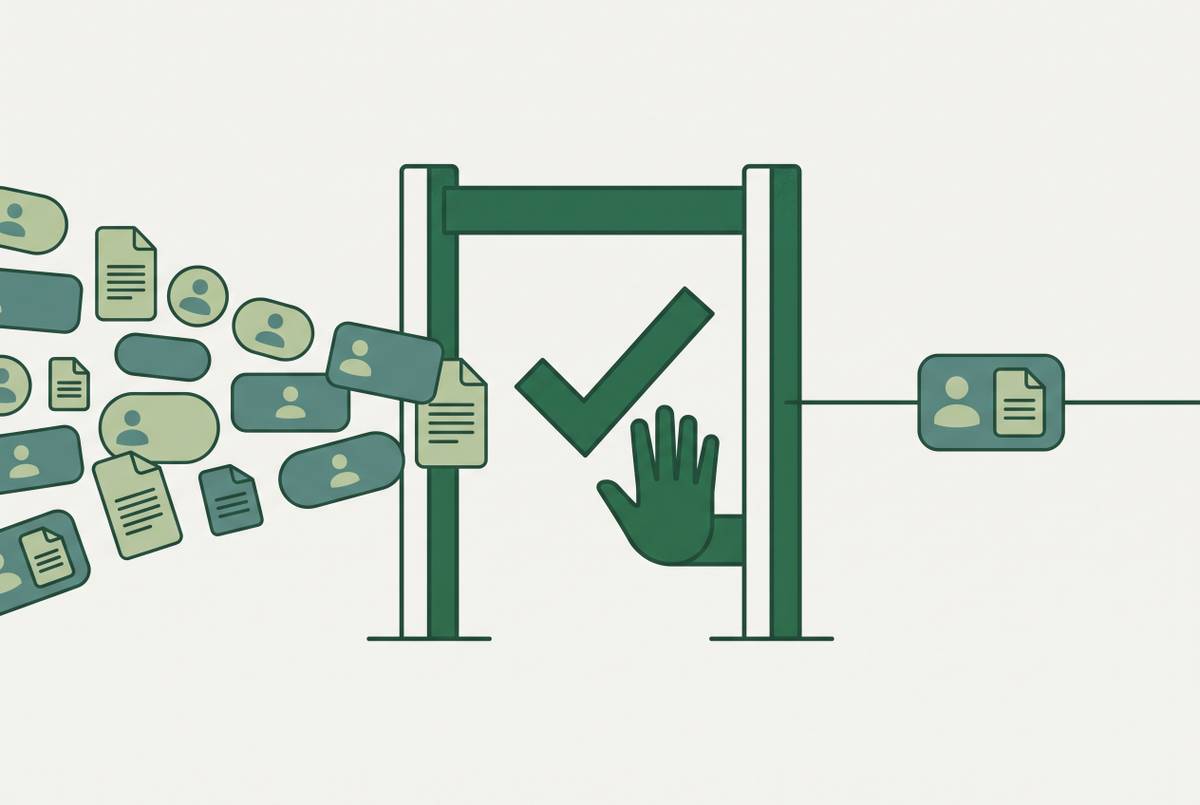
A person sitting in the workflow is not the same thing as an approval gate. The gate requires documented authorization, a traceable decision record, and a named owner for exceptions. Auditors will test for evidence that a person actually engaged with the decision — not just clicked past it.
Grant Thornton's 2026 analysis sets out three design requirements for human oversight of AI controls. Auditors will ask for evidence of all three:
- Human-approved control logic: documented criteria for when the AI can clear a transaction on its own versus when it must route to a person for review, approved by management before the tool goes into use.
- Transparent explanations: a record of the reasoning behind each AI decision, detailed enough that an auditor can independently check whether the control actually worked as designed.
For transactions the AI clears on its own, auditors expect a documented, management-approved policy. That policy must state the risk score threshold, the reasoning behind that number, and the date it was approved. It must also include proof the threshold is reviewed and confirmed at least once a year.
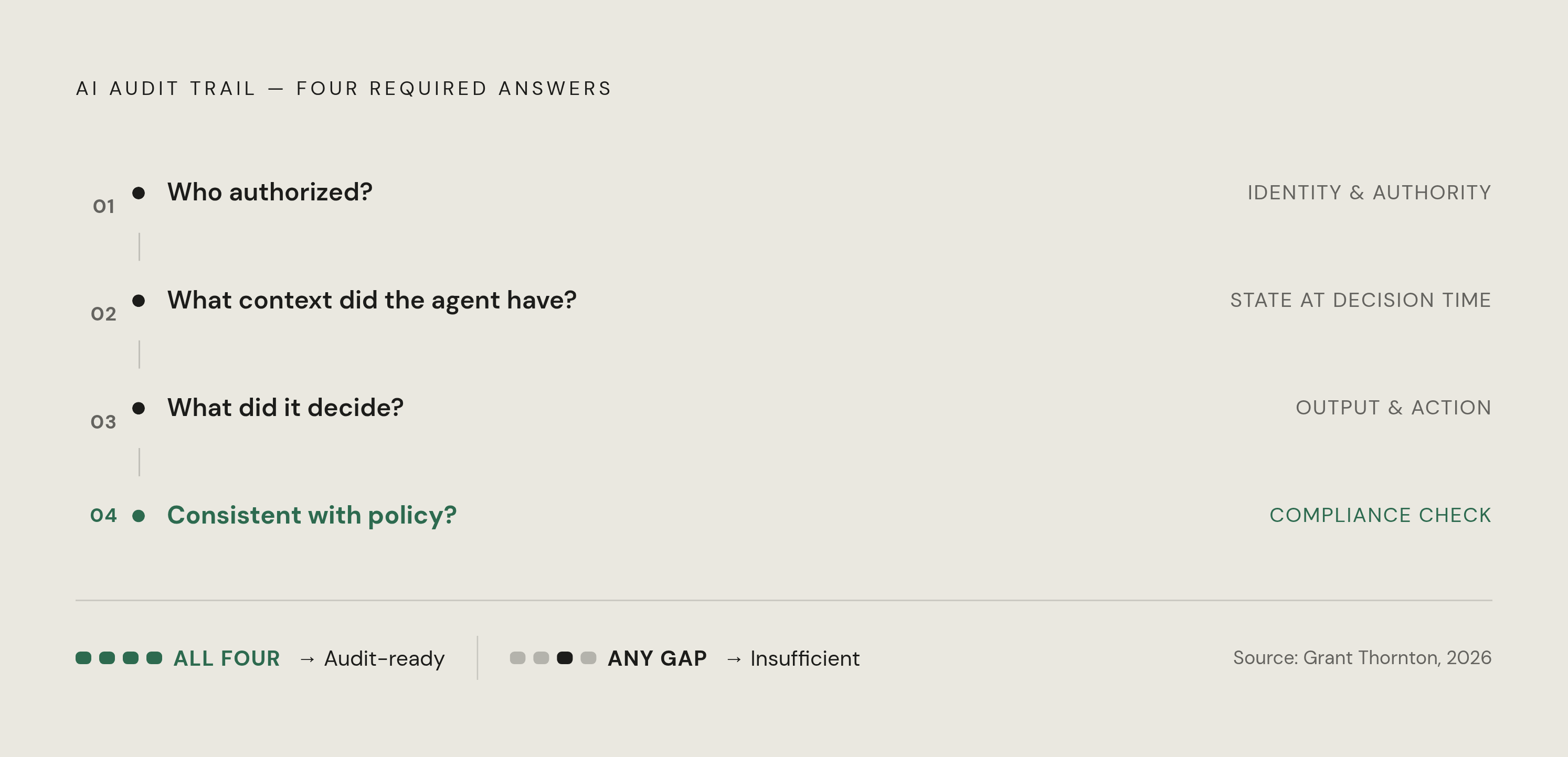
Any audit trail for an AI action must answer four questions: Who authorized the action? What information did the AI have at the time? What did it decide? Was that decision consistent with policy? If your records cannot answer all four, you are not audit-ready — no matter how sophisticated the underlying model is.
The threshold policy and its annual confirmation matter so much because of reversibility. A set of transactions that the AI cleared on its own — and that no person ever reviewed — cannot be reconstructed later for audit purposes. A delayed human review is costly and inconvenient, but you can recover from it. That difference — recoverable delay versus unrecoverable gap — should determine where the approval step sits in the workflow. Administrative convenience should not.
Named people must stand behind all of this. AI tools need to be treated the way you treat an employee: supervised, tested, and reviewed for performance. Control ownership must be assigned to specific people, not left with the AI system itself. Whoever staffs that gate also needs enough understanding to evaluate what the AI actually decided. A reviewer who cannot assess the AI's output is not running a control — just approving a black box. The documentation requirements under SOX 404 already apply to manual adjustments and journal entries. They cover who changed something, when, and why. Those same requirements apply with equal force to anything an AI system generates. AI-generated actions are not exempt from these documentation requirements.
Access controls and separation of duties for AI agents on financial systems
Once an AI agent can post journal entries, change vendor records, or approve transactions on its own, it needs an identity — a login credential. That credential needs the same controls a human employee's login gets. Most organizations have not built that parity yet.
For any identity, human or otherwise, auditors test four specific things. First, granting access requires a documented business reason and a recorded approval. Second, access is restricted so that one identity cannot both prepare and approve the same transaction. Any exceptions need documented compensating controls. Third, access is reviewed regularly, with evidence of genuine engagement rather than a click-through. Fourth, access is removed when it is no longer needed, with timestamps proving the removal happened within a reasonable window. An AI agent's credential must satisfy all four — the same way a person's login does.
The gap auditors usually find is not a missing policy. The actual access state quietly drifts away from what the documented policy says between review cycles. The audit is what reveals it. For an AI agent, the same drift happens when a vendor pushes a model update. The agent's effective behavior shifts without triggering a corresponding access review. The five IT general control areas built around identity — granting access, removing access, periodic review, privileged access, and separation of duties — all apply to AI agents now. The 2026 audit cycle expects evidence of all five for agents, not only for people.
The practical test for 2026 is whether you can produce access reports on demand. That way the audit is a snapshot, not a scramble to reconstruct what the access state actually was. Read access and permission to change records must stay separate. An agent that reads financial records to produce an analysis is a different permission from one that can post journal entries. Mixing them recreates the same fraud risk as a human who both prepares and approves the same transaction.
The governance gap here is wide. A survey of 750 executives found that, as of April 2026, only a small minority of organizations had a named person accountable for an AI agent's behavior. Roughly a third had a documented process to pause or revoke an agent's access. Roughly a third had any plan for how an agent would handle sensitive data. That leaves most organizations deploying AI agents in financial workflows without the governance structure a SOX auditor will ask them to produce.
Tracking model versions and monitoring for behavior changes as ongoing controls
Everything in the approval gate and the access control structure rests on one assumption: the model you govern today is the model that gets audited tomorrow. That assumption breaks the moment a vendor pushes an update. Version tracking is what keeps the assumption true — or shows you the moment it stopped being true.
A tool inventory that records vendor name, version, deployment date, and last update date serves a real purpose. It is the only way you can say, with evidence, which version of a tool was running on the date a given control operated. It also shows whether that version matches what the risk-and-control documentation describes. When a vendor updates a model, the label you assigned to that tool needs a fresh look. Do not assume that fully automated stays fully automated or that semi-automated stays semi-automated. The same update that improves a model's accuracy can quietly change which transactions it clears on its own. When that happens, the auto-clear threshold policy needs review right away — not at the next scheduled annual check.
Monitoring for behavior changes is the ongoing version of that same discipline. Checking controls only at one point in time already fails to catch a control that breaks between assessment dates. That failure gets worse when the thing you are testing is a model that can change behavior without anyone touching a line of code. The access drift auditors find between review cycles has a direct match in model drift. A model's effective behavior shifts after a vendor update the same way an account's effective permissions shift after an unreviewed access change. In both cases, the gap goes undetected until an audit forces the comparison.
None of this works as a one-time setup. Model tracking, version control, and behavior monitoring only work as a standing control when you tie them back into the same structure described throughout this post. That means a labeled inventory revisited on every update, an approval gate that reconfirms its thresholds on a fixed schedule, and an access structure that reviews an agent's permissions every time its underlying model changes. When those three pieces move together, the audit becomes a reading of a system that was already keeping its own record.