How to Set Up Human Approval Gates for AI HR Decisions
Match review depth to each decision's risk, and keep records to prove it.
Most companies use the same review step for every AI tool in HR. It does not matter if the tool is low-risk or high-risk. That is the core problem. This post explains how to fix it. The fix is simple: match the depth of human review to the actual risk of each decision.
Lawmakers in Colorado, Connecticut, Illinois, and New York have spent 2026 writing new rules. These rules treat AI-driven hiring and employment decisions as their own legal category. That is not just another HR technology question. It matters because AI tools in HR have changed faster than the review habits built around them. A few years ago, AI in HR mostly gave advice. It ranked resumes, drafted job posts, and flagged performance trends for a manager to look at. Now it acts on its own. It can update employee records, move candidates through a hiring pipeline, and send messages to applicants. No person has to touch the keyboard in between. The risk changed. The review process, in most companies, did not.
The real failure showing up in audits and lawsuits is not that review is missing. It is that every decision gets the same review, even when the decisions are very different. A tool that summarizes a posted leave policy goes through the same checkpoint as an agent that updates an employee's record or rejects a job candidate. One checkpoint applied evenly across wildly different stakes is too broad for low-risk cases. It is also too thin for the ones that carry legal exposure. Title VII's rules against unequal treatment are still fully enforceable by private plaintiffs, even as federal priorities shift. The EU AI Act's penalties reach €35 million or 7% of global turnover for the most serious violations. A single checkpoint cannot absorb that range of consequence.
What a tiered review system means in plain terms
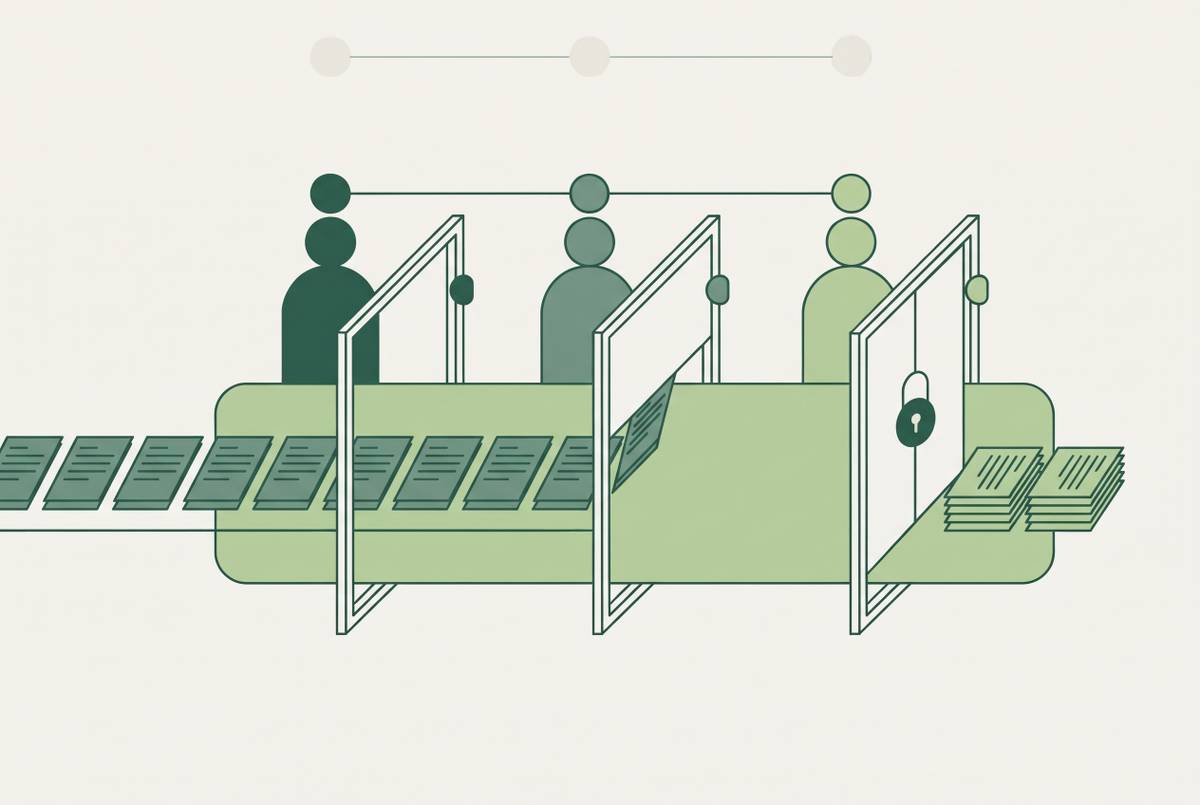
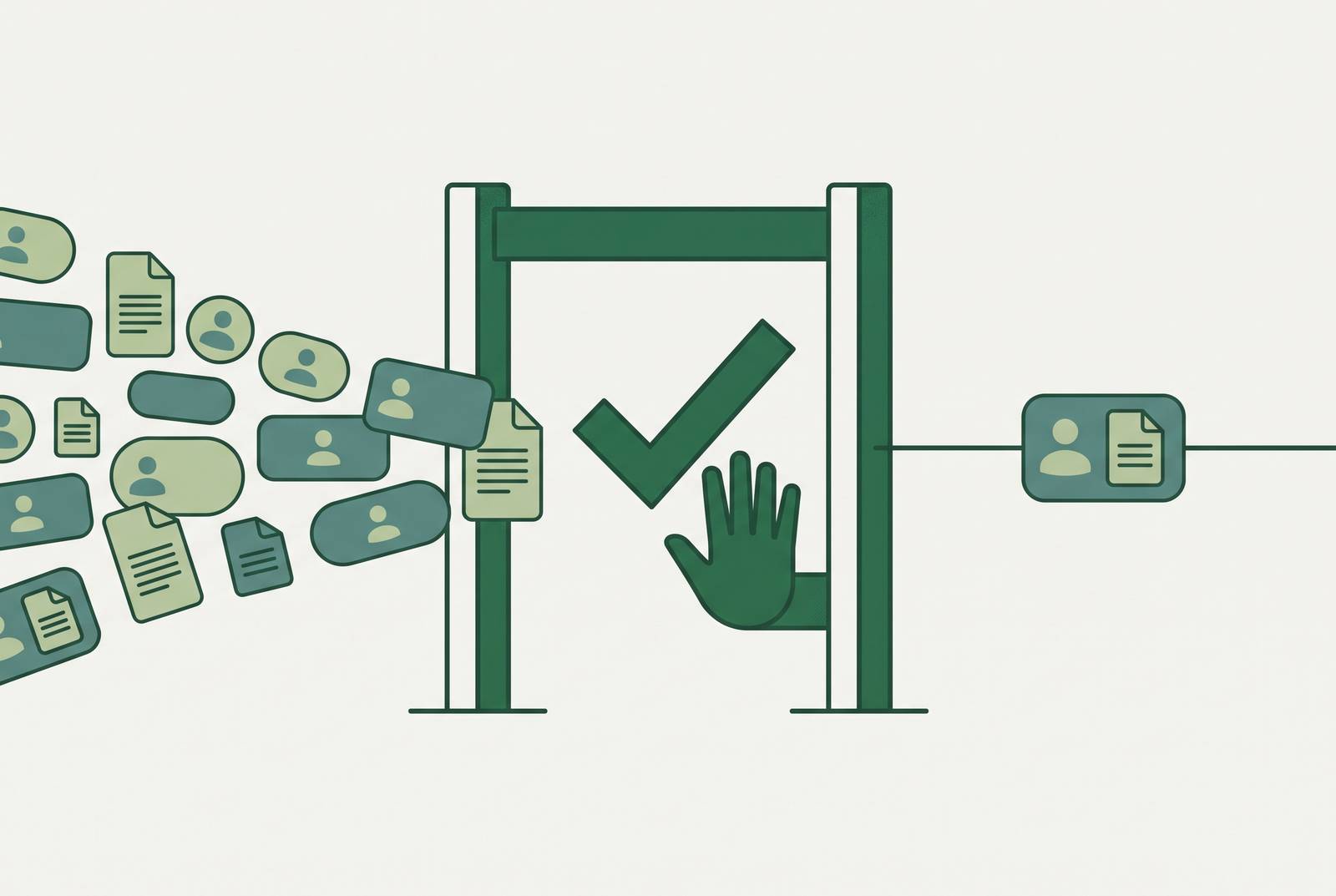
A human approval gate is a checkpoint. A qualified person reviews an AI-generated recommendation at this checkpoint. They sign off before something irreversible or high-stakes happens. The point is real control over the outcome. It is not just a person's name attached to a form.
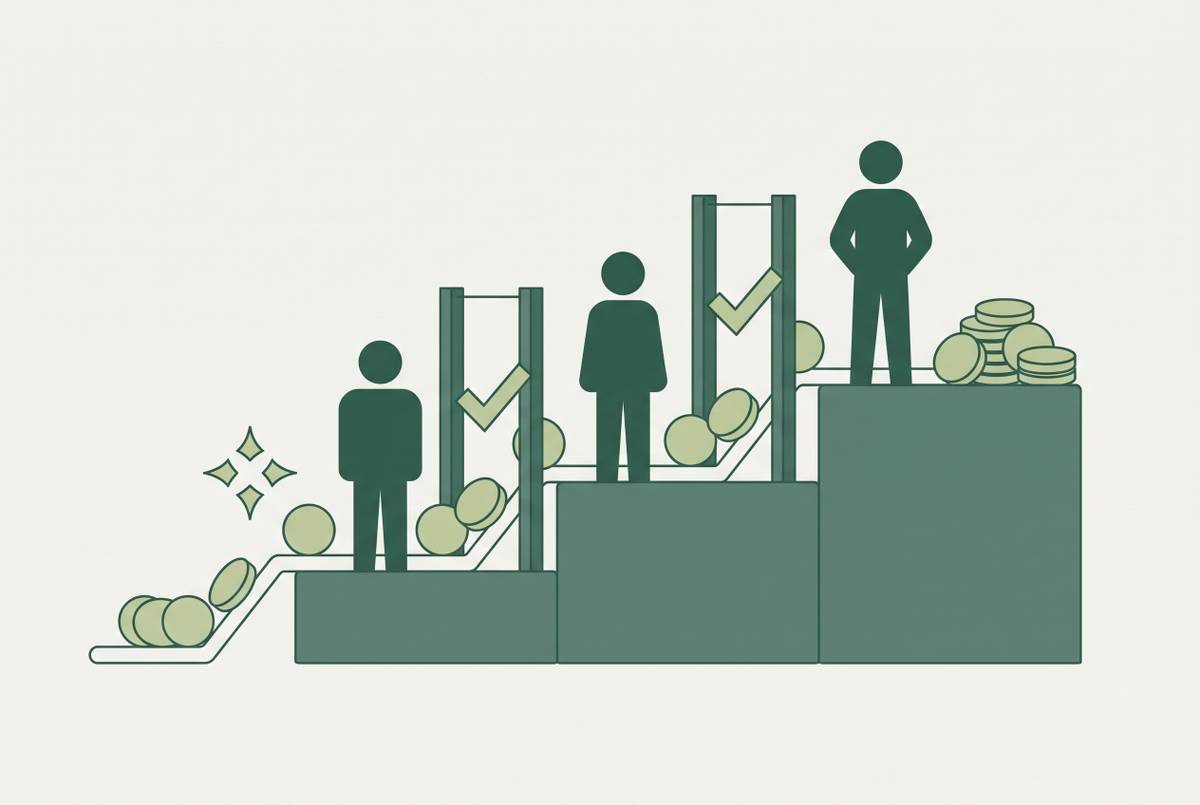
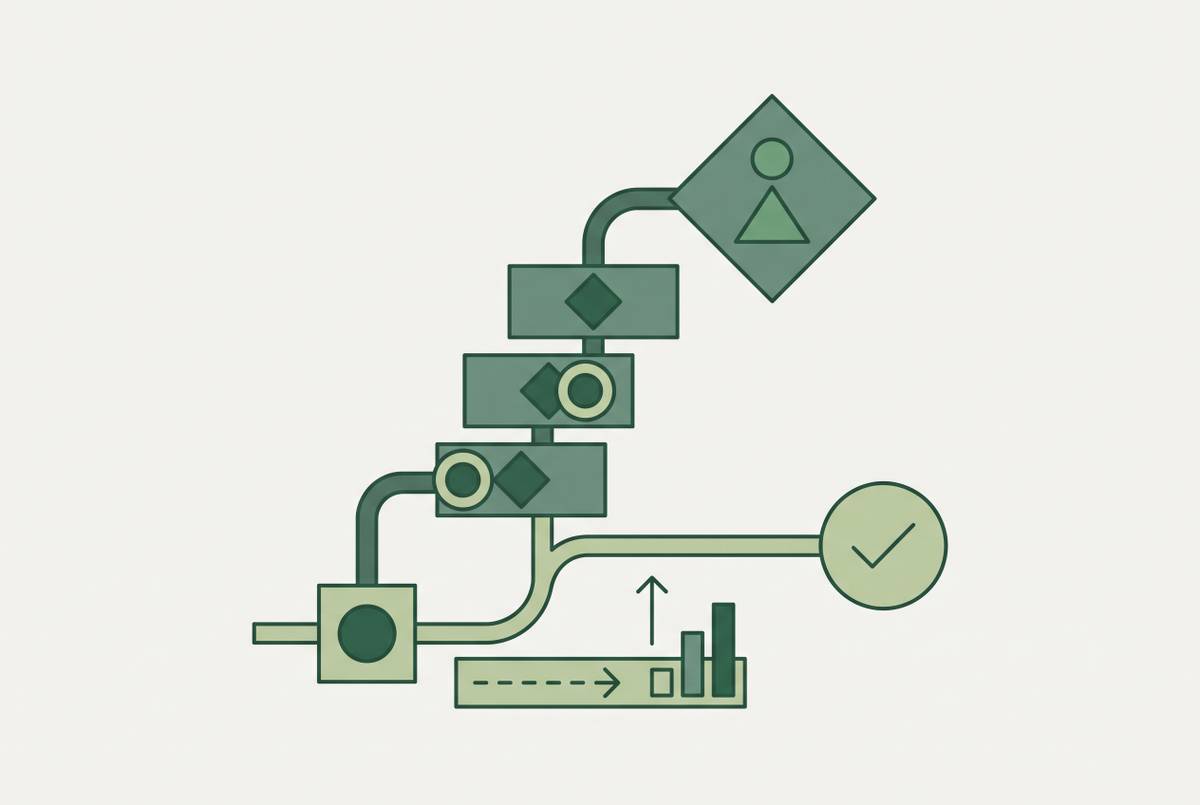
Tiering means adjusting how deep the review is, who does it, and who handles exceptions. You base those choices on two things. First, how much is at stake — how the decision affects the person involved, whether it can be undone, and what legal exposure it carries. Second, what the AI is actually doing — offering a read-only suggestion versus carrying out a change on its own. The AI Governance Institute's HOC-002 control is a published standard built around exactly this problem. It states a practical consequence: without defined risk levels, companies end up escalating everything or escalating nothing. Both outcomes defeat the purpose of having a checkpoint at all.
Low-stakes uses of AI can move through a light, asynchronous review — perhaps just a weekly spot-check. Examples include summarizing a policy document or drafting a job posting a recruiter will edit anyway. High-stakes uses need a human to approve the action before it runs. Examples include turning down a candidate, flagging an employee for a performance action, or triggering a remediation process tied to a licensing requirement. That distinction is not optional for agentic systems — meaning AI that can carry out multi-step tasks on its own. Asynchronous approval (reviewing after the fact) on a multi-step agentic pipeline creates a real timing problem. The AI can move to step two before a human has signed off on step one. By the time the review comes back, the action it was supposed to gate has already happened.
How to decide which risk level a decision belongs in
Sorting a decision into the right tier is not about picking the scariest factor and stopping there. You need to look at several things at once. How reversible is the decision? How much does it affect a specific person? What legal category does it fall under? How confident does the AI say it is in its own output?
Reversibility carries the most weight. A draft message sitting unsent can be corrected in minutes with no lasting harm. A ranked shortlist that has not reached a hiring manager yet can also be fixed quickly. But an action that sets off a chain of events across connected systems is different. Think of payroll adjustments, record updates, and automated messages to candidates all firing at once. You cannot pull those back the same way. Those two situations should never sit in the same review tier.
Legal category sets a floor that efficiency arguments cannot move. Where a high-risk classification under employment-AI regulation applies, the review tier stays high. The same is true where anti-discrimination and background-screening law govern a decision. It stays high no matter how much friction that adds. The Helios HR compliance checklist treats bias testing, transparency, and a candidate's right to appeal as fixed requirements. They are not settings you can dial down to move faster.
AI confidence scores play a role, but only as one input among several. Never let them be the deciding factor on their own. A high-confidence recommendation that turns out to be wrong is more dangerous than a low-confidence one. The low-confidence flag at least invites a second look. Confidence thresholds work when they sit alongside reversibility and legal category. They do not work when they replace those factors.
How much a decision affects someone's livelihood is the dimension the EU AI Act names directly. It is the reason employment AI counts as high-risk. Hiring, promotion, termination, task assignment, and performance monitoring all fall into this bucket. Any decision that touches someone's job or income should default to the higher review tier. You need a specific, written reason to do otherwise. That default should be hard to override. Whoever overrides it should have to put their reasoning in writing.
What records a working checkpoint needs to leave behind
A checkpoint that leaves no record of its own work is just a policy statement nobody can verify. Regulators and auditors treat that gap as a real finding, not a technicality.
The AI Governance Institute's HOC-002 control sets out what the evidence actually looks like. First, document the approval process itself. Write down what triggers a review, which types of decisions get checked, and how long reviewers have to respond. That turnaround window is called a review SLA (a committed response time). Second, keep audit logs covering a sample period. For every reviewed decision, the log should show who looked at it, when, what they decided (approved, modified, or rejected), and a brief reason why. Third, produce a report showing actual review turnaround times measured against the committed window. Fourth, produce a report breaking down how often reviewers changed or rejected the AI's recommendation. Break it down by reviewer, team, and use case over a set period.
None of this is paperwork for its own sake. Version-control logs covering the AI system's setup and the data used to validate it matter because the record has to cover the tool's entire life. It cannot just cover the moment a human clicked approve. When a reviewer overrides an AI recommendation, the reason has to be written down. That can be a short code or a free-text note. That decision record is proof that a human actually engaged with the decision. A reviewer who caught a real problem leaves a different trail than one who never looked. Without that trail, you cannot tell them apart.
Why a checkpoint where nobody ever says no is not really working
A reviewer who approves every AI recommendation without applying their own judgment is still technically part of the process. But the oversight that process is supposed to provide has disappeared. That arrangement is worse than having no checkpoint at all. It creates the appearance of human control while giving a company legal cover for outcomes nobody actually evaluated.
The EU AI Act names this problem directly. Article 14(4)(b) requires that people assigned to oversee a high-risk AI system be in a position to notice when they are over-relying on that system's output. The regulation treats over-reliance on automation as a failure built into how humans interact with automated systems. It is something to design around, not a character flaw a training session can fix. A data protection regulator makes a related point: putting a human somewhere in the AI process does not automatically make a decision meaningfully human-reviewed. It does not by itself count as real oversight.
When a reviewer's override rate stays near zero for a long stretch, reviewers have stopped adding anything the AI did not already produce. The checkpoint has quietly turned into a delay mechanism for automation.
Fixing this takes structural changes, not reminders to pay closer attention. Blinded review is one option. You take a sample of AI outputs and check them against known correct answers. This shows how often a reviewer would actually catch a real error. Another option is to randomly insert cases where the AI's recommendation is deliberately wrong, then check whether reviewers notice. Rotating reviewers across different use cases breaks up the social pressure that builds when the same person approves the same kind of output hundreds of times in a row. Catch-rate auditing tells you something an override rate alone cannot. It shows whether the threshold set for triggering review is calibrated correctly, or whether errors are slipping through a checkpoint that looks fine on paper.
Staffing, turnaround times, and the three numbers that show whether the checkpoint is working
A checkpoint designed well on paper can still fail in practice. It fails if it is understaffed or if reviewers do not have enough time to do the job. Understaffing creates a backlog. Backlog creates pressure to approve without actually reviewing. Staffing levels and turnaround time are part of checkpoint design.
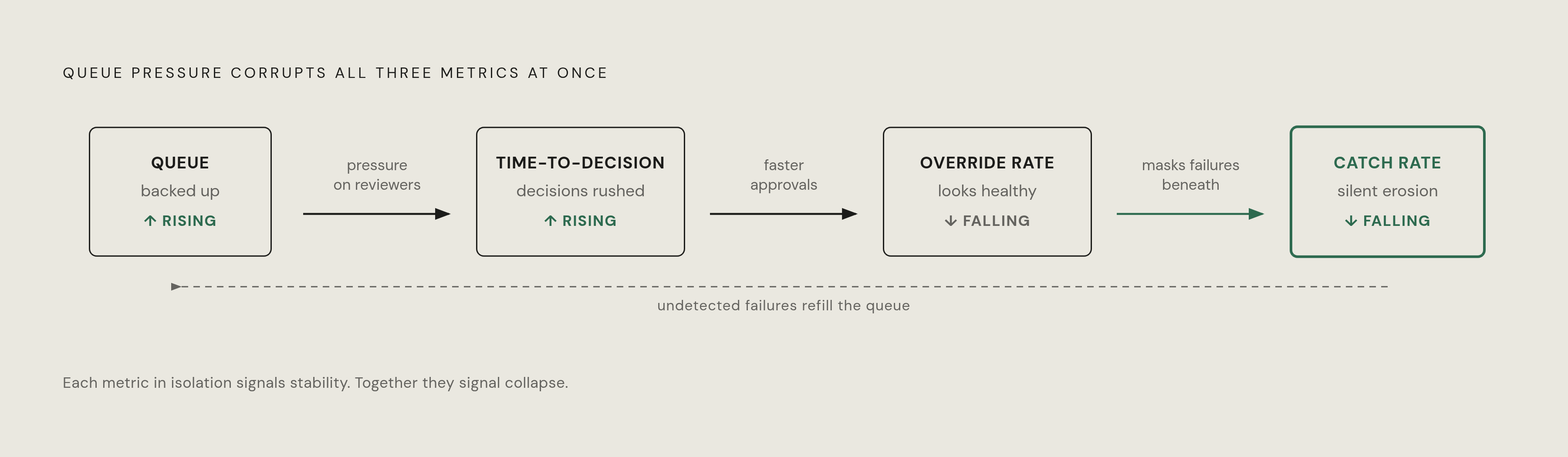
Three numbers show whether a checkpoint is working: override rate, catch rate, and time-to-decision. Override rate shows whether reviewers are contributing judgment. A rate near zero for a long stretch points to rubber-stamping. A rate that is unexpectedly high can mean the AI system is operating outside the range it was validated for. That means you should not trust it at its current confidence level. Catch rate, measured through sampled checks against known correct outcomes, shows whether the trigger threshold is calibrated right. A low catch rate at a high-confidence threshold means real errors are getting through without anyone noticing. Time-to-decision shows whether the review team has the capacity to handle actual volume. This is the number that erodes quietly if nobody watches it. Reviewers working under time pressure are most likely to default to whatever the AI already recommended.
These three numbers work as a system, not as separate dashboards. A backed-up queue drives time-to-decision up. That pushes reviewers toward faster approvals. That drives the override rate down. That can mask a catch-rate problem that has been building the entire time. Reports showing actual turnaround against the committed window belong in front of the governance committee. They should not be buried in an operations dashboard nobody checks. Turnaround time is the earliest warning sign that queue pressure is building. You can see it well before catch rate drops.
Who actually has the authority to stop or change an AI-driven HR action
Reviewing a routine decision and owning an exception are two different jobs. Many companies have only staffed the first one. Exception ownership means knowing who can pause, modify, or reject an AI action when something goes wrong. You need to assign that to a specific person before anything goes wrong. Finding out in the middle of a problem that nobody has the authority — or the technical access — to stop an AI system is itself a governance failure. It is separate from whatever the AI did.
Every HR deployment needs a clear answer to one question: when an AI system touches employees, candidates, or company operations, who can actually stop it, and can that person be reached inside the review window? The Helios HR checklist recommends a cross-functional governance committee. It should be anchored by a sponsor senior enough to act across departments. That sponsor needs genuine authority to halt a deployment on their own. A committee that can only advise someone else with that authority is not the same thing. The gap between the two becomes obvious at the exact moment it matters most.
Agentic HR systems — those that can carry out multi-step tasks on their own — add a layer most companies miss. A system with the ability to change records in an HR information system, a payroll platform, or a candidate database needs its read access governed separately from its ability to make changes. A reviewer who approves a recommendation should not be handing the AI system permission to run every downstream action the recommendation implies. Approving a decision and granting execution rights are two separate permissions. Treating them as one removes the checkpoint a tiered review system was built to provide. Nodes, enterprise AI workflow software that starts read-only and makes changes across finance and HR systems only after a person says yes, keeps the two permissions apart.
Exception owners should be assigned by the type of decision, not simply by rank. A remediation issue tied to a professional licensing gap needs a different owner than a pay adjustment or a candidate rejection. The legal, financial, and reputational exposure in each case is different. The escalation path also needs a time limit. An exception that cannot be resolved inside the review window needs a named person who can authorize a temporary pause. A process that defaults to approval simply because nobody acted in time is not a safeguard.
What to do when an AI-driven HR decision goes wrong
When an AI-driven HR action causes real harm, your first job is containment. Pause the agent, cut off its access, and hold back anything it was about to send or execute. For HR systems specifically, you need to know ahead of time how to cut an AI tool's access to the HR information system, the payroll platform, or the candidate database. You also need to test that the cutoff works before you need it for real.
After containment comes investigation. This is where the records built into the checkpoint earn their keep. To reconstruct what an agent did, in what order, and under whose sign-off, you need audit logs. Those logs should show reviewer identity, timestamp, decision, and reason for every reviewed action. That is the same evidence described earlier as a requirement for proving the checkpoint works day to day. The records that show compliance and the records that support an investigation are the same system. You build it once and use it for both purposes.
The final step is learning from what happened and using it to adjust the system going forward. Override decisions and incident findings should feed back into how the AI model is tuned and where the approval thresholds sit. On the AI Governance Institute's five-level maturity scale, the top level describes exactly this: a checkpoint where override decisions actively reshape approval thresholds based on what actually happened.
None of this works if you wait until after launch to figure it out. Building containment, investigation, and feedback into the system before launch costs far less than trying to construct them in the middle of a crisis. By then, the agent is still running and nobody has tested whether the shutdown switch actually works.