Gate Sequencing for AI-Accelerated Month-End Close When Multiple Approvers Own the Same Period
Assign each entry an owner and keep AI read-only until approval.
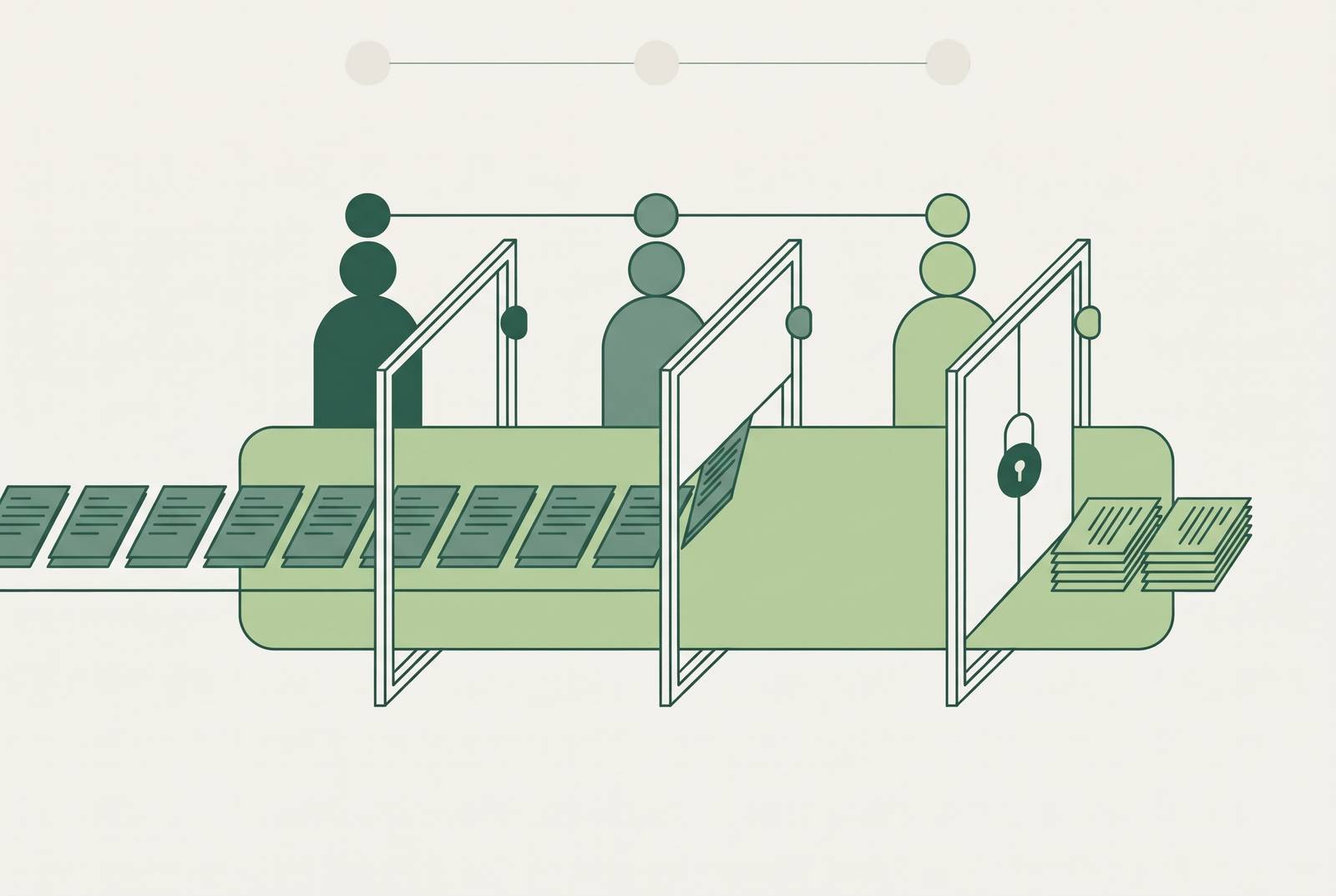
AI workflows for finance shorten month-end close when they remove waiting between controls while preserving approval. When several owners share a period, gate sequencing assigns each entry type an accountable reviewer, keeps AI read-only until a person approves a change, and blocks dependent work until the right owner signs. Faster drafts alone do not close the books.
Why month-end close still takes too long even after AI is added
The close is a dependency chain, so speeding up one task does little if its predecessor remains blocked. Subledgers close before reconciliations begin. Reconciliations complete before accruals are finalized, accruals post before variance review, and variance review precedes sign-off. The slowest link determines how quickly that chain advances.
Automating variance reporting while bank reconciliations still run through spreadsheets leaves the blockage at the start. The reporting task may take less time once it gets its inputs, but those inputs still arrive at the same time. The close can therefore take the same number of days after new software is introduced. The team automated a step that was never the constraint, leaving waiting and re-keying between control points in place.
What the close sequence looks like when it is designed correctly
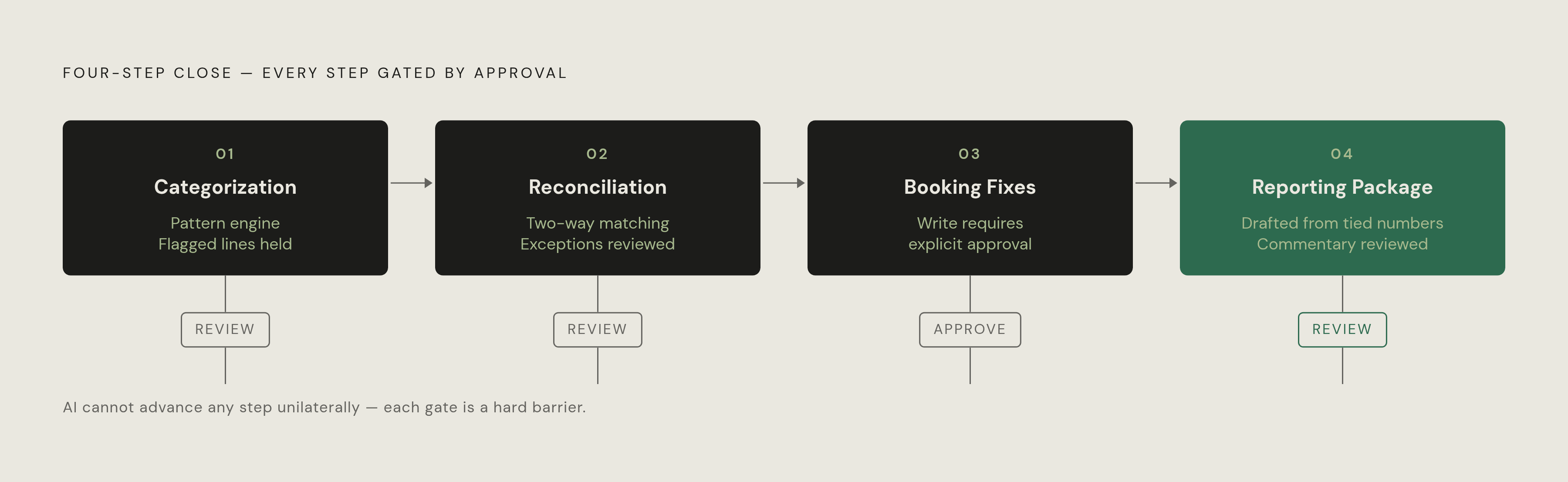
Watermelon AI sets out a four-step sequence with a method and gate for each step. First, the month is categorized through a pattern engine, with flagged lines held for review. Bank and card reconciliation comes next, using deterministic two-way matching and a review of exceptions. Approved fixes are then booked, and each write must have explicit approval. Finally, the reporting package is drafted from tied numbers and reviewed for commentary.
The firm's checklist becomes the instruction file for automation. Each step needs an owner, an approval gate, and retained evidence to support a status of “reconciled. The calendar gives that sequence a working frame, starting with reconciliation and cutoffs five business days before close, followed by period-end cutoff, core postings on close days one through three, and final sign-off. Automation fills the space between those gates. Read-only work can run unattended, but anything that posts an entry, adjusts a balance, or changes the books waits for a person.
Where the single-controller model breaks down in a multi-owner period
A single accountable reviewer simplifies routing, but that model breaks down when the controller, AP owner, revenue lead, and treasury share a period. The first failure is a routing misfire. Accruals, revenue adjustments, FX, reclassifications, depreciation, tax, and consolidation entries need different reviewers. A generic inbox can send work to someone who understands the arithmetic but not the business event. Availability then substitutes for accountability.
The second failure is an intercompany ownership conflict. One entity may post an invoice while its counterparty posts a different amount, so each entity controller must fix the source posting and approve the revised result. In a 14-entity group operating with EUR/USD at 1.08, an AI system netted intercompany FX differences instead of grossing up payables and receivables by entity and currency. The group close tied, but local books did not true-up. Extra hours of manual rework followed.
The third failure is the tension between parallel and sequential gates. Independent approvals can run together, but dependent approvals must wait, and the wrong default creates either delay or rework. These failures become harder to detect when checklist sign-off is detached from the reconciliation that justifies it. Across local finance, shared services, and corporate accounting, a unified calendar is also needed to show which entity is delayed and which task is blocked.
What a gate sequence actually assigns — entry type, accountable owner, and evidence standard
The design starts with the entry category. Before AI enters the workflow, each entry type needs exactly one accountable reviewer, an evidence standard, and a list of downstream tasks that must wait for approval. Queue position must not determine ownership. For bank accounts, AR, AP, payroll liabilities, fixed assets, and intercompany balances, the accounting owner completes reconciliation, while the controller reviews exceptions and signs off before reporting is finalized.
Revenue operations resolves missing contract terms, while accounting approves policy exceptions. Both have legitimate work in the same period, but neither approval replaces the other. Accruals and estimates also need a human to decide whether an unusual item comes from timing, a missing posting, a duplicate, or a genuine error.
The gate also defines what must be retained. The record must show which source transactions matched, which items stayed open, who dealt with each exception, and when approval was given. If a material exception lacks an owner, explanation, or approval, final reporting must be blocked.
How the dependency graph replaces the flat checklist in a multi-owner environment
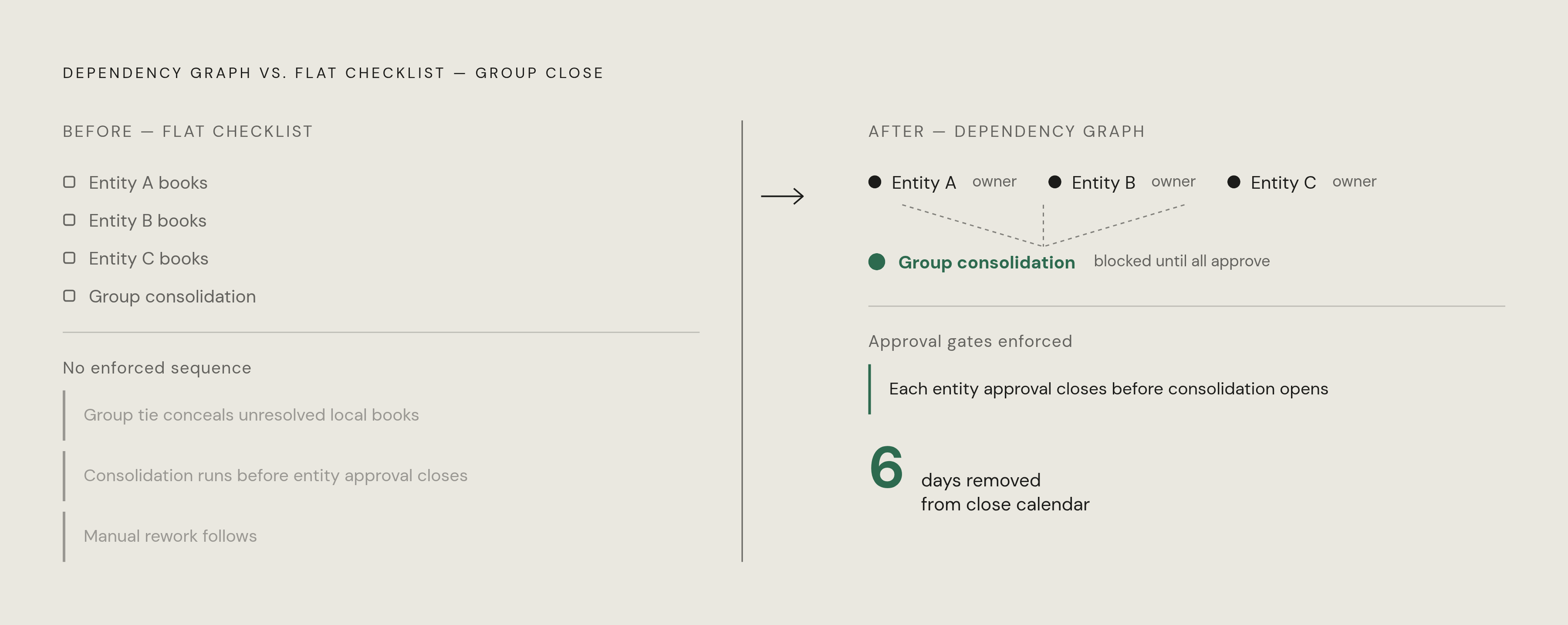
Each close task needs a place in the sequence, with predecessors that must finish first and successors that depend on its completion. That task is a node in a dependency graph. The graph is directed because work moves through a defined order, and acyclic because the sequence does not loop back on itself. In plain terms, it records who is waiting for whom.
The workflow checks that tasks are done and approval gates have closed before it moves on, so journal entries must wait for subledgers to close, and financial statements must wait for all reconciliations to be complete before sign-off. Independent branches can still move in parallel.
In multi-entity groups, each node also needs an owner from the entity. The 14-entity case lacked a block on consolidation pending entity-level approval, which allowed a group-level tie to conceal unresolved local books. Once the graph was in place, the group shaved 6 days off its close calendar.
Where should AI stay read-only, and where can it propose?
An auto-clear threshold is the easiest approval failure to miss. If the same AI system scores entries for risk and clears those below its threshold without a human review, it takes on both control execution and control monitoring. Nobody reviews the auto-cleared population. A low score is not an independent approval, and confidence alone cannot determine which entries escape review.
When an agent can auto-post to an account material to financial statements without a human approval gate, the same non-human actor is both preparer and approver. SOX 404's segregation-of-duties requirement prohibits a single actor from performing incompatible duties. A related conflict arises when the person who can change routing rules also approves that workflow's output.
AI can do mechanical work such as bank clearing, payroll suspense, and routine intercompany matching as long as it stays within pre-approved tolerances. In a read-only-until-yes design, that permission does not extend to changing the ledger. Accruals, reserves, revenue adjustments, estimates, and material entries remain proposals requiring human judgment. For accounts payable, the useful boundary is the same. AI can help prepare reconciliation work and surface exceptions, while the assigned human retains the decision over changes to the books.
What the right reviewer actually needs to see before signing a gate
A reviewer must be able to trace an entry to its source to exercise control. The reviewer also needs to see who prepared it and whether upstream gates have closed. The approval package must therefore contain matched source transactions, remaining open items, exception resolutions, and prior approval records.
Connected evidence binds the checklist item directly to the completed reconciliation, removing the need to hunt through separate files. For revenue entries, the retained record should include the contract reference, extracted terms, applicable policy version, billing record, posting result, and every human override. The amount alone does not explain the decision. For intercompany entries, each entity controller needs the source posting, variance, and revised result rather than a group-level view that nets away the difference.
The reviewer also needs transaction-level matching details, versioned rules, and exception history to understand how the proposed result was reached. A change from “open” to “complete” proves none of that. This evidence standard distinguishes a closed month from a completed report. Every number in the reporting package must trace to a statement line or an approved journal entry.
How the gate sequence handles the specific case of AI-drafted journal entries awaiting human approval
An AI-drafted journal entry is a proposal until the named owner reviews it and approves posting. Approved exceptions become staged entries, and a read-only ledger gateway holds those proposals back from the general ledger until an accountant approves them. Watermelon states the rule plainly. “Nothing posts without a signature”. The reviewer must be able to see exactly what the agent is about to key and stop it.
Routing every staged entry to the first available approver, or to the controller as a catch-all, recreates the routing misfire. For an intercompany accrual affecting both the AP owner and the revenue lead, both owners must sign in the correct order, each reviewing the evidence relevant to their responsibility. The 14-entity case shows why entity-level approval cannot be replaced by a group-level tie.
Nodes takes the same read-only-until-yes approach for AP, AR, month-end close, and spend, keeping reading and changing as separate permissions so that nothing is posted or changed without a person's approval. It logs each decision with the proof, reason, approver, and result, preserving the basis for the action.
How to build and test the gate sequence before the first AI-assisted close runs
Discovering a misconfigured gate during close means stopping the close to fix it. The sequence therefore needs to be mapped, agreed on, and tested with real entry types before AI is brought in. The build starts with ownership and dependencies before tool settings are configured. That order prevents software defaults from becoming accounting policy by accident.
First, map every entry type in the period and assign exactly one accountable owner to each. Define the predecessor tasks that must finish before that owner's gate opens and the downstream tasks blocked until it closes. Where entries involve more than one owner, put the approvals they need in the right order. This turns the close calendar into an enforceable sequence.
Second, set materiality thresholds by entry type and owner. Each threshold needs an owner, an effective date, and an approval record. VDF AI's close policy guidance specifies review every quarter and whenever the auditor revises materiality. Third, confirm that the person who can change routing rules cannot approve that workflow's output. Resolve that conflict before the first run.
Fourth, run the first AI-assisted close in read-only mode, with AI reading and proposing while humans approve and post. Grant write access only after at least two full closes have confirmed that routing, evidence attachment, and gate blocking work as designed. That access does not remove the approval boundary. Predefined rules can execute deterministic work, while ambiguous documents require interpretation and human fallback.
The practical test arrives on day three of close. The system should project completion from task velocity and flag missing evidence while there is still time to fix it. If the team is still chasing commentary on day four, the evidence-attachment step is missing from the gate design. That is a sequencing defect.