GDPR Documentation Requirements for AI Decision Workflows: Plain Guide
Five linked records keep AI decisions defensible under GDPR.
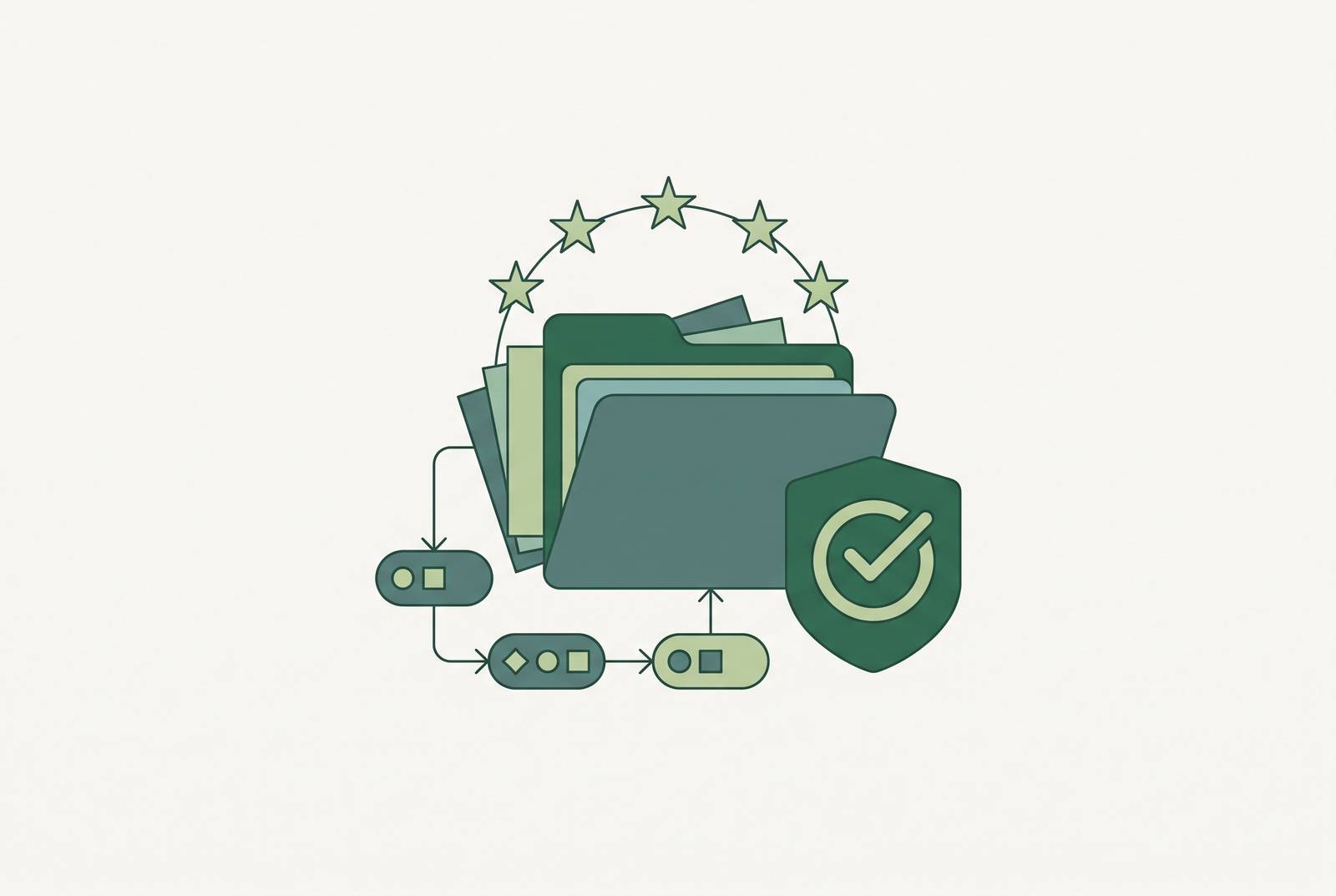
If your AI system makes decisions about EU residents, you must keep five specific sets of records under GDPR. These records are not independent. They form one connected chain. A gap in any one of them weakens all the others.
Why AI decision systems create GDPR record-keeping duties
GDPR follows the person, not the company. If your AI system handles personal data belonging to someone in the EU, these rules apply. It does not matter where your company is based, where the system runs, or who built it. The only location that matters is where the person lives.
GDPR was written in 2016 for a world of simple databases and forms. AI systems break almost every core GDPR principle by default. This includes large language models, chains of AI agents, and systems that make predictions from data. The law assumes you know in advance what data will be used for. It also assumes you can limit what you collect. And it assumes a human can point to a clear reason for any decision. Modern AI pipelines make all three of those assumptions hard to meet. So the paperwork has to work harder than it would for a plain customer database.
Two sets of rules now sit on top of each other. GDPR is the broad baseline. It applies any time personal data is processed, full stop. The EU AI Act adds a second layer. It applies stricter rules to AI systems based on how much risk they carry. Both apply to AI systems that handle the personal data of EU residents. The AI Act's rules for high-risk AI systems — adjusted by the Digital Omnibus on AI signed 8 July 2026 — start applying from December 2, 2027 for stand-alone high-risk systems and August 2, 2028 for AI built into regulated products. GDPR is already fully in force and is the main framework driving compliance today.
That compliance comes down to five types of records. First, a record of processing activities. Second, a data protection impact assessment. Third, notices and safeguard records for automated decisions. Fourth, lawful-basis records. Fifth, human-oversight logs. None of these stands alone. They interlock. A weakness in one creates a weakness in the rest. Failures tend to show up at the joins between documents, not inside any single one.
What your record of processing activities must cover for an AI pipeline
A record of processing activities — usually called a RoPA — is a written list of everything your organisation does with personal data. It is where the whole compliance system starts. For an AI deployment, every model pipeline, every set of training data, and every system that produces predictions counts as its own separate processing activity. Each one needs its own entry in the RoPA. Treating an entire AI decision system as a single line item sounds efficient. But it leaves your organisation unable to say clearly what is being processed, where it happens, and on what legal basis.
GDPR's accountability rules mean a RoPA entry for an AI pipeline has to name every source of data going in and every type of output the model produces. A vague label like "customer data" is not enough. A useful entry states the purpose of the processing and the specific decision the pipeline makes or feeds into. It also cross-references the data protection impact assessment, if one was required for that pipeline.
Any organisation with 250 or more employees must keep a RoPA. So must any organisation doing high-risk processing, regardless of size. A vague entry cannot meet either of those requirements. That detail is also what makes the next document possible. You cannot properly scope a data protection impact assessment against a pipeline you have never described.
What a data protection impact assessment must cover for AI systems
A data protection impact assessment — usually called a DPIA — is a written analysis of the risks a processing activity creates for the people whose data you use. It also covers what you are doing to reduce those risks. Under Article 35 of GDPR, certain types of processing are automatically treated as high-risk. These include systematic profiling of people, large-scale processing, automated decisions with legal or significant effects on a person, and innovative uses of new technology. AI decision workflows fall into one or more of these categories almost automatically. That makes a DPIA required before you go live. Skipping it is a violation on its own, separate from anything that might go wrong afterward.
A DPIA for an AI system has to describe the pipeline itself: its inputs, its outputs, and the people it affects. It has to assess necessity and proportionality. That means asking honestly whether an AI approach is the least invasive way to get the result the business needs. It has to name the specific risks to the people affected. These include biased outcomes, discriminatory patterns, inaccurate profiling, and decisions that nobody outside the system can explain. It should also cross-reference the human-oversight design, which gets documented separately.
Thin DPIAs typically miss one of those pieces. Common gaps are no bias testing, no statement of remaining risk, and no real necessity analysis beyond "this is how the vendor's product works." For high-risk AI systems under the EU AI Act, a Fundamental Rights Impact Assessment is also required alongside the DPIA. The two documents work together and are best done at the same time. But they are not the same document, and one cannot replace the other.
There is a deeper risk here too. A model trained on data that was never lawfully collected carries that problem into every decision it ever makes. A DPIA that skips over where the training data came from leaves your organisation exposed. That exposure is not just at the moment of training. It applies at every single prediction the model produces afterward. A DPIA is also not a document you file once at launch and forget. Regulators expect you to update it whenever the system changes in a material way. A new model version, a new data source, or a wider decision scope each trigger a fresh review, not a footnote.
The legal test for an automated decision under Article 22
Article 22 of GDPR restricts decisions made entirely by an automated system. It applies when those decisions have a legal effect on a person — such as being refused a loan or a job — or an effect that is similarly significant. Whether a workflow falls under Article 22 is a legal question, not a labelling choice. What your company calls the system internally — "AI-assisted" versus "automated" — carries no legal weight. Getting the classification wrong either strips away protections the law requires or buries a workflow in rules it never needed.
The word "solely" in Article 22(1) carries most of the weight. Regulatory guidance has made clear that human involvement has to be real and capable of actually changing the outcome. For human involvement to count, the reviewer needs four things. They need authority to change or override the automated decision. They need access to all the data the automated process used. They need real understanding of the logic and criteria behind that decision. And they need the ability to weigh information the model never saw.
Three exceptions under Article 22(2) set out when automated decisions are allowed. They are allowed when necessary to perform a contract, when authorised by law with safeguards attached, or when the person has given explicit consent. Even when one of these exceptions applies, you still have to deliver the required safeguards under Article 22(3). These are the right to have a human review the decision, the right to express a point of view, and the right to challenge the decision.
Special category data — which covers things like health, race, religion, and sexual orientation — makes this harder still. Automated decisions cannot rely on this type of data except in very narrow circumstances under Article 9(2). In practice, that rules out most profiling systems that use protected characteristics as inputs.
To show compliance, you need a record of the legal exception you are relying on, with supporting evidence. That could be the contract, the legal authorisation, or the consent record. None of that means much unless the human-oversight process behind it is real and gets logged. The next document covers that.
Recording the legal permission to use data in an AI workflow
Every use of personal data inside an AI decision workflow needs a legal permission — called a lawful basis — under Article 6 of GDPR. That permission has to be on record before processing starts. You cannot work it out after a regulator asks about it.
Consent, under Article 6(1)(a), has to be freely given, specific, informed, and unambiguous. Pre-ticked boxes do not count. Consent buried in general terms and conditions does not count either. General terms that simply mention AI somewhere are not enough on their own. Contract performance, under Article 6(1)(b), only holds where the AI processing is genuinely necessary to deliver the service someone actually asked for. It does not stretch to cover analytics or other secondary uses layered on top of that contract. Legal obligation, under Article 6(1)(c), applies where processing is required by law. But that obligation has to be specific and named, not a general sense of business duty.
The requirement to limit data to its original purpose makes all of this harder. Data collected for one purpose under one legal basis cannot be fed into an AI pipeline for a different purpose without securing a new basis first. The enforcement action against Clearview AI marks the outer edge of this problem clearly. Data being publicly available does not create a lawful basis for using it. Where the data came from does not settle whether using it in an AI system is legal.
A proper lawful-basis record states the specific Article 6 basis for each processing activity inside the pipeline. It also states the additional Article 9 basis wherever special category data is involved. It includes a Legitimate Interest Assessment — a written test weighing your organisation's interests against the impact on individuals — wherever Article 6(1)(f) is the basis you are claiming. It states the purpose the data was originally collected for and the purpose the AI is now using it for. It also gives a clear explanation of why the two are compatible. The legal exception you rely on at the decision stage still depends on a human review process that works in practice — with real authority and genuine engagement — not merely on paper.
What human-oversight logs must record
This is where you must actually prove Article 22 compliance, not merely claim it. A reviewer who checks that the algorithm ran without errors has not done what the law requires. The reviewer has to have both the authority and the information needed to reach a different decision than the one the model produced. The log has to show that was true in each case, not just in theory.
A defensible log captures the model's recommendation, clearly labelled as a recommendation. It confirms that the human decision is the decision of record, not the model's output.
Recording the factors the model weighed most heavily at the moment of each individual prediction is one of the more defensible technical approaches available. Methods such as SHAP values, LIME outputs, or attention weights can do this. These are techniques for showing which inputs drove a particular result. GDPR's requirement to explain decisions works per decision, not per model. A general page describing how the model behaves on average tells a specific person nothing useful about their own case. It will not satisfy a request from someone asking what data you hold about them. It will not satisfy a challenge filed under Article 22(3) either.
Systems that chain multiple AI agents together add another complication. In these systems, one AI hands work to another in real time. Data can get combined across those handoffs in ways that trigger Article 22 exposure. This can happen even when each agent, taken on its own, stayed within its stated role. The oversight log has to capture the full chain of a decision from start to finish, not just the final answer that came out the other end.
Override records are compliance documents in their own right. When a reviewer logs that the model recommended a refusal but the reviewer is approving the case, that override needs a recorded reason. The system also needs to actually honour it downstream. A system that logs overrides and then quietly routes around them in practice fails the legal test and the operational one at the same time. Logs built consistently over time become something regulators and internal auditors can query for patterns, not just isolated instances. That is what separates a programme that works from one that only looks good in a folder.
How the five documents work together in practice
Together, the five documents form one chain. The RoPA entry defines what is being processed. The lawful-basis record authorises it. The DPIA assesses the risk and sets the controls. The Article 22 notices and safeguard records tell the person affected about their rights and make those rights usable. The human-oversight log proves the controls are actually doing their job. A break anywhere in that chain weakens everything connected to it.
Failures tend to occur where one document hands off to the next. For example, an Article 22 notice might promise a right to human review somewhere in a privacy policy, with no named contact, no defined process, and no response timeline. The right exists on paper but not in practice. The same handful of GDPR articles turn up repeatedly in AI audits. That shows these failures are structural and predictable, not accidents of any one company's carelessness.
The real test comes when a person uses their right to challenge an automated decision under Article 22(3). At that point, you have to pull together a clear record quickly. That record needs the inputs used, the factors that drove the result for that specific person, the reviewer's identity and reasoning, and the legal basis behind the original processing. All of this must be ready within a timeframe a supervisory authority will accept. Companies whose five documents technically exist but cannot be pulled together and queried as one connected record fail at exactly the moment it matters most.
The practical fix is to build the documentation into the decision workflow at the design stage. Do not try to assemble it after a complaint arrives. Some AI governance platforms now keep a connected record — something like a decision record capability — that links evidence, recommendations, human reasoning, approvals, and outcomes across a decision workflow. This exists precisely because the underlying compliance problem is one of connection, not just collection. The documentation chain has to work as a unit. That is how a regulator, and a person using their rights, will eventually ask to see it.