How to Keep a Record of Who Can Approve What in AI Workflows
A workable approval record names owners, limits agent actions, and proves it.
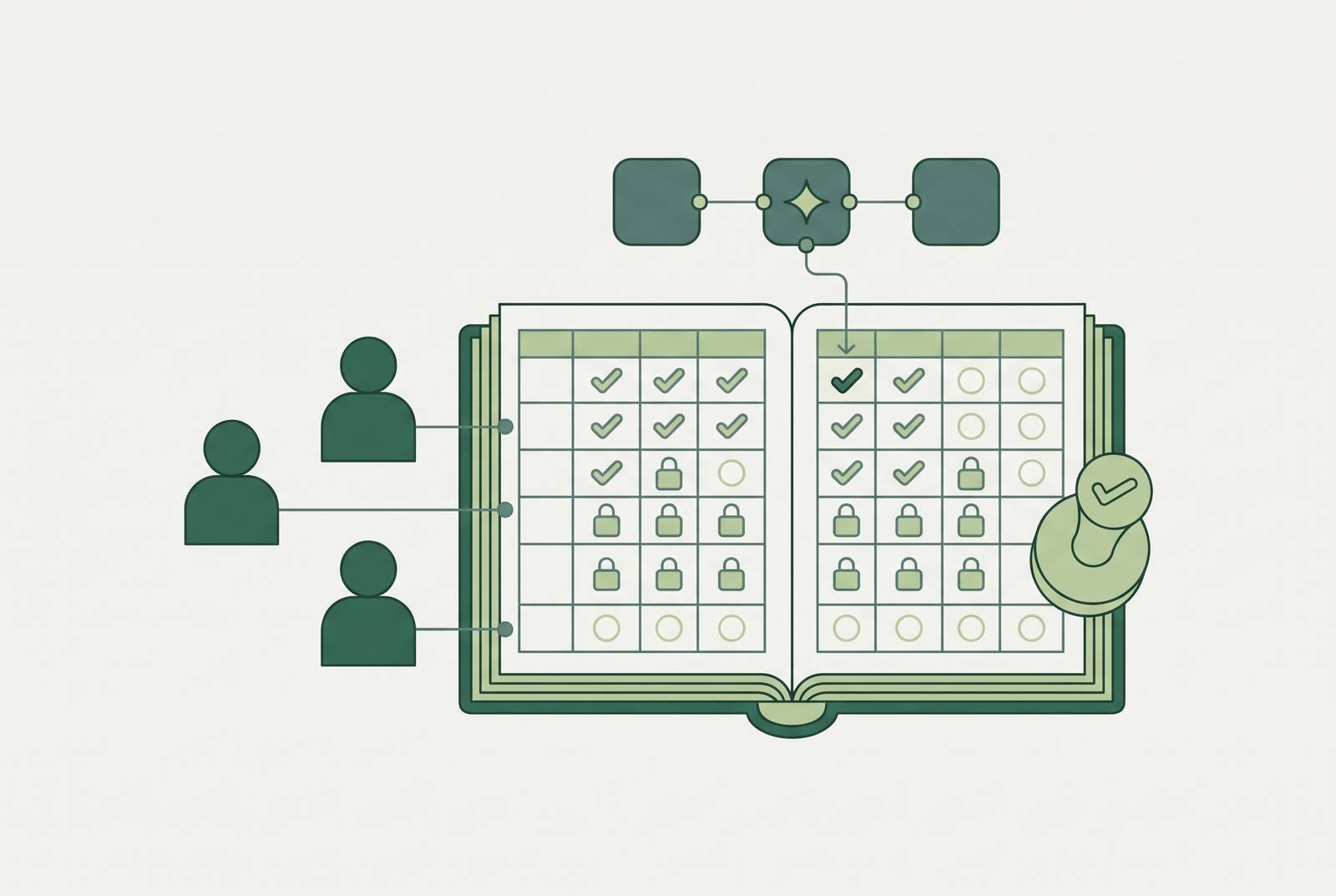
Reliable agentic workflow automation for enterprise needs a record of who can approve each action alongside a policy about responsible AI. That record must spell out permissions, named owners, escalation paths and audit evidence before an agent touches a live system. The test is whether those rules can stop an unauthorized action.
Why approval records in AI workflows fail before they are ever tested
An agent makes several small purchases that each fall below the approval threshold. Each purchase is too small to trigger review, but they add up to material spend. The approval rule exists and still fails. It checks each transaction but puts no limits on the spending pattern, so the approval record cannot account for all the agent’s purchases together.
This exposes assumptions built into workflows designed for people. The requester was human, spending authority was explicit, data access was bounded and the audit trail followed a sequence. Agents can instead inherit permissions to vendor APIs and internal databases that exceed their intended scope. They can also work concurrently across systems, producing decision paths that sequential logs cannot reconstruct. A policy written for the old workflow does not automatically govern the new one.
What "governance" actually means at the workflow level, not the policy level
A rule to “use AI responsibly” leaves the operational questions unanswered. It does not specify what an agent may retrieve, which action needs approval, what evidence to retain or when execution must stop. Those decisions belong inside the workflow itself. Without them, the policy states an intention but supplies no control.
AI governance sets the boundaries for allowed tools, data and uses. Workflow governance applies those boundaries to a particular action, on a particular system, at the moment it runs. Most organizations already have policies for privacy, security, acceptable use, vendor review and retention. The practical work is translating each into a rule the workflow can enforce.
For example, a data policy must specify what the workflow may retrieve, while an approval policy must set the conditions under which it may commit a change. The distinction becomes decisive at execution. A prompt telling an agent not to exceed its authority is not a permission boundary. Enforcement must sit at the API layer, where access and actions can actually be blocked.
Risk tiering every workflow before assigning any approver
A ticket-tagger and a payment agent need different controls. One classifies support tickets using non-sensitive data, while the other moves money. Applying the same approval process to both either burdens routine work or gives consequential actions too little scrutiny. Classify each workflow by what it can change, what data it touches and whether its actions can be undone.
A three-tier model provides a practical starting point. Low-risk workflows, such as drafting internal summaries or tagging tickets, can run independently with logging and scheduled review. Medium-risk workflows need scoped access, a named owner and exception review, as when reading customer records to route a case or updating a CRM field. High-risk workflows need a named approver before every commit that moves money, changes production data or writes back to a system of record.
Keep the intake process short enough that teams use it. Capture the owner, systems touched, write capability, data class and reversibility. These answers determine the operational tier. Also check the workflow against EU AI Act legal risk categories, which use a separate classification and may put it at a different level.
Building the permission matrix with one level per action, not one label per agent
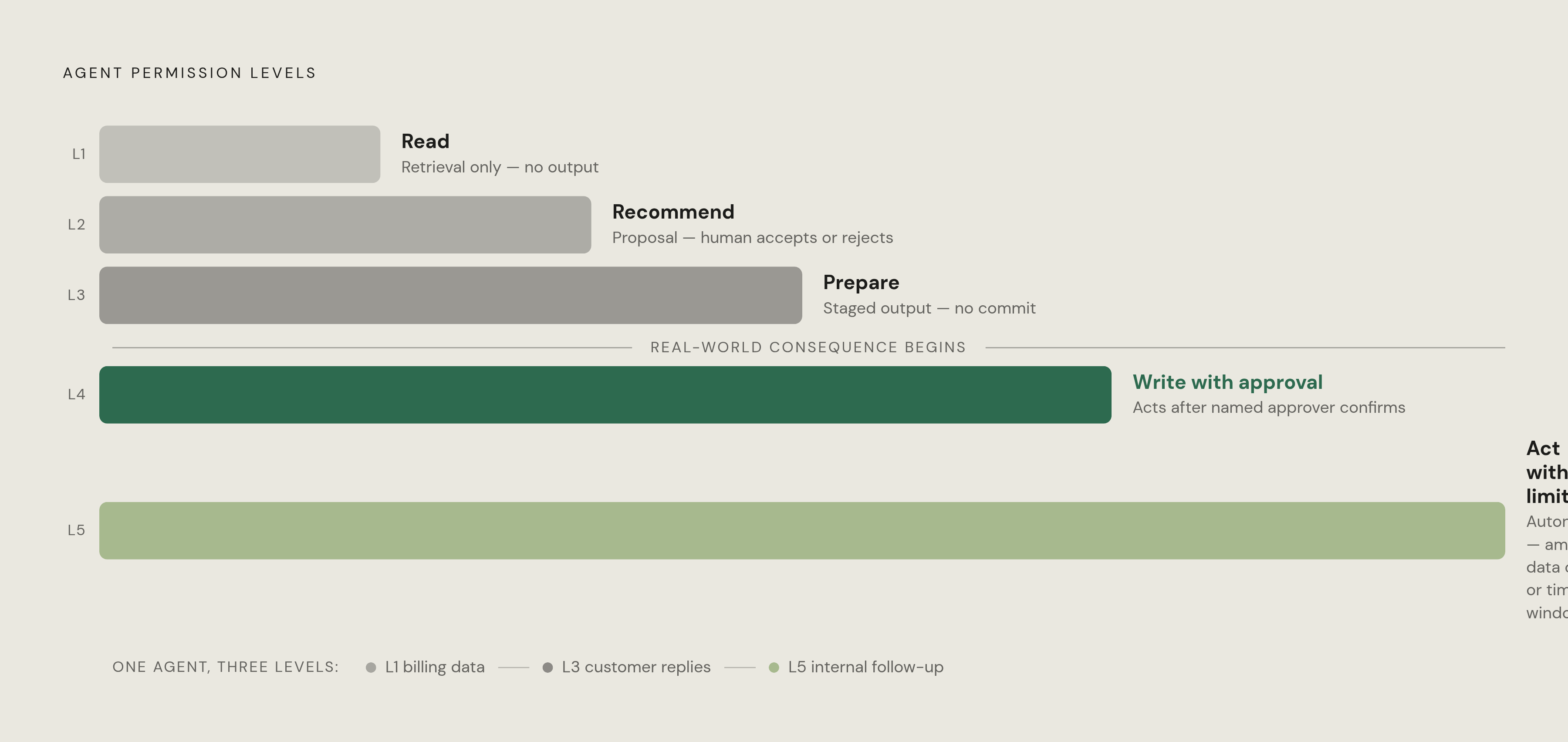
An agent-wide label such as “read and write” hides the distinctions approval rules need. Instead, set permissions for each action on each system before giving the agent live access. Reading billing data, drafting a customer reply and executing an internal follow-up task should not share one permission decision.
The production matrix has five levels. Level 1, Read, permits retrieval and presentation of data only. Level 2, Recommend, permits a proposal for a person to accept or reject. Level 3, Prepare, permits staged outputs such as payment proposals, responses and work orders, without permission to commit them to a live system.
Level 4, Write with approval, lets the agent act after a named approver confirms. Level 5, Act within defined limits, lets the agent act on its own within agreed boundaries such as an amount limit, data class or time window. It is not unrestricted access. An agent might have Level 1 for billing data, Level 3 for customer replies and Level 5 for internal follow-up tasks. Credentials belong in the automation platform, never in the prompt, so the permission matrix controls what the agent can actually do.
Naming approvers and escalation paths in the approval authority record
“Human review required” does not name an accountable person. The approval authority record must map the risk tier, governed action, authorized role and evidence artifacts, then identify who holds that role for the workflow. It must also state the response expectation and who takes over when the approver cannot act.
That authority must cover the workflow’s whole lifecycle. Evaluation, deployment, changes in scope and retirement are separate decisions, rather than extensions of the original launch approval. A department head may approve evaluation in the medium-tier, while deployment in the high-tier needs approval from senior management. If an authority framework has a critical tier, the executive committee must approve work in that tier.
Accounts payable shows how the human boundary follows the action. Extracting invoice fields and matching them to a purchase order can run in Level 5 lanes, while a move of money needs approval before it is committed. IT ticket triage makes the ownership more explicit. A named service desk manager owns the pilot and review, and an assigned analyst records approval or rejection of every recommendation before routing. If excluded data reaches the model or an unauthorized action is attempted, the service desk owner stops the workflow and escalates to security.
The UK NCSC distinguishes human-in-the-loop approval before action, human-on-the-loop monitoring with intervention, and human-out-of-the-loop operation without human review. Record the chosen model for each workflow. That choice determines what evidence of oversight the workflow must produce.
What the audit evidence record must capture at every approval event
Configure eight fields for every approval event. Record who approved or rejected, the role used, the action reviewed and the original proposal. Capture any modifications made by the approver, the execution result, the timestamp and the policy version in force. The original proposal must remain distinguishable from the approved action. Otherwise, the record cannot show what the reviewer changed.
Workflow-specific evidence belongs with those core fields. For IT ticket triage, retain the ticket reference, model version, workflow version, AI recommendation, reviewer decision and timestamp in approved repositories under the retention policy. Email threads alone are not a reliable approval record. Nor are logs that show only success or failure, or omit which workflow version ran.
The evidence should be live and queryable before an incident occurs. Include failed actions as well as successful ones, because execution failure is part of the decision history. Then monitor approval cycle time, exception rate and the share of runs with complete evidence.
The ten policies that must exist before a workflow goes to production
Treat the ten policies as a launch checklist. First, acceptable use must establish which tools and uses are approved or prohibited, what data cannot enter public AI and which examples employees should follow. Second, use case approval must require intake before connection, capturing the owner, purpose, data, systems, AI role, human review, risk tier and expected value.
Third, approval authority must answer who can approve low-, moderate- and high-risk use. A generic governance committee is not enough. Fourth, data handling must say which categories AI can process, whether prompts and outputs inherit sensitivity, how logs are kept and when vendor review is needed. Fifth, model use must list which models, platforms, vendors and deployment environments are approved for each data classification.
Sixth, workflow action must distinguish reading, summarizing, classifying, recommending, drafting, routing, updating, sending and approving, including what AI must never do. Seventh, human review must name reviewers, their checks, their authority to approve or escalate and the conditions requiring a second reviewer. Eighth, escalation must prescribe named steps for wrong sources, sensitive-data exposure, incorrect routing and unexpected actions. Someone must be responsible for the next step.
Ninth, monitoring must cover acceptance rates, overrides, escalations, errors, cost spikes, data exposure events and stop conditions. Tenth, documentation and evidence must define retention for approvals, data handling, reviews, actions, monitoring, incidents and change history. Hold workflows with unresolved data permissions, no named reviewer or no pause path. Before launch, also address non-human identities with standing credentials but no scope or rotation schedule. An approval policy cannot compensate for access that remains open beyond the workflow’s boundaries.
Where the approval record breaks down in practice, and how to fix it
A system can be safe on paper and unusable in practice. If routine work has to wait for approvals it does not need, teams have a reason to work around the controls. The remedy is better calibration, using the monitoring signals already collected.
Rising approval cycle time without a corresponding increase in exceptions caught indicates that the tier is too high for the risk. A near-zero exception rate needs closer examination. The workflow may be genuinely low risk and over-governed, or the agent may be staying below review thresholds. A falling share of runs with complete evidence indicates that approvers are bypassing the record.
Adjust the tier while maintaining oversight. Low-risk workflows can move quickly with logging and scheduled review, while high-risk actions retain friction because a wrong action costs more. Learning should not silently expand authority either. Repeated patterns can become proposals for new workflows, but those proposals still need approval before execution.
Enforcement also needs a hard stopping point. If a policy check fails before a payment step, halt the workflow and route the invoice to the finance lead with match details attached. Log the reviewer and decision, and have the workflow owner review the trigger if the violation repeats. An alert sent after an unauthorized action has run does not undo that action.
What regulators and standards now require from approval authority records
The EU AI Act’s Article 26 requires deployers of high-risk AI to assign oversight to people with the necessary competence, training and authority. It also requires monitoring operation and responding to risks and serious incidents. Article 26(5) requires deployers with reason to consider that use may present a risk within Article 79(1) to inform the provider or distributor and the market surveillance authority, and suspend use. A named approver without authority to intervene is insufficient.
The NCSC’s interim guidance, published August 20, 2026, distinguishes the three oversight models described earlier. The approval authority document should record the chosen model per workflow and justify it against the risk tier. This is guidance, distinct from the Act’s legal obligations.
The resulting approval record brings together permissions, accountable people, escalation paths and evidence. It gives an enterprise a way to show which rule applied, who could intervene and what happened at execution. That is a stronger basis for governance than reconstructing authority after a disputed action.
Nodes is one option built around this separation, starting read-only, granting reading and changing as distinct permissions, and holding every change until a named person approves it. It works with the AI models and systems a company already uses, so the approval layer does not depend on one vendor.