How to Answer Regulator Questions About AI Compliance Decisions
Regulators want a traceable record of evidence, review, and outcome.

When a regulator asks how your firm made a compliance decision using AI, you need a clear paper trail. That trail must show what information the system used, who reviewed it, what was approved, and what happened next.
Why regulators now demand proof of how every AI-assisted decision was made
Telling an examiner that AI helped make a decision is not enough. Your firm must show how the AI was used. It must also show where a real person with real authority stepped in. FINRA's 2026 Annual Regulatory Oversight Report has an entire section on generative AI. Generative AI is AI that can write, summarise, or recommend. The report treats it as something firms must govern, supervise, and document.
The UK Treasury Committee's January 2026 report warns that a "wait-and-see" approach risks serious harm to consumers and the broader financial system. David Geale, FCA Executive Director for Consumers, Payments and Competition, stated that explainability and governance remain non-negotiable. This matters especially where decisions affect consumers or market integrity. The FCA (the UK's Financial Conduct Authority) does not say exactly which controls to use. But firms still have to explain the ones they chose.
The EU AI Act sets logging and record-keeping requirements for high-risk AI systems. Article 12 requires automatic event logging. This must allow traceability throughout the system's lifetime. The Monetary Authority of Singapore's November 2025 consultation addresses oversight and lifecycle controls for generative AI and AI agents. IOSCO's May 2026 toolkit supports supervision of AI-based systems used by regulated entities. These rules differ in legal force. But they all point toward decisions that can be inspected.
What a regulator is actually asking when they question an AI-assisted decision
An inquiry asks for a complete chain of events. It starts with the evidence the system used. Then it follows the recommendation through human review to the final action and result. For tasks like sorting documents, triaging alerts, or spotting patterns, a good outcome alone does not prove the work was governed well. The record must make the reviewer's judgment visible. That includes why they accepted or dismissed a significant recommendation.
The NIST AI Risk Management Framework (a US government guide for managing AI risk) lists accountability, transparency, explainability, and interpretability as key features of trustworthy AI. Traceability and documentation support those features. They do this through structured records of how human judgment interacts with model output. Full explainability also involves tracking where training data came from, scoring how much influence different inputs had, keeping complete audit trails, allowing decisions to be challenged, and certifying the model. Most off-the-shelf platforms do not supply all five. So a tool's built-in explanation cannot stand in for the firm's complete record.
A global manufacturing group shows what can go wrong. During an internal review, staff cleared a large volume of AI-generated flags in rapid succession. But no reviewer could explain why any individual alert was dismissed. The EU AI Act's lifetime traceability requirement also means an inquiry can reach beyond recent activity. Your firm must be able to reconstruct an individual decision on demand.
Why most firms cannot answer that question today, and why speed and volume are not the reason
The structural gap sits around the model. Firms have added AI to separate systems. They have not connected evidence, review, and outcomes into one retrievable record. An application, a licensing database, and a support history may each hold information used in a decision. But none of them may record how that information shaped the decision. A good model used in good faith cannot repair a process that never captured the reviewer's reasoning.
As a result, a firm may prove that a recommendation existed but not why someone accepted it. It may also struggle to explain what changed between the recommendation and the final action. Even approved AI tools need human review for automated or sensitive decisions. The exception is where the firm has specifically approved the AI to act on its own. Where the record does not show that boundary being observed, a general approval for the tool answers the wrong question.
Industry support for the PRA's (the UK Prudential Regulation Authority's) principles-based approach came with concerns. Those concerns were about whether traditional model validation can scale across generative and agentic AI. Agentic AI is AI that can act and make sequences of decisions. That is a governance architecture problem. Agents make it sharper because their operating conditions can change between scheduled reviews. Faster processing does not create this gap. But it can put more decisions through a process that lacks a defensible record.
What a traceable decision record actually contains, component by component
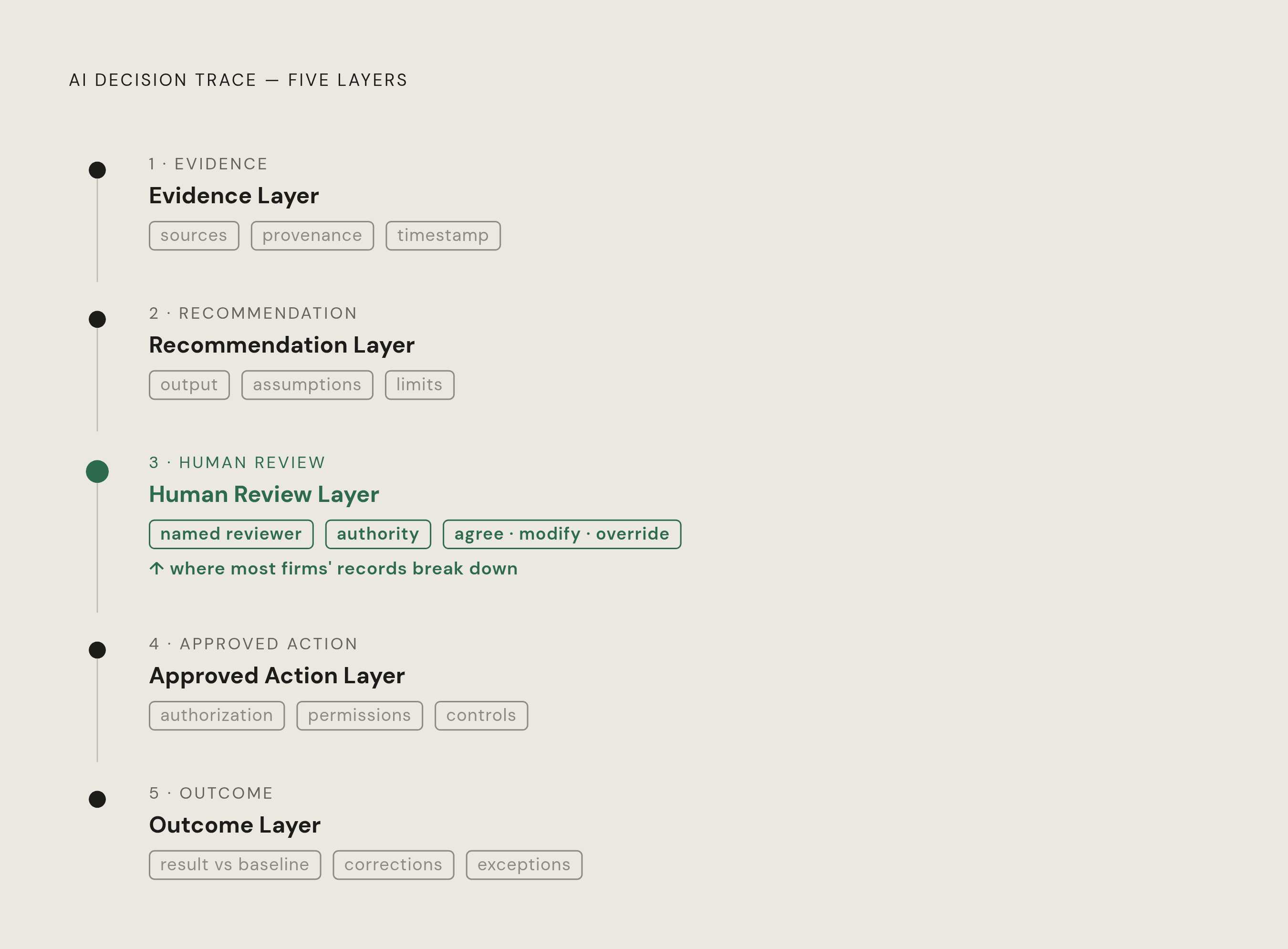
The evidence layer records what the system drew on, where it came from, and when it was available. It links both structured and unstructured material to the systems of record it came from. This gives the examiner the factual starting point as it stood when the decision was made.
The recommendation layer records what the AI surfaced, the assumptions it applied, and what it did not consider. Its purpose is to show the limits of the recommendation as well as its conclusion. The examiner needs those limits to understand what the reviewer was being asked to judge.
The human review layer names the reviewer and records their authority. It explains their judgment. It shows whether they agreed with, changed, or overrode the output. Under accountability frameworks such as SMCR (the UK Senior Managers and Certification Regime, which ties decisions to named individuals), an approval with no name attached does not give the same evidence. A record that names the person accountable for it is what you need.
The approved action layer states what was authorised, under which permissions, and with which controls over what the system could do. It separates permission to read information from permission to change records. That lets the examiner compare what the system could do with what it was actually allowed to do in the case.
The outcome layer records the result against a baseline agreed in advance. It also captures corrections, exceptions, and the reasons for them. Failed or inconclusive results belong here just as successful ones do. Together, these layers form more than a log file. They connect evidence to judgment and consequences in a record that you can retrieve at the decision level.
How AI agents change what your records must capture
An agent can take a sequence of actions. Its record must therefore cover each intermediate action. It must also cover the authority for that action and the conditions that would trigger a pause or escalation. Accountability remains with the Provider or Deployer. Using a third-party agent does not transfer that obligation to the vendor.
The record must show approvals by action type, quality standards, and risk limits by workflow. It must also show budget authority. It must identify who owns exceptions and document the triggers for pausing or revoking authority. Those controls cannot rest on a one-time approval if the operating environment changes. You must trigger reauthorisation when an underlying foundation model updates. You must also do so when the arrangement of AI components in the workflow changes, or when an external service changes its execution controls.
The revised US interagency guidance SR 26-2 explicitly excludes generative and agentic AI from its formal model risk management scope. Other supervisory rules continue to apply. These include consumer protection, fair lending, and third-party risk guidance. So the exclusion is not an exemption from oversight. Firms cannot assume the model governance programme they already have covers the gap. The MAS November 2025 consultation gives firms a clearer template for agent documentation. It covers oversight, lifecycle controls, and organisational capabilities. It is still a consultation and has no force as a universal rule.
How your data setup determines whether a compliant record is even possible
Separate systems may retain an application, a licensing record, and a support history. But they may not connect what those records mean for the same person and workflow at the time of a decision. Without that connection, piecing together the record after the fact is unreliable. A document that informed a recommendation needs attribution just as much as a database field does.
Data access also has limits that your infrastructure must respect. FINRA identifies vendor contracts that comply with regulatory obligations as an effective practice. This includes language that stops sensitive firm or customer information from entering a third-party vendor's open-source GenAI tool. For insurance workflows, client names, policy numbers, and financial information are subject to Gramm-Leach-Bliley Act obligations. Health details are primarily governed by HIPAA and state insurance codes. Such information must not enter public, general-purpose AI tools unless a secured, compliant setup is specifically approved.
Deployment choices affect both the data available to a workflow and the audit trail the firm controls. These choices include VPC (a private cloud environment), on-premises, or standard cloud. If a third-party environment cannot provide the records, the firm cannot explain the decisions made there. The decision history must also survive changes in models and agents. Keeping company context and business rules separate from a particular model allows that continuity. Replacing the technology then does not erase the basis for earlier decisions.
Building the record before the inquiry arrives: what to set up at the start, not after
Before a workflow goes live, agree its baseline, success measures, measurement owner, and measurement period. Next, define what counts as a significant decision. Name the people with review authority, escalation responsibility, and ownership of exceptions. A role description alone does not show who is personally accountable for a given case.
Then set the approval points, quality standards, risk limits, and budget authority before the work starts to run on a recurring basis. Any changes to those controls while the work is running must be logged. The record must show who made them. Keep read access separate from permission to change records from the start. Begin with investigation and recommendations only. Then authorise the AI to act as quality and value are demonstrated.
Risk assessment must also come before live decisions. Estimate plausible failure modes, their likelihood, detectability, and reversibility. Include those estimates in the record. Later reports must keep estimates separate from what actually happened. They must also keep time saved separate from cash savings. Otherwise, the firm blurs what it hoped to achieve with what it can substantiate.
FINRA's 2026 Annual Regulatory Oversight Report calls for clear procedures to develop, use, and monitor GenAI. It also calls for comprehensive documentation. For deployment, that means deciding who may use the tools, what data may enter them, how outputs will be reviewed, and when escalation is required. Make these decisions before an inquiry arrives. Once a workflow has run without capturing its reasoning, a later policy cannot supply the missing evidence.
How to present a decision record credibly when a regulator is in the room
Start with the workflow, its accountable owner, and the business outcome it was deployed to affect. That context gives the examiner a reason for the system's use before you introduce its output. Show the baseline first, then the action, then the measured result. Keep expectations distinct from observations so that the record demonstrates measurement.
Make the human review specific. Show who reviewed the recommendation, what they saw, and what they decided. Show where they corrected or overrode the AI. Where the system was wrong, explain how quickly the firm detected the error and what it did next. Corrections and explained exceptions demonstrate control more credibly than a presentation that shows only successful outputs. Counts of users, prompts, and agent interactions do not substitute for business results against baselines or review rates against quality standards.
The FCA's Mills Review, launched January 2026, is examining how AI could reshape retail financial services. It is also asking whether supervisory frameworks need to evolve. Across the jurisdictions covered here, scrutiny is tightening even where the rules remain principles-based or under development. A record built now can carry evidence and accountability forward as those requirements change. Its lasting value is institutional memory that compounds. It preserves not just what the firm did, but why it was authorised and what it learned from the result.